The vector database is the part of your AI stack everyone wants to debate and almost no one should. Which one is fastest, which one scales, which one the famous companies use — none of that is the operational risk. The risk is whether the retrieval running on top of it is fresh, secure, and testable. A best-in-class vector database fed by a stale, ungoverned pipeline will confidently serve your operations team yesterday's truth. A modest one wired into a disciplined pipeline will not.
So the executive decision is not "which vector database should we buy." It is "can I prove that what my AI retrieved was current, permission-aware, and reproducible at the moment it acted." If you cannot answer that, the database brand on the box does not matter.
This is the operations-leader follow-up to AI Context in Live Operations. That post was about which fields must stay live. This one is about the machinery that decides whether "live" is actually possible.
Key Takeaways
- A vector database stores embeddings and answers "what is most similar to this query." That is a useful capability, not a guarantee of correctness, freshness, or safety.
- The operational question is never "which database is best." It is whether retrieval is fresh (reflects the current source), secure (respects permissions), and testable (reproducible and auditable).
- The most common failure is not a slow database. It is a fast database serving embeddings that were indexed before the source changed — a confident answer built on a stale chunk.
- You can pressure-test any retrieval setup in ten minutes with one question: if a source record changed one minute ago, would the next AI answer reflect it — and could you prove it did?
What this post covers
After reading this, you will be able to run a "freshness drill" on one AI workflow: trace a retrieved answer back to its source and decide whether your retrieval is fresh, secure, and testable enough to trust in production.
- What a vector database actually does — the technical version and the business version
- Why the database choice is not where operational risk lives
- The three tests that do matter: freshness, security, testability
- A worked example of fast retrieval serving a stale chunk
- A worksheet to score your own retrieval setup
- The retrieval layer that makes "fresh, secure, testable" enforceable
New to the mechanics? Start with Vector Search and Vector Database Basics for CEOs for the embeddings primer, then come back for the operational view.
What a vector database actually does
The technical explanation. A vector database stores embeddings — numerical representations of text, where similar meanings land near each other in mathematical space. When a query arrives, it is embedded too, and the database returns the stored chunks whose vectors sit closest to it. This is vector search, and it is what makes semantic search and retrieval augmented generation possible: instead of matching exact keywords, the system finds passages that mean something close to the question. The database is very good at one job — "given this query, return the nearest stored chunks, fast."
The business explanation. Picture a filing system that does not need exact labels. You describe what you are looking for in your own words — "the refund exception we made for enterprise accounts last quarter" — and it hands you the documents that match the idea, even if none of them use those exact words. That is genuinely powerful for discovery. But notice what the filing system does not do: it does not know whether the document it handed you is still accurate, whether you were allowed to see it, or whether someone updated the real record this morning. It returns the closest match to your description, nothing more. Everything that makes retrieval safe in operations happens around the database, not inside it.
The database choice is not where the risk lives
Operations leaders get pulled into vector-database comparisons because vendors and engineers frame the decision as a database choice. It rarely is. The databases in serious use are all fast enough, scale well enough, and return relevant matches. Differences in latency and recall are real but second-order for most business workflows.
The first-order risk is in the pipeline feeding the database and the rules around reading from it. A chunk is only as good as the moment it was last indexed. A retrieval is only as safe as the permissions it enforces. An AI answer is only as trustworthy as your ability to reproduce and inspect it. None of those three properties is a database feature you can buy — they are pipeline and governance disciplines you have to operate. Swapping vector databases changes almost none of them.
So reframe the conversation. When someone asks "which vector database should we use," the operationally correct response is: "Show me how a record change reaches retrieval, who is allowed to see what comes back, and how we'd reproduce any given answer." Those three questions are the actual decision.
The three tests that matter: fresh, secure, testable
Live operational context goes stale in distinct ways, so test each property separately.
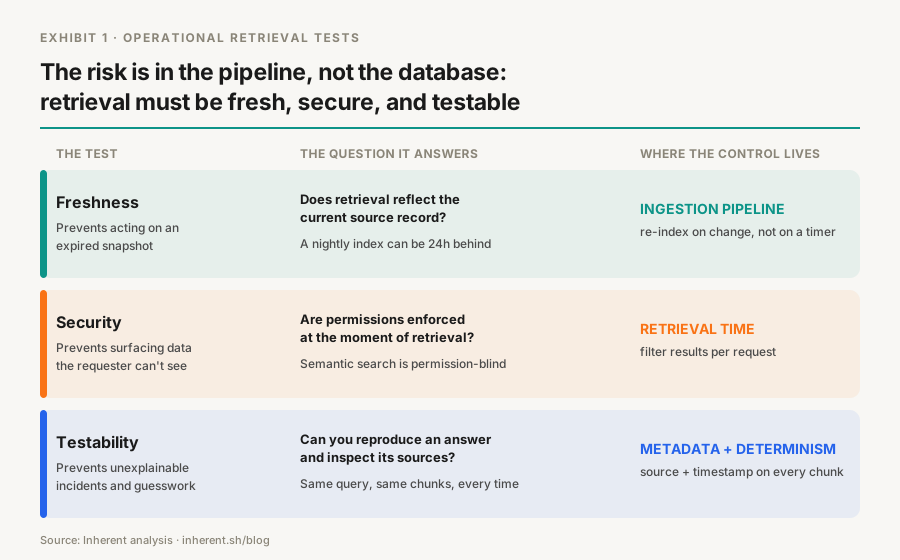
1. Freshness — does retrieval reflect the current source? Embeddings are a snapshot. The moment a source record changes, every chunk indexed from it is potentially stale until it is re-embedded. If your pipeline re-indexes nightly, your AI can be up to 24 hours behind the truth — and it will not look behind, because the stale chunk reads as perfectly valid. Freshness is the property most teams assume they have and most do not.
2. Security — does retrieval respect permissions? Semantic search is permission-blind by default. It returns the nearest match regardless of whether the person (or the agent acting for them) is allowed to see it. Without permission filtering applied at retrieval time, a well-meaning query can surface a document the requester should never have reached. In operations, that is not a curiosity — it is a data-exposure incident waiting for an audit.
3. Testability — can you reproduce and inspect the answer? When an AI gives a wrong or surprising answer, can you see exactly which chunks it retrieved, from which sources, indexed when? If retrieval is a black box, every incident is unexplainable and every fix is a guess. Testable retrieval means the same query over the same data returns the same chunks, and each chunk carries its origin and timestamp.
The pattern: freshness is a pipeline property, security is a retrieval-time property, and testability is a metadata-and-determinism property. A vector database, on its own, guarantees none of the three.
A business example: the fast database that served a stale chunk
A logistics operations team runs an AI assistant that answers "can we still expedite this order?" It retrieves from a vector database holding embedded shipping-policy notes and account records. The database is fast and the answers are fluent.
A key account's contract was amended last week: expedited shipping was removed to cut cost. That change updated the contract system immediately. But the vector index re-embeds account documents on a nightly batch, and the amended contract had not yet been re-indexed when a rush request came in. The AI retrieved the previous chunk — "expedited shipping: enabled" — and told the rep to proceed. Fast retrieval, relevant match, confidently wrong. The database did its job perfectly; it returned the nearest chunk. The chunk was a week-old snapshot of a record that had already moved.
Independent reporting frames data freshness as a leading driver of enterprise RAG failures, precisely because of this dynamic — the answer is not hallucinated, it is expired (RAG About It, 2026). And the underlying cost is not small: Gartner estimates poor data quality costs organizations $12.9 million a year on average, with outdated data a named component.
A worksheet to score your retrieval
Run this on one AI workflow. Score each property red, amber, or green. Any red is where your risk actually lives — not in the database brand.
| Property |
The question to answer |
Green looks like |
Red looks like |
| Freshness |
When a source record changes, how long until retrieval reflects it? |
Re-index on change, minutes not hours |
Nightly or weekly batch; no change detection |
| Security |
Are permissions enforced at the moment of retrieval? |
Per-request permission filter on results |
Index is shared; access checked only in the UI, or not at all |
| Testability |
Can you reproduce an answer and see its sources? |
Same query returns same chunks, each with source + timestamp |
Black-box retrieval; no chunk-level provenance |
The fastest way to find your weakest property is the freshness drill: change one source record, then ask the AI a question that depends on it. If the answer does not reflect the change — or you cannot prove whether it did — you have found your red.
Why this needs a governed retrieval layer
Fresh, secure, and testable are not settings you toggle on a vector database. They are properties of the layer around it: how documents are ingested, how permissions travel with each chunk, and what metadata every retrieval carries.
When ingestion is managed, sources are re-indexed on change instead of on a slow timer, so freshness is a property of the pipeline rather than a hope. When every chunk carries its source, its permissions, and an ingestion timestamp, security can be enforced at retrieval time and testability becomes automatic — you can reproduce any answer and inspect exactly what fed it. When retrieval is deterministic, the same documents and the same query return the same context every time, so an incident is explainable instead of mysterious.
This is the layer Inherent is built around: managed ingestion, deterministic retrieval, and source-and-permission-and-timestamp metadata on every chunk. The vector database underneath can be any competent one. What makes retrieval trustworthy in live operations is the governance wrapped around it — which is exactly the part the database-comparison debate ignores.
The next step
Pick one AI workflow that retrieves from a vector store. Run the freshness drill: change one source record it depends on, then ask the AI a question that should reflect the change. Watch whether the answer updates — and whether you can prove, from provenance, that it did.
Most teams discover at least one of the three properties is red. That red is your real operational risk, and it has nothing to do with which database you chose.
Once you have run the drill, DM Flow on X @human_in_loop with which property failed first — freshness, security, or testability.
This is Day 28 of the AI readiness series, which began with What Is AI in Business, Really?. For the governance behind reliable answers, see Knowledge Management AI for Teams and Production RAG Needs Truth and Memory.