Most teams buy knowledge management AI to generate more knowledge — summarize the meeting, draft the doc, answer the question. That is the wrong job. The job that actually matters in operations is the opposite: making sure the answer a team relies on is current, owned, permissioned, and traceable. More content does not produce reliable answers. It usually produces more ways to be confidently wrong.
This is the decision for an operations leader: stop measuring knowledge management AI by volume — articles written, documents indexed, questions answered — and start measuring it by reliability. Can the team trust the answer, and can the system prove where it came from? A tool that generates a thousand summaries but cannot tell you which one is still true has made your knowledge worse, not better.
The shift is from a bigger knowledge management system to a governed one. The store is not the problem. The flow is.
Key Takeaways
- Knowledge management AI is not a content-generation problem. It is a governance problem: keeping answers current, owned, permissioned, and traceable.
- More content makes reliability worse. Every new copy of a fact is a new chance for the AI to serve the version that has gone stale.
- A reliable answer must clear five gates — source of truth, owner, freshness, permission, evidence. A bigger knowledge base clears none of them on its own.
- You can audit where your operational knowledge goes stale in under an hour, and the output is a short list of facts no one owns.
What this post covers
After reading this, you will be able to identify where your team's operational knowledge becomes unreliable today — the facts that look authoritative but are stale, unowned, or impossible to trace back to a source.
- What knowledge management AI actually is, versus content generation
- Why adding more content makes answers less reliable, not more
- The five gates that turn raw content into a reliable answer
- A business example of confident, stale knowledge causing a real error
- A one-hour audit to find where your knowledge goes stale
This is the operations follow-up to AI Context in Live Operations. That post was about state that must stay live at the moment of action. This one is about the knowledge behind it — the documents, policies, and answers a team treats as settled.
Knowledge management AI is governance, not generation
The technical explanation. Most AI knowledge tools optimize for production: ingest documents, embed them, and generate fluent answers on demand. That pipeline is good at one thing — turning a query into readable text. It is indifferent to whether the underlying content is the authoritative version, whether anyone still maintains it, or whether the person asking is allowed to see it. The model will answer with the same confidence whether the source was updated this morning or abandoned two years ago. Reliability is not a property of the generator. It is a property of the flow that feeds it.
The business explanation. Think about how a strong operations manager answers a hard question today. They do not just recall something. They ask: is this the official policy or a draft, who owns this process now, was this updated after the last change, and am I even allowed to share it? That set of checks is the real work of knowledge management. An AI knowledge base that skips those checks is not managing knowledge — it is laundering it, taking uncertain content and returning it in a confident voice. Knowledge management AI earns trust only when it runs the same checks your best operator runs, every time, automatically.
Why more content makes answers less reliable
The instinct is that a richer knowledge base means better answers. In operations, the opposite is often true.
Every document an AI ingests is a claim about the world. When two documents disagree — last quarter's pricing and this quarter's, the old escalation path and the new one — the AI does not know which is right. It retrieves whatever scores highest on similarity, which has nothing to do with which is current. The more content you add, the more contradictions you create, and the more often the system surfaces a plausible answer that happens to be the stale one.
This is the stale knowledge tax: a once-true fact, served long after it stopped being true, is more dangerous than a missing answer. A missing answer makes the team go check. A confident wrong answer makes them act. Generating more content without governing it does not reduce this tax — it compounds it. This is why "we'll just index everything" is a strategy for producing reliable-sounding errors at scale.
The five gates of a reliable answer
A reliable answer is not retrieved. It is cleared. Before any content becomes an answer a team can act on, it should pass five gates. Skip one, and reliability quietly drops to whatever that gate would have caught.
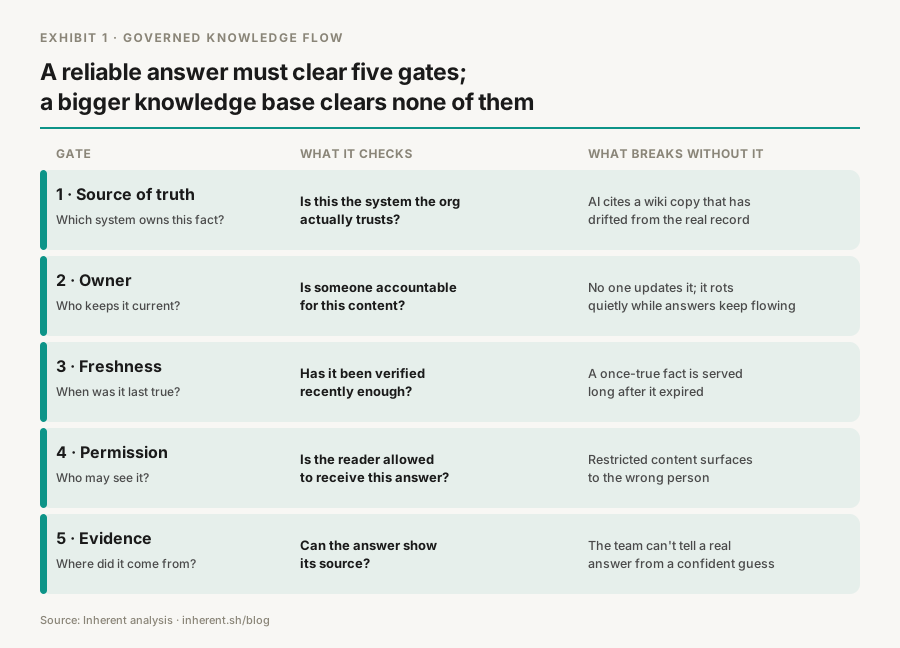
- Source of truth. Which system actually owns this fact? If the AI answers from a wiki copy that has drifted from the system of record, it is confidently quoting a fork. The first gate is making the AI prefer the authoritative source over the convenient one.
- Owner. Is someone accountable for keeping this content current? Unowned content does not announce that it has rotted. It keeps producing answers until someone gets burned. An owner is the difference between knowledge and debris.
- Freshness. When was this last verified true? Freshness is the gate the knowledge management process most often lacks. Content carries no expiry by default, so the system cannot tell a fact updated today from one frozen since 2023.
- Permission. Is the reader allowed to receive this answer? Knowledge management software that ignores permissions will eventually surface a restricted document to the wrong person — not maliciously, just helpfully. Permission has to travel with the content, not sit in a separate access list.
- Evidence. Can the answer show where it came from? Without a citation back to the source, the team cannot distinguish a grounded answer from a fluent guess. Evidence is what turns "the AI said so" into "here is the document, last updated on this date."
These gates are MECE: source of truth fixes which copy, owner fixes accountability, freshness fixes when, permission fixes who, evidence fixes proof. A bigger store improves none of them. A governed flow enforces all five.
A business example: the onboarding answer that was a year out of date
A fast-growing company rolls out an AI assistant over its internal knowledge so new hires can self-serve. A new manager asks how to approve a contractor's expenses. The assistant retrieves a clear, well-written process doc and walks her through it confidently.
The doc was accurate — a year ago. Finance had since moved approvals into a new tool and changed the threshold, but the old doc was never retired. No one owned it. It carried no "last verified" date. It scored highly on similarity because it was detailed and well-phrased. The manager followed it, approved an expense she was no longer authorized to approve, and finance caught it a week later.
Nothing in the system was broken in an obvious way. The content existed, the retrieval worked, the answer read well. It failed at the gates that were never built: no owner, no freshness signal, no link to the source of truth. The content was abundant. The knowledge was not reliable.
A one-hour audit: where does your knowledge go stale?
You do not need a platform migration to find your reliability gaps. Pick one workflow where a team relies on AI or internal search for answers, list the handful of facts it depends on, and score each against the five gates.
| Fact the workflow relies on |
Source of truth? |
Has an owner? |
Freshness signal? |
Permission-aware? |
Cites evidence? |
| e.g. approval thresholds |
✅ / ❌ |
✅ / ❌ |
✅ / ❌ |
✅ / ❌ |
✅ / ❌ |
| e.g. current pricing |
|
|
|
|
|
| e.g. escalation path |
|
|
|
|
|
Any row with a ❌ is a place your knowledge can go stale without warning. The most common failure is the freshness column — facts that were true once and have no mechanism to flag that they have moved. The second most common is ownership: facts that everyone uses and no one maintains.
This is the same discipline behind agent memory without risk — knowledge is only safe when it is scoped, owned, and explainable, not when it is merely plentiful.
Why reliable answers need a governed retrieval layer
The five gates are easy to agree with and hard to enforce by policy. "Keep docs current" and "always cite the source" are wishes unless the system makes them mechanical. That requires a retrieval layer that knows where the source of truth lives, re-indexes content when it changes, carries an ownership and freshness signal on every chunk, respects permissions at query time, and returns a citation with every answer.
That is the layer Inherent is built around: managed ingestion that tracks where each fact came from, deterministic retrieval that returns the same grounded context for the same question, and source-and-timestamp metadata on every chunk so freshness and evidence are properties of the system, not afterthoughts. It is the difference between a knowledge management system that stores more and one that can be trusted to answer. Reliable answers are not the output of a bigger model or a fuller index. They are the output of a governed flow.
The next step
Run the one-hour audit above on a single workflow. List the five-to-ten facts it depends on, score each against the five gates, and circle every ❌. The output is a short list of facts that are stale, unowned, or untraceable today — your reliability backlog, ranked by how often the team acts on them.
Then DM Flow on X @human_in_loop with the fact that failed the most gates — the one everyone trusts that turns out to have no owner and no freshness signal. That single fact is usually the most expensive thing in your knowledge base.
This is Day 27 of the AI readiness series, which began with What Is AI in Business, Really?. Tomorrow moves from the knowledge itself to the machinery under it — vector databases and retrieval — and why the operational question is freshness and security, not which database is fashionable.