The decision for operations leaders is not "should our agents have memory?" Deploy an AI agent on a multi-step task and it already carries state from one step to the next. That is what makes it an agent, not a single prompt. The real decision is narrower: what is the agent allowed to remember, what may it reuse without checking, and what must it re-verify against source truth before it acts?
That boundary is the whole game. A chat assistant that misremembers something produces one wrong answer, and a human reads it before anything happens. An agent that misremembers something acts on it — and then acts again, and again, across a chain of autonomous steps, before any person is in the loop. The same stale fact that would be a harmless mistake in a chat window becomes a sequence of wrong actions in an agent. Agent memory is not risky because agents remember. It is risky because they act on what they remember without asking.
This post is the deeper sibling of AI Memory in Operations, which covered memory policy for assisted workflows. Here we go one layer down: memory inside autonomous agent runs, and the plain-English rules that keep it safe.
Key Takeaways
- Agent memory is safe only when it is scoped (limited to what the task needs), expiring (carries a review or discard trigger), and re-verified at the point of action (re-read from source truth before any irreversible step).
- The risk that makes agent memory different from chat memory is blast radius: an agent acts on remembered state across multiple steps before a human reviews anything, so one stale memory becomes a chain of wrong actions.
- An agent remembers three distinct things, and each needs its own rule: facts about the world (customer data), permissions it was granted (approvals), and shortcuts it took before (exceptions).
- You can write a safe memory rule for one agent in under an hour, and the most valuable rule is almost always "re-verify before acting," not "remember less."
What this post covers
After reading this, you will be able to write a one-line memory rule for each of the three things an agent remembers — and decide which remembered facts your agent must re-verify against source truth before it is allowed to act.
- What agent memory actually is — the technical definition and the business one
- Why agent memory is riskier than chat memory: the blast-radius problem
- A worked operations example of a stale memory propagating through a task chain
- The three things every agent remembers, and the rule each one needs
- The safe pattern: scope, expiry, and re-verification at the point of action
New to autonomous agents? Start with Agentic AI Explained for CEOs, then come back here for the memory boundary.
What "agent memory" actually is
The technical explanation. An AI agent runs a loop: it reads a goal, picks a tool or action, observes the result, and decides the next action — repeating until the task is done. To do this across many steps, it keeps a working memory: the goal, what it has already done, intermediate results, and any facts it has retrieved along the way. Some agents also keep a long-term memory that persists across separate runs: summaries, learned preferences, prior decisions. These sit in a database or vector store and get pulled back in on the next task. Agent memory is just the state the agent carries forward — within a run and across runs — so it never starts from zero.
The business explanation. Picture a new operations hire who handles a queue of work. Within one task, they hold the details in their head — who the customer is, what was approved, where they are in the process. That is working memory. Over weeks, they also build up habits and shortcuts — "this client always wants the express option," "finance signed off on that discount last quarter." That is long-term memory. Both make the employee faster. Both also become dangerous the moment the underlying facts change and the employee keeps acting on the old version. An agent is the same — except it never pauses to double-check unless you tell it to, and it works the entire queue in minutes.
Why agent memory is riskier than chat memory
The risk is blast radius. In a chat tool, memory feeds a single answer that a human reads before acting. In an agent, memory feeds an action, that action changes the world, and the next step builds on it — all autonomously. One wrong remembered fact does not produce one error. It produces a chain.
This is a recognized risk, not a hypothetical one. The OWASP Top 10 for Agentic Applications (2026) lists Memory & Context Poisoning and Cascading Agent Failures as distinct categories — corrupted or stale agent state can persist across sessions and propagate through later actions long after it was introduced.
flowchart LR
  M[Stale memory:<br/>discount approved] --> S1[Step 1: apply discount]
  S1 --> S2[Step 2: generate quote]
  S2 --> S3[Step 3: send to customer]
  S3 --> S4[Step 4: update CRM as won]
  S4 --> H[Human finally reviews]
  style M fill:#F97316,stroke:#F97316,color:#fff
  style H fill:#0D9488,stroke:#0D9488,color:#fff
By the time a person looks, the agent has already applied a discount that expired, quoted it, sent it, and recorded the deal — four actions downstream of one stale memory. The fix is not to give the agent less memory. It is to decide which remembered facts are allowed to drive an action without being checked first.
A business example: the procurement agent that remembered too well
A mid-size company deploys an agent to handle routine purchase approvals. Last quarter, an operations manager granted a one-time exception: a particular supplier could be approved above the usual threshold to clear a backlog. The agent recorded it in long-term memory as "supplier X: approve above threshold."
The backlog cleared. The exception was meant to end there. But nobody told the agent, because the exception lived only in the agent's memory, not in a system with an expiry date. Three months later, a new order for supplier X arrives. The agent recalls the prior approval, applies it, issues the purchase order, and marks it complete — autonomously, in the same minute the order landed. Finance discovers the over-threshold spend in the quarterly review. The agent did exactly what it remembered. The memory was past its life, and nothing forced it to check.
This is the signature failure of agent memory: not forgetting, but confidently reusing a fact that should have expired or been re-verified.
The three things an agent remembers — and the rule for each
Every agent's memory falls into three classes. Treating them the same is the mistake. Each needs its own rule.
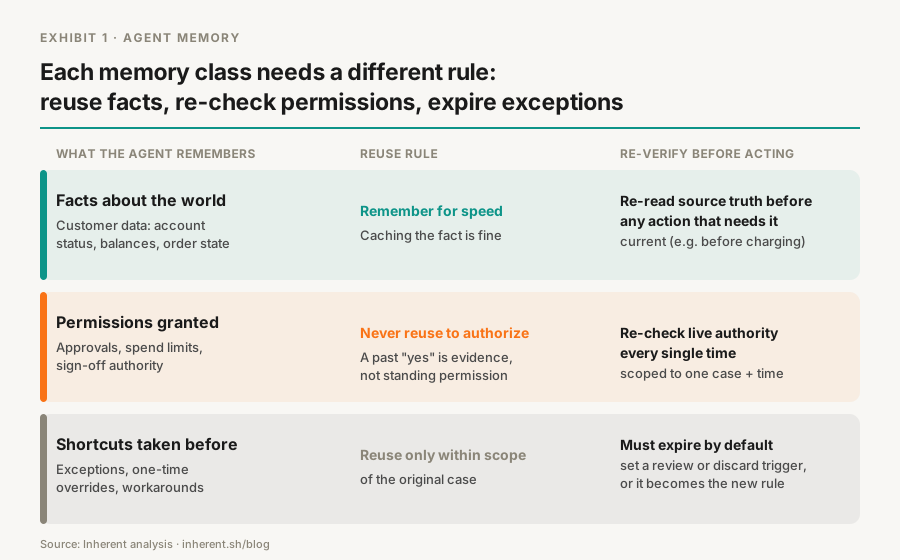
1. Facts about the world (customer data). What the agent believes is true: account status, contact details, balances, order state. Rule: remember for speed, but re-read from source truth before any action that depends on the fact being current. An agent may keep "customer is on a payment plan" to route a conversation — but must re-verify the balance before charging anything.
2. Permissions it was granted (approvals). What the agent is allowed to do: spending limits, sign-off authority, who approved what. Rule: never let a remembered approval authorize a new action. Approvals are scoped to a specific case and time. A remembered "yes" is evidence that something happened once, not a standing permission. Re-check the live authority every time.
3. Shortcuts it took before (exceptions). Deviations from the normal path: one-time overrides, special handling, workarounds. Rule: exceptions must expire by default. If an exception has no expiry or review trigger, it silently becomes the new rule — exactly the procurement failure above.
The pattern across all three is the same boundary, applied with increasing strictness: facts may be reused and re-verified; permissions must be re-checked; exceptions must expire.
The safe pattern: scope, expiry, re-verify
Three properties make agent memory safe, regardless of which framework or model you use:
- Scope — the agent only retains what the current task requires, not everything it has ever seen. Unscoped memory is how facts from one customer or one case leak into another.
- Expiry — every remembered fact, approval, or exception carries a review trigger or a discard date. Memory with no expiry defaults to "keep forever," which is how stale state accumulates.
- Re-verification at the point of action — before any step that is irreversible, external-facing, or financial, the agent re-reads the current value from source truth instead of trusting what it remembered. This single rule neutralizes most blast-radius failures, because the chain breaks the moment the agent checks reality before acting.
Notice that none of these is "remember less." Memory is what makes agents useful. The discipline is about when remembered state is allowed to drive an action. For anything consequential, the answer is one line: only after it has been checked against the source.
Why this needs an auditable retrieval layer
Re-verification is only possible if the agent has a fast, trustworthy way to ask "what is true right now?" That is a property of the retrieval and ingestion layer underneath the agent, not of the agent itself.
When retrieval is governed — documents re-indexed on change, every chunk carrying its source and an ingestion timestamp, every lookup producing a receipt — the agent can re-verify a fact cheaply and prove what it saw. "Re-read the balance before charging" is a real, enforceable step. When retrieval is not governed, re-verification has nothing reliable to check against, so teams fall back to trusting agent memory and catching errors after the fact, one incident at a time.
This is the layer Inherent is built around: managed ingestion, deterministic retrieval, and source metadata on every chunk. An agent can ask "is this still true?" before it acts, and you can audit what it knew and when. Agent memory without that foundation is a guess that compounds; with it, memory becomes a speed optimization you can trust.
The next step
Pick one agent — or one agentic workflow you are considering — and write three one-line memory rules, one for each class:
- Customer data: which facts may the agent remember for speed, and which must it re-verify before acting?
- Approvals: which remembered permissions must be re-checked live every time? (Hint: all of them.)
- Exceptions: what is the default expiry or review trigger for any one-time override?
The exercise takes 20–30 minutes and usually surfaces at least one place where a remembered fact could drive an autonomous action with no check in front of it. That gap is your highest-priority fix.
Once you have your three rules, DM Flow on X @human_in_loop with the one you found hardest to write — it is usually the most revealing.
This is Day 25 of the AI readiness series, which began with What Is AI in Business, Really?. Tomorrow goes from what an agent remembers to what "context" means in a live workflow: AI Context in Live Operations — who can act, what changed, and which record is current.