In a live workflow, context is not a pile of documents. It is the real-time answer to three questions at the moment the AI acts: who is allowed to act right now, what changed since the last read, and which record is the current one. Get those three right and the AI behaves like a careful operator. Get one wrong and it acts on a world that has already moved.
This is the failure most operations leaders miss. They test an AI assistant, it answers correctly, and they ship it. The fact it retrieved was true — at the time it was indexed. By the time the AI acts on it in production, the customer has churned, the order has shipped, the approval has been revoked. The fact did not become inaccurate. It became stale. A once-true fact that has since moved is the most dangerous input in live operations, because nothing about it looks wrong.
This post is the operations-leader follow-up to Agent Memory Without Risk. Memory is what the system carries forward; context is what it must check against reality before it acts.
Key Takeaways
- In live operations, AI context is not stored knowledge. It is the real-time answer to three questions at the moment of action: authority (who can act), change (what moved), and currency (which record is current).
- The operational risk is not a wrong fact. It is a once-true fact that has gone stale — accurate when indexed, wrong when acted on.
- Not every field needs to be live. The discipline is deciding which fields must be read at the moment of action and which can be safely cached.
- You can map the live-context requirements of one workflow in under an hour, and the output is a short list of fields that must never be served from cache.
What this post covers
After reading this, you will be able to list the fields and sources in one workflow that must stay live — read fresh at the moment of action — and which can be cached without risk.
- What "context" means in a live workflow, versus stored knowledge
- The three questions that define live context: authority, change, currency
- A worked example of an AI acting on a once-true fact that had moved
- How to decide which fields must be live and which can be cached
- The control that makes live context enforceable, not aspirational
For the concept behind this — why context is the layer between a model and a useful answer — see AI Context: The Missing Layer and What Is Context Engineering.
Live context is not stored knowledge
The technical explanation. Most AI retrieval is built for stored knowledge: documents are chunked, embedded, and indexed, then pulled back by similarity when a query matches. That model works for facts that rarely change — a policy, a product spec, a definition. Live operational context is different. It is state that changes by the hour: order status, account balance, who owns a ticket, whether an approval still stands. Serving that from an index built last night means answering today's question with yesterday's truth.
The business explanation. Picture your best operations employee handling a live case. Before they act, they do not trust their memory of the account. They open the record and check it now — is this still the contact, is the order still open, am I still allowed to approve this. That final check against the current record is what separates a reliable operator from a confident one who is wrong. Live context is simply that habit, made into a system rule: check reality at the moment of action, not at the moment of indexing.
The three questions that define live context
Live context is not one thing. It is the answer to three distinct questions, and each goes stale in its own way. Treat them separately.
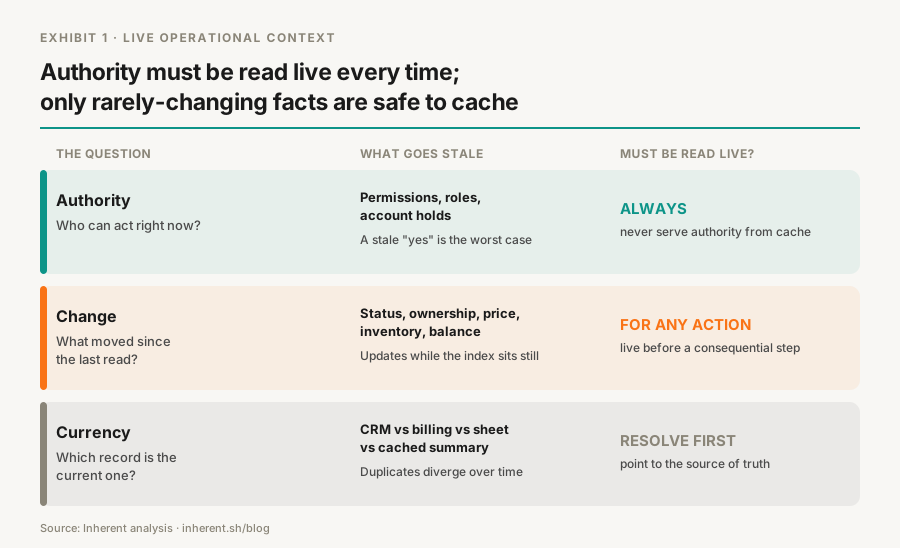
1. Authority — who can act right now. Permissions, roles, and account state change quietly. A user who could approve refunds last month moved teams. An account moved to legal hold. Authority is the highest-risk context to cache, because a stale "yes" lets the AI take an action no one is allowed to take anymore.
2. Change — what moved since the last read. Status, ownership, price, inventory, balance. These are the fields that update constantly in the systems of record while the AI's index sits still. The question is not "what does the document say" but "what has changed since the document was written."
3. Currency — which record is the current one. In real operations the same entity exists in several places: the CRM, the billing system, a spreadsheet, a cached summary. Currency is knowing which copy is the source of truth right now, so the AI does not act on a duplicate that diverged weeks ago.
The pattern: authority must always be live, change must be live for any consequential action, and currency must resolve to the source of truth before either is trusted.
A business example: the refund the AI was no longer allowed to give
A support team deploys an AI assistant to handle refund requests. It retrieves the policy, the customer's history, and a note that this customer's account was flagged for "expedited handling — approve refunds up to $500 without review." All true when indexed.
Three weeks earlier, finance had moved the account to a payment dispute and revoked expedited handling. That change lived in the billing system. The AI's context came from an index refreshed nightly from a different source. A request comes in, the AI reads its stale context, approves a $480 refund, and closes the ticket — in seconds, with no human in the loop. The policy was right. The customer history was right. The authority was three weeks out of date, and nothing in the workflow forced a live check before the action.
This is the signature failure of live context: not a hallucination, not a wrong document, but a real fact that expired between indexing and action.
How to decide what must stay live
Not every field needs a live read. Live reads cost latency and load, so the goal is precision: make live only what must be live. Sort each field a workflow touches into one of three tiers.
| Tier |
Rule |
Examples |
| Must stay live |
Read from source of truth at the moment of action |
Authority/permissions, account holds, balances, order status, current owner |
| Cache with a short expiry |
Refresh on a defined interval; flag staleness |
Pricing, inventory counts, recent activity summaries |
| Safe to cache |
Rarely changes; refresh on change |
Policies, product specs, definitions, historical records |
The test for the top tier is one question: if this field changed one minute ago and the AI acted on the old value, would it cause harm — a wrong action, a compliance breach, a customer impact? If yes, it must stay live. The cost of staleness here is not theoretical: Gartner estimates poor data quality costs organizations $12.9 million a year on average, with outdated data a named component. In live operations, most of that cost is once-true facts acted on too late.
Why live context needs a governed retrieval layer
A live-context rule is only real if the system can act on it. "Read authority from the source of truth before approving" requires retrieval that knows where the source of truth is, can fetch the current value on demand, and can prove how fresh it was.
When retrieval is governed — sources re-indexed on change, every chunk carrying its origin and an ingestion timestamp, every lookup producing a receipt — live context becomes enforceable. The AI can check "is this still true?" before it acts, and you can audit the freshness of every fact behind a decision. When retrieval is an overnight batch with no timestamps, live context is a wish. The system serves whatever it last indexed and hopes it still holds.
This is the layer Inherent is built around: managed ingestion, deterministic retrieval, and source-and-timestamp metadata on every chunk. It is what lets an operations team say "these fields must be live" and have the system honor it, rather than catch the failures one refund at a time.
The next step
Pick one live workflow that uses AI. List every field and source the AI touches before it acts. Then sort each one into the three tiers above, and mark the ones that must stay live.
The output is a short list — usually three to six fields — that must never be served from cache. That list is your live-context contract for the workflow. Most teams find at least one field sitting in cache that belongs at the top tier.
Once you have your list, DM Flow on X @human_in_loop with the field that surprised you — the one you assumed was safe to cache but is not.
This is Day 26 of the AI readiness series, which began with What Is AI in Business, Really?. Tomorrow turns from live context to the knowledge behind it: Knowledge Management AI for Teams — how to keep operational knowledge reliable instead of just abundant.