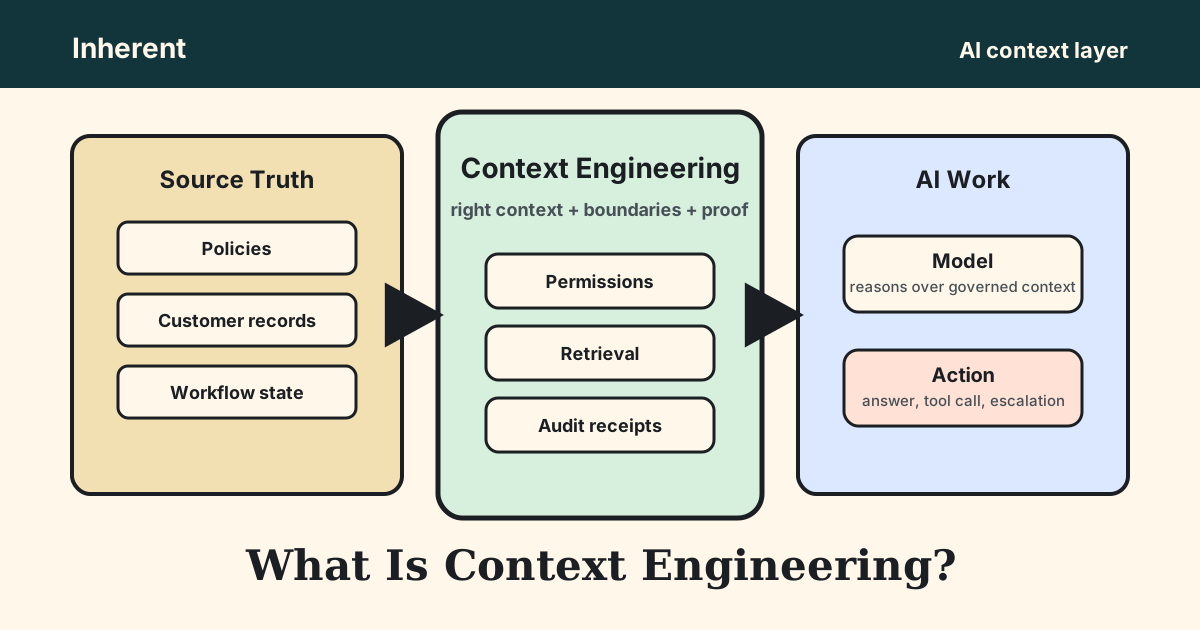
Context engineering is the work of giving an AI system the right information, boundaries, memory, tools, and evidence at the moment it needs to answer or act. It is becoming a core enterprise AI discipline because stronger models still fail when they are grounded in stale, incomplete, or unauthorized business context.
That is why the phrase is suddenly everywhere. Companies have learned that an AI agent can sound capable in a demo and still fail inside a real workflow. The model may be intelligent, but the business context around it is often messy: old policies, scattered customer notes, partial permissions, conflicting docs, and no record of which evidence shaped the answer.
For CEOs and founders, the practical takeaway is simple: context engineering is no longer a prompt-writing trick. It is the operating layer that decides whether AI can safely use your company knowledge.
Key Takeaways
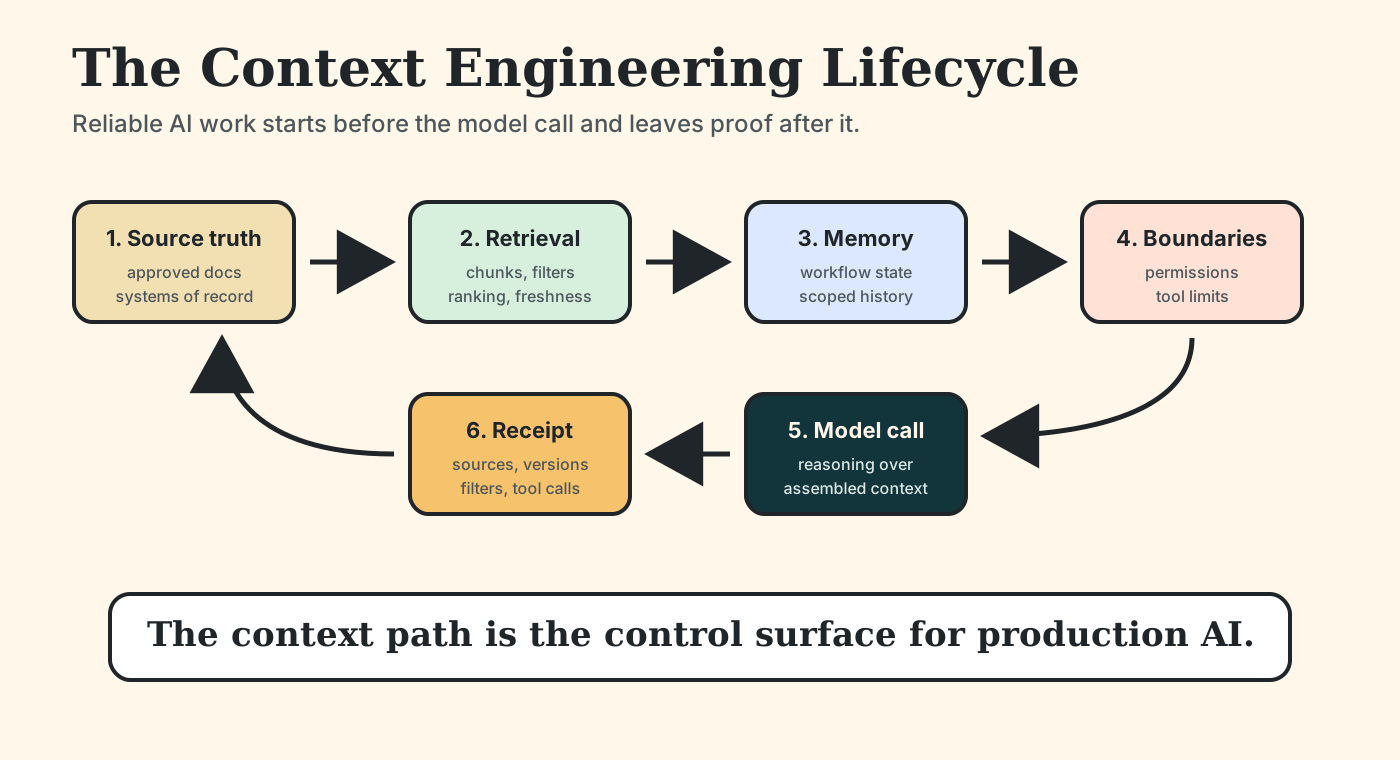
- Context engineering manages the full AI context lifecycle: source truth, retrieval, memory, permissions, tools, and auditability.
- Prompt engineering tells the model how to respond; context engineering controls what the model is allowed to know and use.
- The business risk is not only hallucination. It is stale context, permission drift, missing provenance, and unreproducible decisions.
- Start by mapping one high-value decision to the exact sources, rules, approvals, and receipts a human uses today.
What is context engineering?
Context engineering is the design and operation of the context layer around an AI system. It determines which company knowledge is retrieved, which user and workflow state is included, which tools are available, which permissions apply, and which sources can be proven after the answer or action is produced.
A useful plain-English definition is:
Context engineering gives AI the right context, for the right user, from the right source, at the right time, with proof.
That makes it broader than retrieval-augmented generation and narrower than "put every company document into AI." It includes retrieval, but it also includes source authority, freshness, memory boundaries, access control, evaluation, and audit logs.
In technical terms, context engineering covers the systems that assemble a model's working context before inference. That can include document ingestion, chunking, embeddings, metadata filters, tool schemas, conversation state, user attributes, tenant boundaries, function outputs, and retrieval receipts. In business terms, it asks a more concrete question: what would a competent employee need to know before making this decision?
Why is everyone talking about context engineering now?
Context engineering is getting attention because model quality is no longer the only bottleneck. Enterprises now have access to strong foundation models, but production AI still breaks when the surrounding business context is incomplete, stale, over-broad, or impossible to audit.
The early generative AI playbook focused on prompts and model choice. Teams asked: which model reasons best, and which instruction produces the best answer?
The production playbook asks different questions:
- Which source is authoritative?
- Is the retrieved policy current today?
- Is this user allowed to see this customer record?
- Did the model receive enough context, or too much?
- Which tool result changed the answer?
- Can we reproduce the decision next week?
Google Cloud's grounding documentation separates model output from the data used to ground that output. Anthropic's guidance on context engineering for AI agents also frames context engineering as the next step after prompt engineering, where tools, memory, and retrieved information shape what the agent can do.
The industry shift is visible: the model is becoming the reasoning engine, while the context layer is becoming the reliability surface.
How is context engineering different from prompt engineering?
Prompt engineering shapes the instructions given to a model. Context engineering shapes the environment the model operates inside: the sources it can retrieve, the state it can remember, the tools it can call, the permissions it must respect, and the evidence trail it leaves behind.
The difference matters because many AI failures are not instruction failures.
If a support agent refunds a customer using a six-month-old policy, the root problem is not that the prompt failed to say "use the current policy." The deeper problem is that the system allowed stale policy context into the working set. If a sales assistant summarizes notes from another account, the issue is not wording. It is permission-aware retrieval.
Prompt engineering is still useful. It can define tone, role, output structure, and reasoning style. But prompts cannot compensate for missing source truth, weak metadata, broken access control, or absent audit logs.
What does an AI context layer include?
An AI context layer includes the sources, memory, metadata, rules, permissions, tools, and receipts that surround a model call. In production, it should behave less like a document dump and more like a governed decision system that assembles only the context needed for the current user and workflow.
A practical context engineering stack has five parts:
| Layer |
What it controls |
Why it matters |
| Source truth |
Authoritative systems, document ownership, versioning, deprecation |
Prevents answers from drafts, duplicates, and stale policies |
| Retrieval |
Chunking, embeddings, metadata filters, reranking, query rewriting |
Finds relevant context without flooding the model |
| Memory |
Conversation state, workflow state, user history, durable business memory |
Lets agents use what already happened without leaking across boundaries |
| Boundaries |
Permissions, tenant scope, tool access, approval rules |
Keeps AI context aligned with business and security rules |
| Receipts |
Retrieved chunks, source versions, filters, tool calls, timestamps |
Makes answers debuggable, auditable, and reproducible |
The 2025 arXiv paper "A Survey of Context Engineering for Large Language Models" describes context engineering as a discipline that goes beyond prompt design into retrieval, processing, management, memory, tool use, and multi-agent systems. That framing moves teams beyond "retrieve more text." Good context must be enough, but not noisy. Relevant, but not unauthorized. Current, but still traceable.
What breaks when AI context is unmanaged?
Unmanaged AI context creates failures that look like model problems: stale answers, generic outputs, permission leaks, inconsistent decisions, and impossible debugging. Teams often respond by changing models or tuning prompts, but the real issue is that the AI has no governed context layer.
The most common failure is stale context. A policy changes, but old chunks remain searchable. The AI answers from the old version because the retrieval system cannot tell which source is current.
The second failure is permission drift. Enterprise knowledge is not public to every employee, customer, or workspace. If retrieval does not enforce permissions before context reaches the model, AI can combine information that ordinary business systems would have kept separate.
The third failure is missing provenance. A user challenges an answer, but the team can only inspect the final prompt and response. They cannot see which source chunks were retrieved, which filters were applied, which tool outputs were used, or whether the answer can be replayed.
The fourth failure is context overload. Teams push too much text into the prompt window and assume more context means better context. In reality, excessive context can bury the important evidence, increase cost, slow the workflow, and make the model more likely to attend to the wrong detail.
How does context engineering look in a business workflow?
Context engineering turns a fragile AI workflow into a controlled operating loop. The best way to see the difference is through a customer support agent handling billing disputes, where the agent must combine policy, account state, user history, and escalation rules before taking action.
Without context engineering, the workflow is risky:
- The agent retrieves a refund policy from an old help-center article.
- It misses that the account already received multiple exceptions this year.
- It issues a refund because the prompt says to be helpful.
- Operations cannot reproduce the decision because no retrieval receipt exists.
With context engineering, the same workflow changes:
- Source truth: the agent retrieves only the active refund policy from the approved billing source.
- Retrieval: metadata filters exclude deprecated policy versions and unrelated account docs.
- Memory: scoped customer history shows prior exceptions without exposing other customers.
- Boundaries: the refund amount crosses an approval threshold, so the agent cannot act alone.
- Receipt: the ticket includes policy version, retrieved chunks, filters, customer state, and escalation reason.
The visible AI behavior improves because the invisible context system is better engineered.
How should leaders start with context engineering?
Leaders should start context engineering by mapping one recurring business decision before buying more AI tooling. The goal is to identify the sources, permissions, exceptions, and proof a human uses today, then turn that decision path into a governed context flow for AI.
Use this 30-minute exercise:
- Pick one high-value decision: refund approval, vendor review, lead qualification, support escalation, roadmap prioritization, or compliance response.
- Write the exact sources a competent human checks before making that decision.
- Mark which source is authoritative when two systems disagree.
- Note which information is private, tenant-scoped, role-scoped, or time-sensitive.
- Define what proof the business would need if the AI answer were challenged.
If the answer lives across Slack threads, outdated wikis, tribal knowledge, and dashboards with unclear ownership, the company does not have a model problem yet. It has a context problem.
What should you build before an AI agent?
Before building an AI agent, build the minimum context layer that makes the target workflow reliable: authoritative source ingestion, freshness checks, permission-aware retrieval, scoped memory, and audit receipts. An agent should not be allowed to act until the context path behind that action can be inspected.
The first version does not need to be complex. Start with one workflow and require three receipts:
- Source receipt: which document, record, or system supplied the answer?
- Permission receipt: why was this user allowed to use that context?
- Decision receipt: which retrieved evidence and tool result shaped the final output?
Once those receipts exist, model evaluation becomes clearer. You can tell whether the system failed because the source was wrong, retrieval missed evidence, permissions were too broad, the prompt was weak, or the model ignored valid context.
That is the real value of context engineering: it turns AI reliability from guesswork into an operating system.
(Read next: What Is a Context Engine for AI Agents?)