A context engine is the infrastructure layer that turns company knowledge into governed, retrievable, auditable context for AI agents. It connects source systems, ingestion, retrieval memory, permissions, and audit receipts so an agent can answer or act with the right information instead of whatever text happens to be closest in a vector search.
The practical definition is:
A context engine gives an AI agent the right context, for the right user, from the right source, at the right time, with proof.
That is narrower than "all company knowledge" and broader than "a vector database." It is not just storage. It is the operating layer between messy work knowledge and an agent that needs to reason over that knowledge.
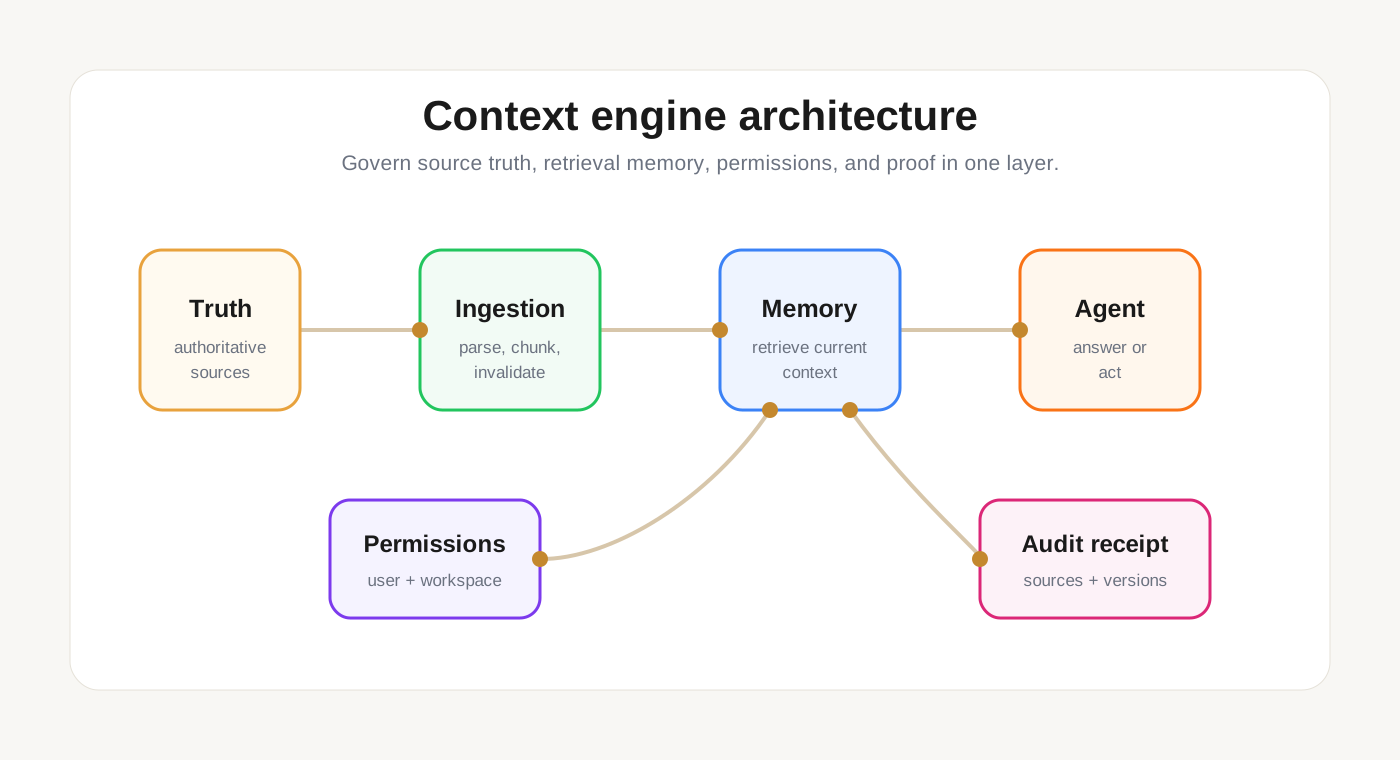
A useful context engine usually has five jobs:
- Identify authoritative sources.
- Keep derived memory current as sources change.
- Retrieve context that is relevant and allowed.
- Preserve boundaries across users, teams, tenants, and workspaces.
- Produce an audit trail for every answer or action.
If one of those jobs is missing, the agent may still demo well. It will be harder to trust in production.
Why do AI agents need a context engine?
AI agents need a context engine because their work depends on live, private, company-specific knowledge that foundation models do not carry by default. Public model training cannot know your current policies, customer state, source permissions, roadmap decisions, support history, or which document version should govern an answer today.
The shift from chatbots to agents raises the stakes.
A chatbot can answer a question. An agent can inspect systems, draft work, call tools, update records, and trigger workflows. Once the system can act, the context layer becomes part of the control surface.
Google Cloud's grounding documentation separates model output from the data used to ground that output. That distinction matters for company agents. The model may be capable, but the answer is only as reliable as the context it is grounded in.
Glean's agent launch materials make a similar enterprise point: agents at work need access to structured and unstructured work knowledge, governance, and deployment controls. In other words, agent capability depends on the knowledge substrate underneath it.
Without a context engine, teams usually push this work into application glue:
- One script syncs docs into a vector store.
- Another script handles chunking.
- Another layer tries to enforce permissions.
- Logs capture the final answer but not the retrieval path.
- Old chunks may remain searchable after the source changed.
That can work for a prototype. It becomes fragile when the agent is expected to serve real users.
How is a context engine different from a vector database?
A vector database stores and searches embeddings. A context engine manages the full lifecycle of context: source truth, ingestion, metadata, retrieval, permissions, versioning, and audit. Vector search can be one component inside the engine, but it does not automatically solve freshness, authority, access control, or reproducibility.
This distinction matters because many RAG systems stop at storage and similarity search.
Vector search can answer: which chunks are semantically close to this query?
A context engine has to answer harder production questions:
- Is this source still current?
- Is this chunk from the approved version?
- Is this user allowed to use it?
- Was the retrieval path deterministic enough to debug?
- Which evidence shaped the final answer?
- Can the team reproduce the answer next week?
Those questions sit outside the core job of a vector database.
That does not make vector databases bad. It means they are infrastructure for retrieval memory, not the whole memory system. Pinecone, pgvector, Weaviate, Qdrant, and similar tools can be valuable inside the memory layer. The context engine is the layer that decides how memory should be created, governed, retrieved, and proven.
How is a context engine different from RAG?
RAG is a generation pattern: retrieve external information, put it near the model, and generate a grounded answer. A context engine is the production system that makes that pattern reliable over time. It manages source changes, permissions, retrieval policy, evaluation hooks, and answer receipts before and after the model call.
RAG describes a workflow. A context engine describes an operating layer.
In a basic RAG app, the flow is often simple.
That flow omits the work that production systems need:
- Source ownership
- Document versioning
- Chunk invalidation
- Permission-aware retrieval
- Workspace boundaries
- Retrieval receipts
- Failure replay
- Freshness checks
- Evaluation against known questions
The 2026 context engineering paper on arXiv frames context engineering around relevance, sufficiency, isolation, economy, and provenance. Those criteria are useful because they move the conversation beyond "retrieve more text." The right context must be enough, but not noisy. Relevant, but not unauthorized. Current, but still traceable.
A context engine is how those criteria become infrastructure.
What should a context engine store, retrieve, and prove?
A context engine should store source metadata and derived memory, retrieve the smallest useful set of allowed context, and prove which sources shaped an answer. It should not become a dumping ground for every document. Its value comes from preserving authority, freshness, permissions, and traceability as knowledge changes.
The storage layer should keep more than text chunks.
It should track:
- Source system
- Source owner
- Document ID
- Version or content hash
- Last indexed time
- Chunk boundaries
- Workspace or tenant scope
- Permission metadata
- Deprecation status
The retrieval layer should return more than passages.
It should return:
- Why the result matched
- Which filters were applied
- Which sources were excluded
- Which version was used
- Whether the context is current
- Whether the user had access
The audit layer should preserve a receipt.
That receipt should show the query, retrieved chunks, source documents, versions, user, workspace, permissions, timestamps, and model call. Without that receipt, teams are left debugging the final answer instead of the context path that produced it.
What breaks when context is unmanaged?
Unmanaged context creates failures that look like model quality problems: stale answers, inconsistent retrieval, permission leaks, generic outputs, and impossible debugging. Teams often tune prompts or swap models, but the real issue is that the agent has no governed memory layer between changing company knowledge and model generation.
The most common failure is stale context.
A policy changes, but old chunks remain retrievable. The agent answers from a prior version. The response sounds fluent, so the error is easy to miss until a customer or reviewer catches it.
The second failure is permission drift.
Enterprise knowledge is rarely public to every user. If retrieval is not permission-aware, an agent can combine sources across workspaces, teams, or customers in ways that ordinary search would have blocked.
The third failure is missing provenance.
When a user challenges an answer, the team can see the prompt and response but not the exact retrieval path. They cannot tell whether the wrong source was indexed, the wrong chunk was selected, the prompt truncated evidence, or the model ignored retrieved context.
The fourth failure is context overload.
More context is not always better. Too much irrelevant material can bury the answer and increase the chance that the model reasons from noise. A good context engine optimizes for sufficiency, not maximum stuffing.
How do you know if your agent needs a context engine?
Your agent needs a context engine when answers depend on changing internal knowledge, private data, source permissions, or auditability. If the agent can cause user-visible work, influence customer decisions, or answer from company-specific sources, retrieval cannot be treated as a one-time script.
Use this five-minute test.
Pick one answer your agent must get right. Then ask:
- Which source should govern the answer?
- When did that source last change?
- Which chunk or record would the agent retrieve?
- Is the current user allowed to use that context?
- Could your team prove the retrieval path later?
If any answer is unclear, the issue is probably not the model. It is the layer between your knowledge base and your agent.
For a deeper primer on the source layer, read What is a Knowledge Base in the AI Agent World?. For a product workflow example, read The AI-Ready Knowledge Base Checklist for Better PRDs.
FAQ
Is a context engine the same as agent memory?
Not exactly. Agent memory often refers to what an agent remembers across turns, tasks, or users. A context engine is broader: it governs the company sources, retrieval rules, permission boundaries, and audit receipts that make that memory usable in production.
Does every AI app need a context engine?
No. A simple public-content chatbot may only need a lightweight retrieval pipeline. A context engine becomes important when the app uses private work knowledge, changes over time, supports multiple users or tenants, or needs to prove why an answer was given.
Can a vector database be part of a context engine?
Yes. A vector database can power semantic retrieval inside the memory layer. The context engine still needs to manage ingestion, source authority, metadata, permissions, invalidation, and auditability around that vector search.
What is the first thing to build?
Start with retrieval receipts. Log the source documents, versions, chunks, user, workspace, filters, and model call for every important answer. Receipts make the system easier to debug and reveal which parts of the context layer need work next.
What to do next
Run a context audit before adding another agent feature.
Choose one production answer and trace the full path from source document to final response. If you cannot identify the source version, permission boundary, retrieved chunk, and audit receipt, you have found the first context-engine gap.
DM Flow on X with the weakest link: truth, ingestion, memory, permissions, or audit. I will help you reason through the architecture.