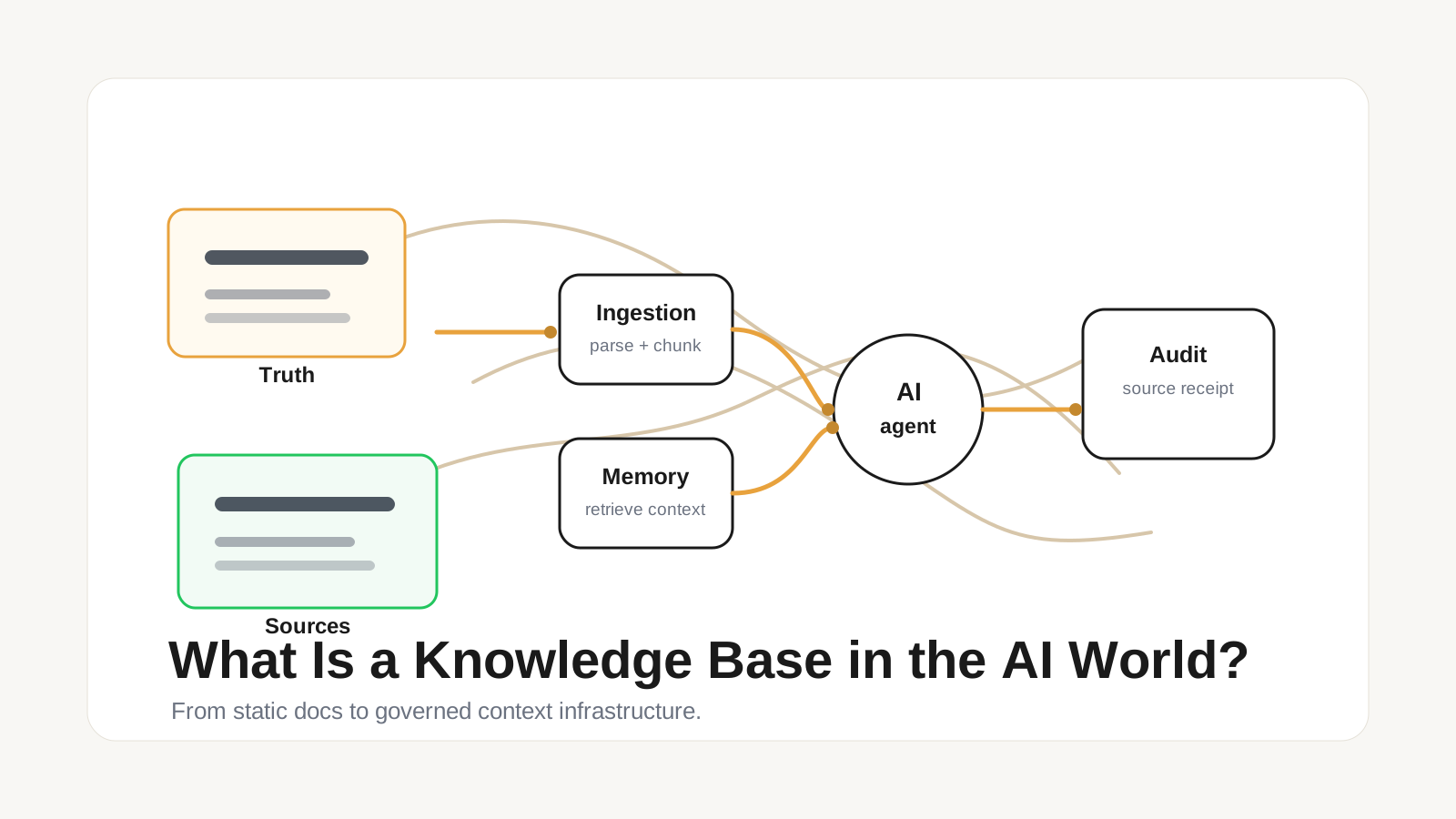
At its simplest, a knowledge base is a structured collection of information about a product, service, team, process, or company.
That information might include:
- Product documentation
- FAQs
- Troubleshooting guides
- Internal policies
- Support macros
- Runbooks
- Customer implementation notes
- Engineering decisions
- Legal and compliance guidance
Atlassian describes a knowledge base as a self-service library of information about a product, service, department, or topic. IBM frames knowledge management as the work of identifying, organizing, storing, and sharing information inside an organization.
That traditional definition still matters. Companies need a shared place where people can find answers.
But AI changes the job of the knowledge base.
Traditional knowledge bases were built for humans
Most knowledge bases were designed around human behavior.
A person opens a help center, searches a phrase, scans a few article titles, reads the most relevant page, and applies judgment. If the article is outdated, the person might notice. If the page is ambiguous, they might ask a colleague. If the content is missing, they might open a ticket.
That workflow is forgiving because humans add context.
AI agents do not work that way.
An agent retrieves snippets, ranks chunks, passes context into a model, and generates an answer. If the wrong chunk is retrieved, the answer may still sound confident. If the source is stale, the model may not know. If the agent cannot see permissions, it may use context it should not have touched.
The failure mode is simple: a knowledge base that is good enough for human browsing may not be safe enough for AI reasoning.
In AI, the knowledge base becomes a context layer
The practical definition changes:
An AI knowledge base is the governed source of truth an AI system uses to retrieve, reason, and answer with company-specific context.
That definition has three implications.
First, storage is not enough. Putting documents in a wiki, drive, or vector database does not make them reliable context. The system still needs ingestion, parsing, chunking, metadata, versioning, and updates.
Second, retrieval quality becomes business logic. The question is not only "can we find something similar?" It is "did we retrieve the right source, for the right user, at the right time, under the right permissions?"
Third, every answer needs traceability. If an AI system gives an answer, the team should be able to inspect which documents, chunks, versions, and retrieval events shaped that answer.
This is where many AI projects break. Teams treat the knowledge base as a content repository when the agent needs a memory system.
A production AI knowledge base has five layers
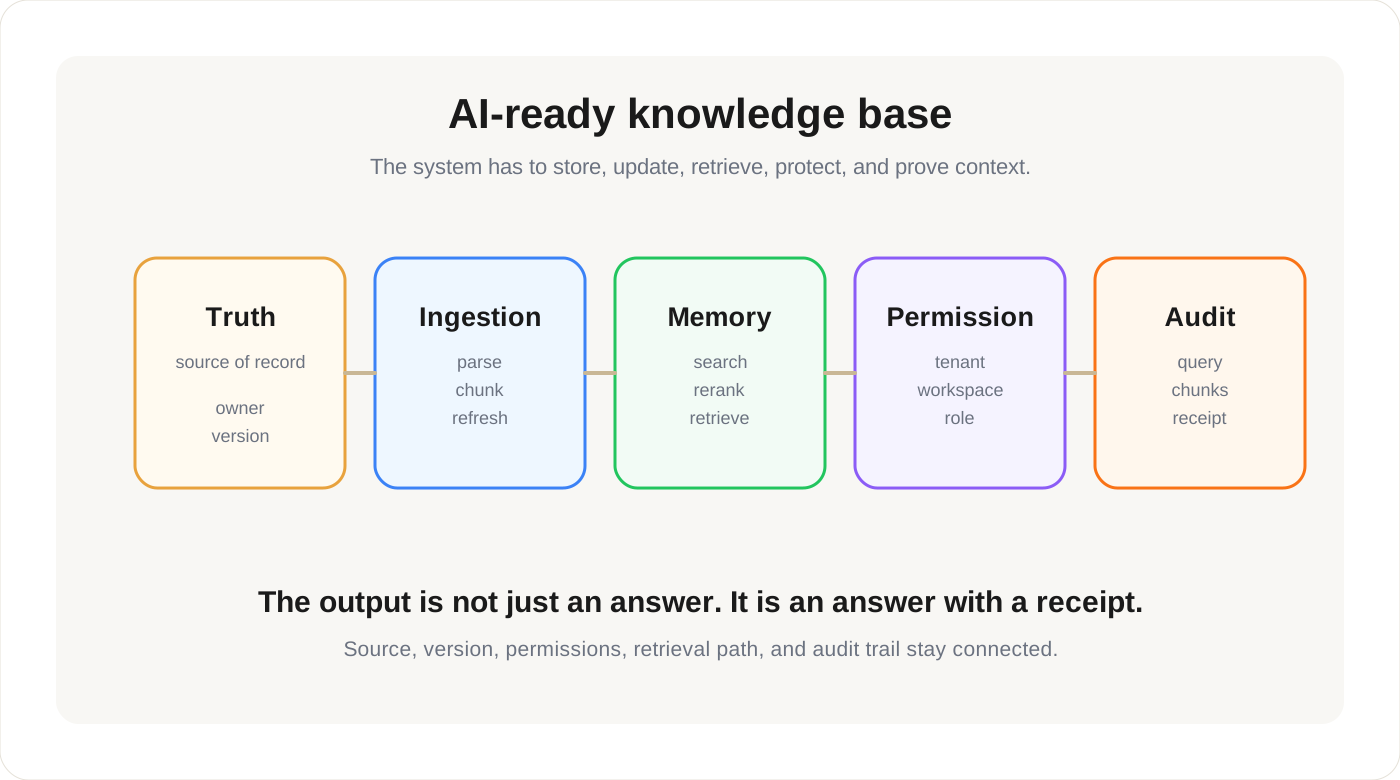
A production-grade AI knowledge base needs five layers. They are separate because they answer different operational questions.
The truth layer stores authoritative sources
The truth layer answers: what is the source of record?
This might be product docs, Notion pages, Google Drive files, Confluence articles, PDFs, database records, or internal runbooks. The key is authority. The system needs to know which document is real, who owns it, when it changed, and whether it is still valid.
Without a truth layer, the AI system can retrieve content but cannot prove whether the content should still be trusted.
The ingestion layer keeps knowledge current
The ingestion layer answers: how does new or updated knowledge enter the system?
This includes parsing, cleaning, chunking, embedding, indexing, and reprocessing. It also includes detecting when a source changed and removing stale derived data.
This layer looks boring until it fails. If a policy changed at 2pm and the agent still answers from the 9am version, the problem is not the model. The problem is unmanaged ingestion.
The memory layer retrieves usable context
The memory layer answers: what context should the agent use now?
This is where search, embeddings, hybrid retrieval, metadata filters, reranking, and query understanding come in. Vector search is useful here, but it is not the whole system. It helps find similar content. It does not automatically solve freshness, permissions, provenance, or auditability.
A memory layer should retrieve context that is relevant, current, allowed, and explainable.
The permission layer prevents context leaks
The permission layer answers: is this agent allowed to use this knowledge for this user?
This matters more in AI than in classic search because agents combine information. A small permission mistake can become a confident answer built from content the user should never have seen.
For company AI, memory needs boundaries: tenant boundaries, workspace boundaries, role boundaries, and document-level access rules.
The audit layer proves what happened
The audit layer answers: why did the agent say that?
A useful audit trail should show the query, retrieved chunks, source documents, timestamps, workspace, user, permissions, and model call. This creates a receipt for the answer.
Without that receipt, teams are debugging vibes. With it, they can reproduce failures, remove stale content, improve retrieval, and answer compliance questions.
The AI-era test is whether you can prove the answer
The old knowledge base test was:
Can a person find the right article?
The AI-era test is harder:
Can the system prove which knowledge produced the answer?
That proof matters because AI systems collapse search, interpretation, and response into one workflow. Google Cloud describes RAG and grounding as a way to retrieve facts before generating an answer. That helps, but production teams still need to know which facts were retrieved, whether they were current, and whether the agent was allowed to use them.
If the system cannot show the source, the answer is hard to trust. If it cannot show the version, the answer may be stale. If it cannot show permissions, the answer may be unsafe. If it cannot reproduce the retrieval path, the team cannot debug the failure.
This is why AI knowledge bases need to be treated as infrastructure, not content storage.
Enterprise agents make governance non-negotiable
The market is already moving this way.
Glean's agent platform positioning ties enterprise agents to work knowledge, structured data, and governance. That is the right direction: once agents can act across systems, the knowledge layer underneath them needs controls that a human-facing help center never had to provide.
For AI engineers, the implication is direct. The question is not "do we have a knowledge base?" Most companies do. The question is whether that knowledge base is agent-ready.
Agent-ready means:
- Sources are authoritative.
- Updates are ingested and old context is invalidated.
- Retrieval respects user, workspace, and tenant boundaries.
- Answers can be traced back to source documents and retrieval events.
- Failures can be reproduced.
That is the line between a searchable library and production AI memory.
What to do next
If you want to make this practical, read Production RAG Needs Truth and Memory next. This article explained the concept. That one goes deeper into the operating model: source truth, retrieval memory, and audit trails.
Before you read it, do one 10-minute audit.
Pick one answer your AI agent must get right. Then write down:
- Which source document should govern the answer?
- When did that source last change?
- Which chunk or passage would your system retrieve?
- Is the current user allowed to see that source?
- Could your team prove the retrieval path after the answer is generated?
If you cannot answer all five, the issue is probably not the model. It is the layer between your knowledge base and your agent.
Send me what you find. DM Flow on X with "passed all five" or "failed on X." If you are building this yourself, include where the chain breaks: ingestion, retrieval, permissions, or audit. I will help you think through the architecture.