Production RAG fails when leaders treat retrieval as the whole system. Retrieval augmented generation can help an AI system find relevant company information, but production trust comes from three controls around retrieval: source truth, scoped memory, and audit receipts. The real requirement is not just retrieval. It is source truth.
So what: before putting a RAG system in production, leaders should be able to answer a harder question than "did search find something relevant?" They should know which source is authoritative, which memory is allowed for this user, and what evidence proves why the answer happened.
By the end, you should be able to decide whether your RAG architecture is ready for a live workflow.
Previous post: RAG for CEOs: What Retrieval Augmented Generation Actually Solves.
What this post covers
- Why production RAG is an operating model, not only a retrieval pattern.
- How source truth decides which company knowledge is allowed to win.
- Why AI memory needs tenant, workspace, and permission boundaries.
- What an audit receipt should prove after an answer is generated.
- How truth, memory, and audit change a real support workflow.
- A production RAG checklist leaders can run today.
Production RAG is an operating model, not only a search pattern
Production RAG is the full operating model that turns company knowledge into reliable AI context: ingestion, retrieval, permissions, memory, orchestration, and evidence. The original RAG paper by Lewis et al. framed retrieval augmented generation as combining a model's internal knowledge with explicit external memory. That is the base pattern. Production adds the controls required to use that pattern inside a business.
Technical explanation
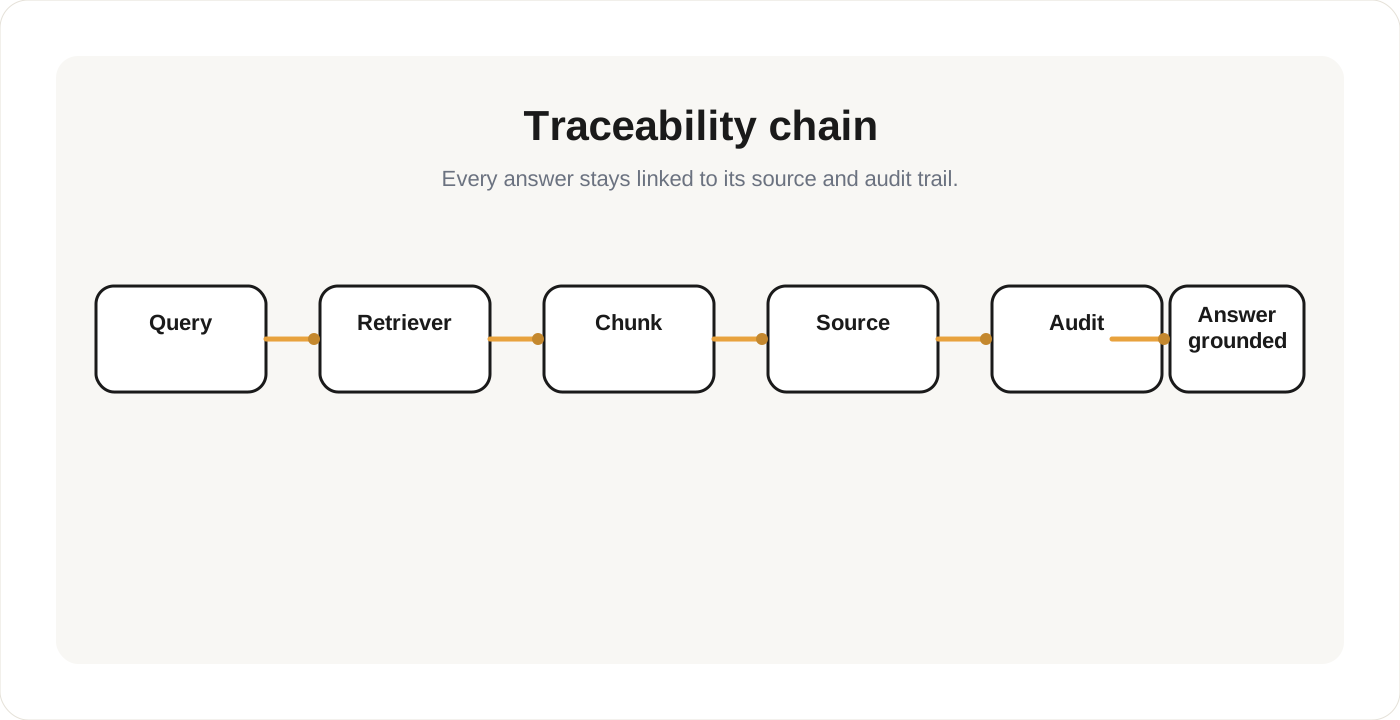
A basic RAG system ingests documents, chunks them, embeds them, retrieves relevant chunks, and sends those chunks to a model. AWS Prescriptive Guidance describes production-level RAG as more than that retrieval path: connectors, data processing, embeddings, vector databases, retrievers, guardrails, orchestration, user experience, and identity management all matter.
Business explanation
Imagine a customer asks support:
"Can you refund the renewal charge from yesterday?"
A demo RAG system may retrieve a refund article and draft a confident answer. A production RAG system must also know whether that article is approved, whether it is current, whether this customer has a contract exception, whether the support rep can issue the refund, and what receipt should be logged if the customer challenges the answer.
The model is not the only risk. The context path is the risk.
Source truth decides which knowledge is allowed to win
Source truth is the control that tells a RAG system which document, record, policy, or system should govern the answer when multiple relevant sources exist. Without source truth, the retriever can find text that is semantically similar but operationally wrong.
A draft policy, deprecated onboarding guide, or Slack thread can be relevant. None should automatically outrank the approved source of record.
For leaders, source truth has four practical requirements:
| Requirement |
Question it answers |
Failure if missing |
| Authority |
Which source wins? |
The system answers from drafts or duplicates. |
| Freshness |
Is this version current? |
Old chunks survive after the policy changes. |
| Ownership |
Who maintains the source? |
Nobody knows who should fix bad context. |
| Traceability |
What produced the answer? |
Teams cannot debug or explain the response. |
Microsoft's Azure AI Search RAG guidance makes the same production point: RAG quality depends on content preparation, relevance tuning, governance, and access control. Before asking whether retrieval is accurate, ask whether the system knows which sources are allowed to be true.
AI memory needs boundaries, not silent accumulation
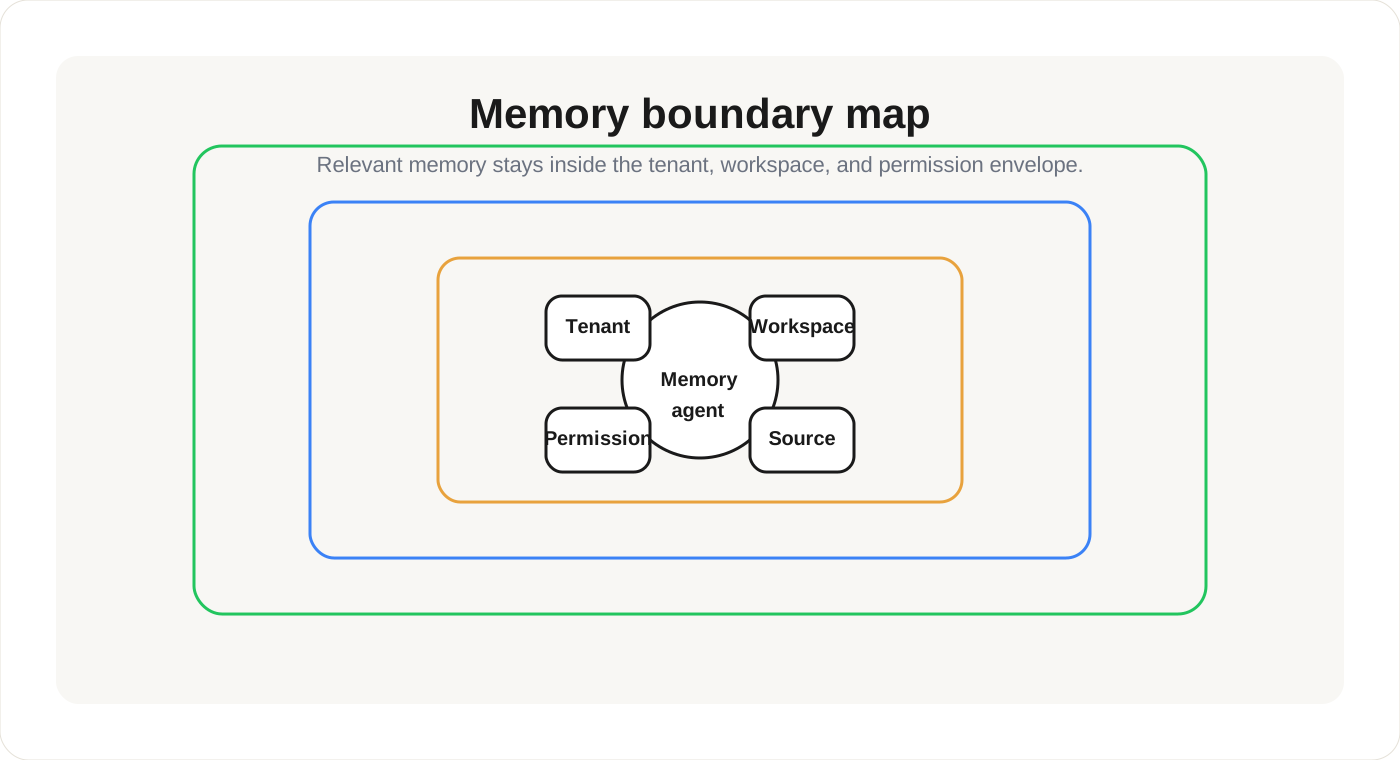
AI memory is useful only when the system controls what persists, where it persists, and who can use it. In production RAG, memory should not mean "save everything the agent saw." It should mean scoped context that can be retrieved later under explicit business rules.
Technical explanation
Anthropic's context engineering guidance separates runtime context from longer-lived memory. That maps directly to production RAG: the system needs to know whether memory is scoped to a user, workspace, tenant, account, project, or workflow, plus the retention, deletion, and retrieval rules.
Business explanation
Think about an AI assistant for customer success.
It may be helpful to remember that a customer prefers monthly business reviews, has an open implementation risk, and received an approved exception last quarter. It is not acceptable for that memory to leak across workspaces, outlive retention rules, or influence a sales recommendation without provenance.
Memory improves continuity. Boundaries make that continuity safe.
Audit receipts make RAG debuggable
An audit receipt is the record of what context shaped an AI answer: source documents, chunks, versions, filters, permissions, retrieval event, tool outputs, timestamps, and the user or workspace boundary. Without that receipt, the team is debugging the final answer without seeing the path that created it.
This matters because many AI failures look like model failures at first:
- The answer cited an old policy.
- The agent missed an exception.
- The same question produced different support guidance.
- A user asked why the system gave an answer, and nobody could reconstruct the source path.
The fix is not always a better model. Often the fix is better evidence. If the business cannot inspect the retrieval path, it cannot manage the risk.
A real workflow changes when truth, memory, and audit are explicit
Consider the refund question again.
A weak RAG system does this:
- The customer asks for a renewal refund.
- Retrieval finds a relevant article.
- The model writes a helpful answer.
- The support rep sees a confident draft with no source path.
That may be acceptable for an internal demo. It is not enough for live operations.
A production RAG system does this:
- It retrieves only approved refund policy sources and excludes deprecated versions.
- It checks the customer's current account, contract state, and scoped memory.
- It applies the support rep's permission boundary.
- It escalates if the refund crosses an approval threshold.
- It logs the source, chunk, filters, version, user, workspace, and final answer.
The visible user experience may still look like a simple answer. The operating model behind it is different.
This is the same principle behind context engineering: give AI the right source, for the right user, at the right time, with proof.
The production RAG checklist for leaders
Before scaling a RAG system, ask for evidence across three layers: truth, memory, and audit. If the team can only show a vector database and a prompt, the system is probably not ready for live business use.
Use this checklist:
Workflow:
Question the AI must answer:
User or agent asking:

Truth:
Approved source of record:
Source owner:
Version or freshness rule:
Deprecated sources to exclude:

Memory:
What should persist:
Memory scope: user / workspace / tenant / account / workflow
Retention rule:
Deletion or correction path:

Permissions:
Who is allowed to retrieve this context:
Which metadata filters enforce the boundary:
Which action requires human approval:

Audit:
Documents and chunks to log:
Retrieval filters to log:
Tool outputs to log:
Receipt shown to user or retained internally:
Failure replay path:
A production RAG review should prove what is true, what can be remembered, who can use it, and how the team can reconstruct what happened.
What should you do today?
Pick one AI workflow your team wants to put into production: internal search, customer support, sales research, finance exceptions, onboarding, or product documentation.
Run the checklist on one real question. Do not start with model choice. Start with the context path:
- Which source should govern the answer?
- Which memory is useful but risky?
- Which permission boundary must be enforced before retrieval?
- What receipt would make the answer defensible?
If the team cannot answer those four questions, the system does not have a model problem yet. It has a production RAG problem.
DM Flow on X with the weakest layer: truth, memory, permissions, or audit. That weak layer is the starting point for a company context audit.