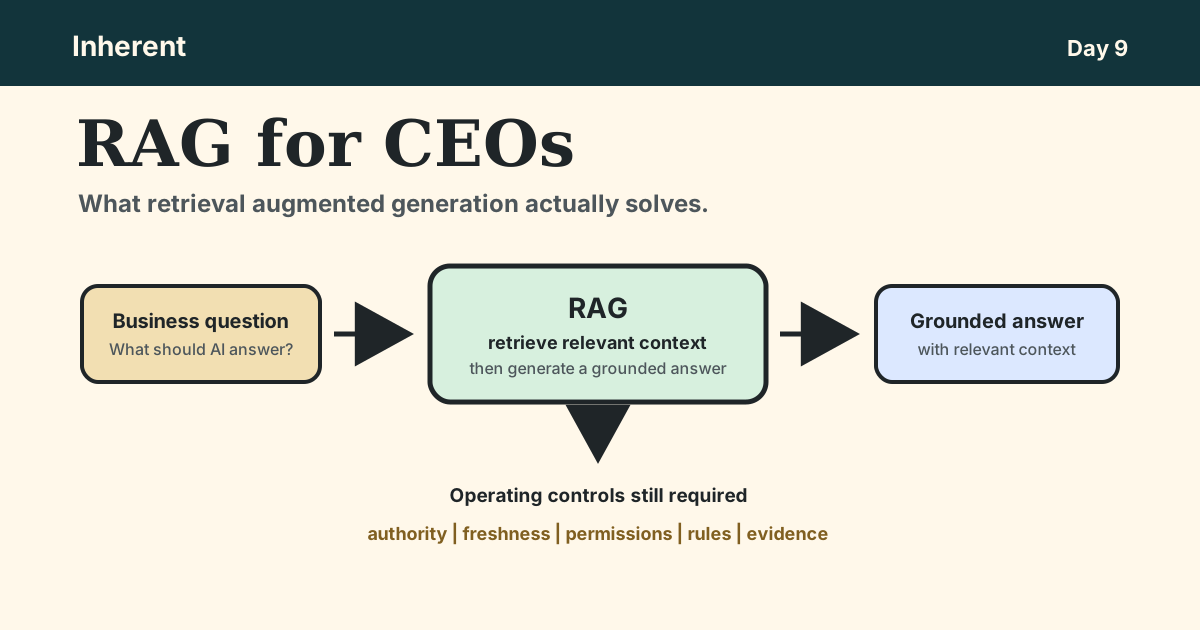
Retrieval augmented generation, usually shortened to RAG, gives an AI system a way to look up relevant information before answering. Instead of relying only on what a model learned during training, a RAG system can retrieve company documents, policies, records, or product knowledge and place the relevant context in front of the model.
So what and why do you care?
RAG is useful infrastructure, but it is not a complete AI operating model. Before approving an internal search tool, support assistant, or AI agent, leaders need to understand both sides of the boundary: what retrieval solves and what the business must still control.
Previous post: Knowledge Base AI: Why CEOs Should Care.
What this post covers
By the end, you should be able to decide whether a proposed RAG system solves your actual business problem or only improves document retrieval.
- What retrieval augmented generation means in plain English.
- What problem RAG actually solves.
- What RAG does not solve by itself.
- Where RAG fits in a real business workflow.
- What leaders should require before scaling a RAG system.
- A 15-minute retrieval filter to run today.
What is retrieval augmented generation?
Retrieval augmented generation is a pattern that adds relevant external information to a model's working context before the model produces an answer.
The original RAG paper by Lewis et al. framed the approach as combining a model's learned knowledge with explicit external memory. AWS Prescriptive Guidance explains the practical flow: ingest documents, retrieve relevant context for a user query, add that context to the prompt, and generate a response.
Technical explanation
A basic RAG architecture works like this:
Documents are usually split into smaller chunks. The system indexes those chunks so it can retrieve the passages most relevant to a question. The model then answers using the retrieved context.
Business explanation
Imagine a customer asks:
"I cancelled last week. Can you refund today's charge?"
A standalone model can explain how refunds usually work. A RAG AI system can look up your company's refund policy before drafting the answer.
That is the value: RAG lets the model use your business information instead of answering only from general knowledge.
What problem does RAG actually solve?
RAG solves a specific problem: a model needs access to information that is private, specialized, or more current than its training data.
That matters in real businesses because many valuable questions depend on company knowledge:
- Which onboarding policy applies to this customer?
- What does the latest product documentation say?
- Which support procedure should the team follow?
- What information is available in the internal knowledge base?
- Which approved policy explains this billing decision?
Google Cloud describes the core pattern as retrieving facts about a question before generating the answer. Microsoft Learn similarly describes RAG as grounding model responses in proprietary content.
The implication is straightforward: RAG can make AI answers more useful because the model sees relevant business context at the moment of work.
What does RAG not solve by itself?
RAG retrieves relevant information. It does not automatically decide whether that information is authoritative, current, allowed, complete, or safe to act on.
This is the boundary leaders need to understand.
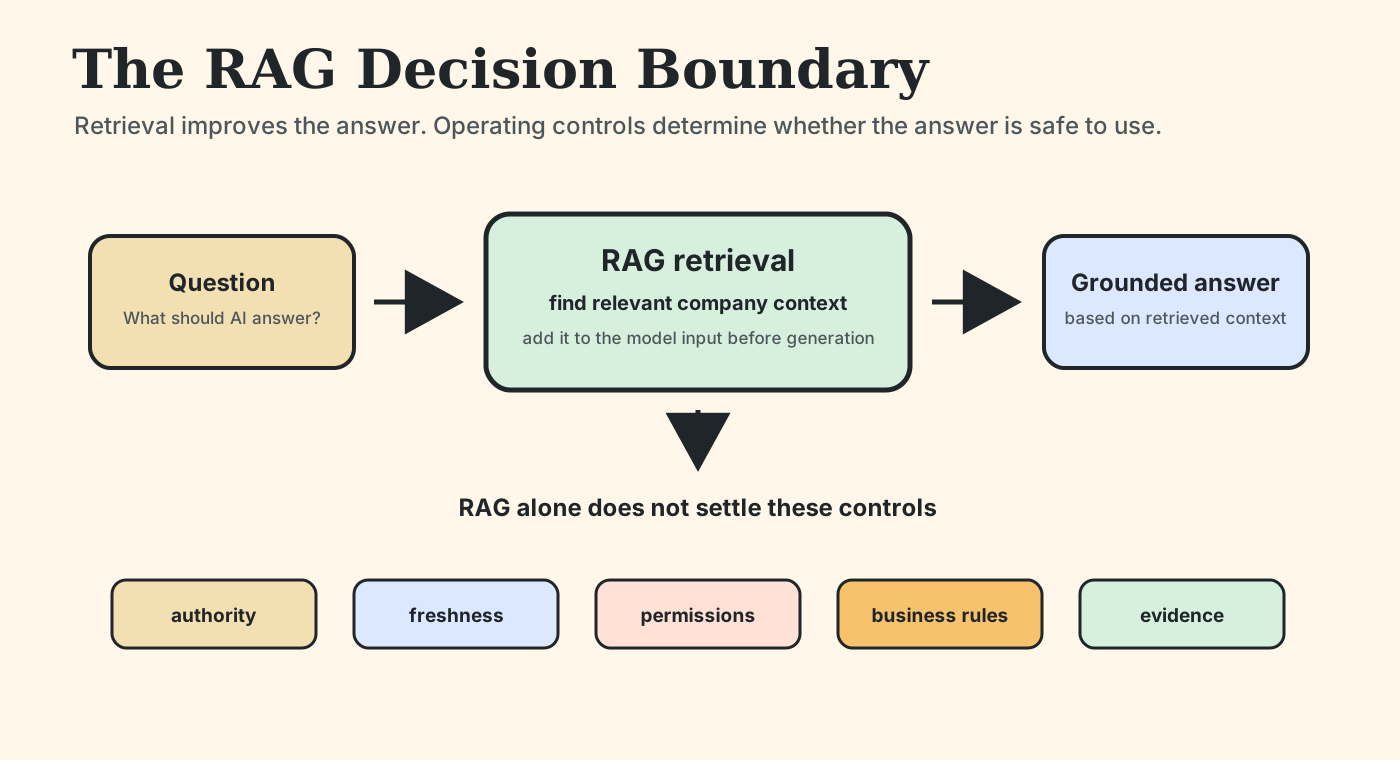
A document can be relevant and still be wrong for the current situation.
Authority: A draft refund policy and an approved refund policy may contain similar language. Relevance alone does not tell the system which source wins.
Freshness: A wiki page can change while old chunks remain searchable. Retrieval can return stale context unless the ingestion pipeline updates the index.
Permissions: A customer record can be relevant and still be unsafe for the current user or agent. Microsoft identifies granular access control as a core RAG implementation challenge: users and agents should retrieve only authorized content.
Business rules: A policy may explain the standard process while a live account record shows an exception, approval threshold, or contractual constraint.
Evidence: If the AI gives the wrong answer, the team needs to know which sources, versions, filters, and passages shaped the response.
RAG is not the problem here. The mistake is treating retrieval as the entire system.
Where does RAG fit in a real business workflow?
Consider the refund request again.
A weak RAG system retrieves an old help-center article because it closely matches the customer's wording. It drafts a confident reply. It does not check the current billing record, whether the policy was superseded, whether the support agent may issue the refund, or whether manager approval is required.
A production-ready workflow is more controlled:
- Retrieve the approved refund policy.
- Check the customer's live billing record.
- Exclude deprecated policy versions.
- Apply the current user's permission boundary.
- Escalate when the refund crosses an approval threshold.
- Log the sources and rules that shaped the answer.
The model may produce the final reply, but retrieval is only one part of the workflow.
AWS makes the same distinction in its production RAG guidance. Beyond retrieval, it lists connectors, data processing, embeddings, vector storage, guardrails, orchestration, user experience, and identity management as parts of a production-level RAG system.
The business lesson: do not evaluate RAG as a chatbot feature. Evaluate the full path from source truth to answer.
What should leaders require before scaling a RAG system?
Before approving a RAG system, run this retrieval filter:
Business workflow:
Question the AI must answer:
Approved source of truth:
Where that source is stored:
How updates reach the retrieval index:
Which stale versions must be excluded:
Who is allowed to retrieve this information:
Which live records must also be checked:
What requires human approval:
What evidence should be logged:
If the team can only answer the first three lines, the system is ready for a demo, not live operations.
A useful RAG architecture should sit inside a broader context engineering model: the right source, for the right user, at the right time, with proof.
That is also why production RAG needs truth and memory. Retrieval quality matters. But operational trust depends on what happens before and after the search.
What should you do today?
Pick one AI workflow your team is considering: internal search, customer support, sales research, finance operations, onboarding, or product documentation.
Run the retrieval filter on one high-value question. Ask where the answer comes from, how the system knows the source is current, who may see it, which business rule applies, and what receipt will be logged.
If the team cannot answer those questions, do not start by changing the model. Start by mapping the company context the workflow depends on.
DM Flow on X with the first place the workflow breaks. That failure point is the starting point for a company context audit.