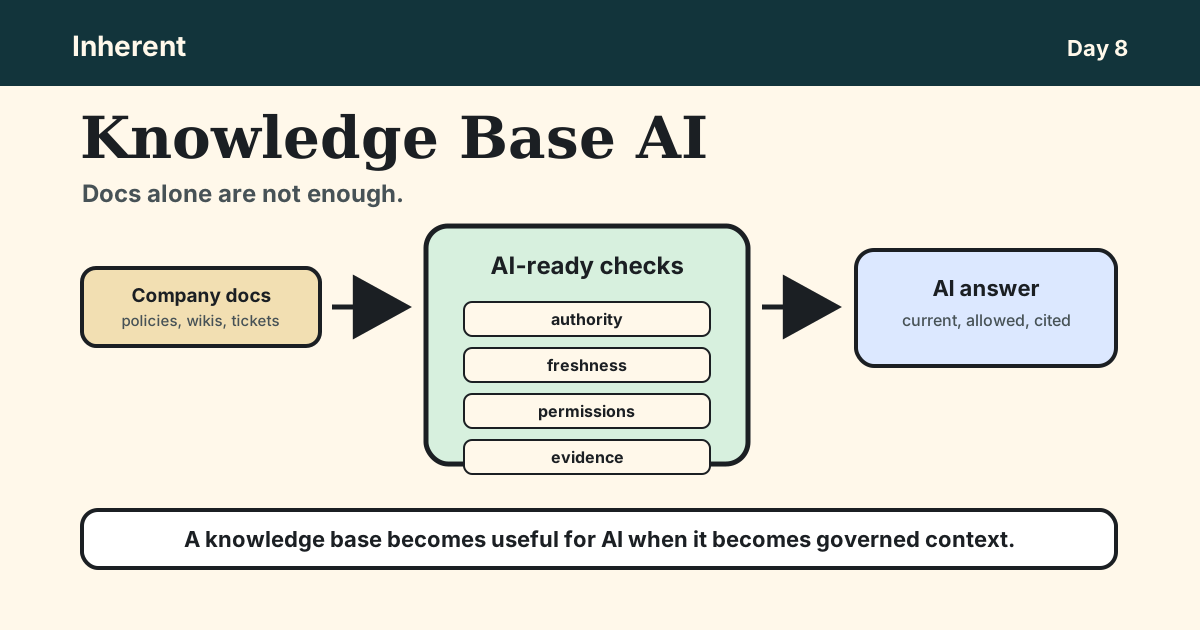
Knowledge base AI is the part of an AI system that turns company knowledge into answers employees or customers can use. It connects policies, product docs, help-center articles, CRM notes, ticket history, contracts, runbooks, and other business records to an AI assistant, search experience, workflow, or agent.
That sounds like a documentation project. For a CEO, it is not.
The CEO-level question is whether the company can let software answer from its knowledge without creating wrong refunds, bad sales promises, policy drift, permission leaks, or invisible operational risk. A useful AI knowledge base does not merely find documents. It knows which source wins, whether the source is current, who may see it, and what proof should appear with the answer.
Key Takeaways
- Knowledge base AI means AI that answers from company knowledge, not only from general model training.
- CEOs should care because AI turns messy internal knowledge into customer-facing and employee-facing decisions at scale.
- A normal knowledge base stores information for humans. An AI-ready knowledge base must encode authority, freshness, permissions, and evidence.
- Before approving a pilot, test one workflow where a wrong AI answer would cost money, trust, or compliance attention.
Previous post: What is context engineering?, which explains the broader discipline of giving AI the right context, boundaries, memory, and proof.
What is knowledge base AI?
Knowledge base AI is software that uses a company's knowledge base and related source systems to answer questions, summarize information, support employees, assist customers, or prepare actions. In plain English: it is AI that can use what your company knows.
Traditional knowledge management is about identifying, organizing, storing, and sharing organizational information. IBM defines knowledge management in that direction: making institutional knowledge easier to use across the organization. That is still the foundation.
Knowledge base AI raises the bar because the information is no longer just being read by a person. It is being converted into an answer by software.
A human can notice that a wiki page looks old. A support manager can remember that the refund policy changed last month. A sales leader can recognize that a pricing note was written for a different segment. An AI system needs those signals encoded into the knowledge path.
The useful definition is:
Knowledge base AI turns governed company knowledge into current, permission-aware, evidence-backed answers.
If the system cannot prove those four words, it is not ready for serious use: governed, current, permission-aware, evidence-backed.
Why should a CEO care?
A CEO should care about knowledge base AI because it changes the scale at which company knowledge affects operations. Before AI, a stale document might confuse one employee. With AI, the same stale document can shape hundreds of customer replies, sales summaries, onboarding answers, or internal decisions.
That is why "connect our docs to a chatbot" is the wrong executive frame.
The real question is whether the business can trust AI answers inside real workflows:
- Can support use the answer without creating refund leakage?
- Can sales use the answer without promising the wrong packaging?
- Can customer success use the answer without exposing another customer's details?
- Can operations use the answer without relying on a deprecated SOP?
- Can leadership inspect the answer path when something goes wrong?
This is not a model-quality problem alone. It is an operating problem.
If the source truth is unclear, AI becomes faster confusion. If permissions are loose, AI can surface information that was technically accessible but operationally unsafe. If freshness is broken, the answer may sound current while relying on old chunks. If evidence is missing, the team cannot diagnose failures.
That is why CEOs should read a post about knowledge base AI. The category sounds technical, but the decision is about whether company knowledge is ready to be used by software that can answer at scale.
Why docs alone do not make AI useful
Docs are necessary, but they are not enough. A company can have a large help center, a busy wiki, years of ticket history, and detailed SOPs while still being unready for knowledge base AI.
The first demo often hides this. Someone asks a clean question, the AI finds a matching page, and the answer sounds reasonable. Real work is harder. A live customer question may depend on a changed policy, a contract exception, a billing-system record, a regional rule, and a manager approval threshold.
Human-readable docs usually fail as AI context in four places.
Authority: The system needs to know which source wins. A draft policy, an archived page, a Slack explanation, and an approved billing rule can all contain similar language. Relevance alone does not decide the business answer.
Freshness: The retrieval layer needs to know when a source changed. "We updated the doc" is not enough if old chunks, embeddings, caches, or summaries still power the answer.
Permissions: The answer must respect role, workspace, tenant, customer, and sensitivity boundaries. Microsoft tells Copilot customers to find overshared, ownerless, inactive, and sensitive content before rollout because workplace AI can surface content users already have access to (Microsoft, SharePoint Advanced Management for Copilot readiness).
Evidence: The team needs to inspect why an answer happened. That evidence may include source links, document versions, retrieved passages, applied filters, timestamps, and escalation rules.
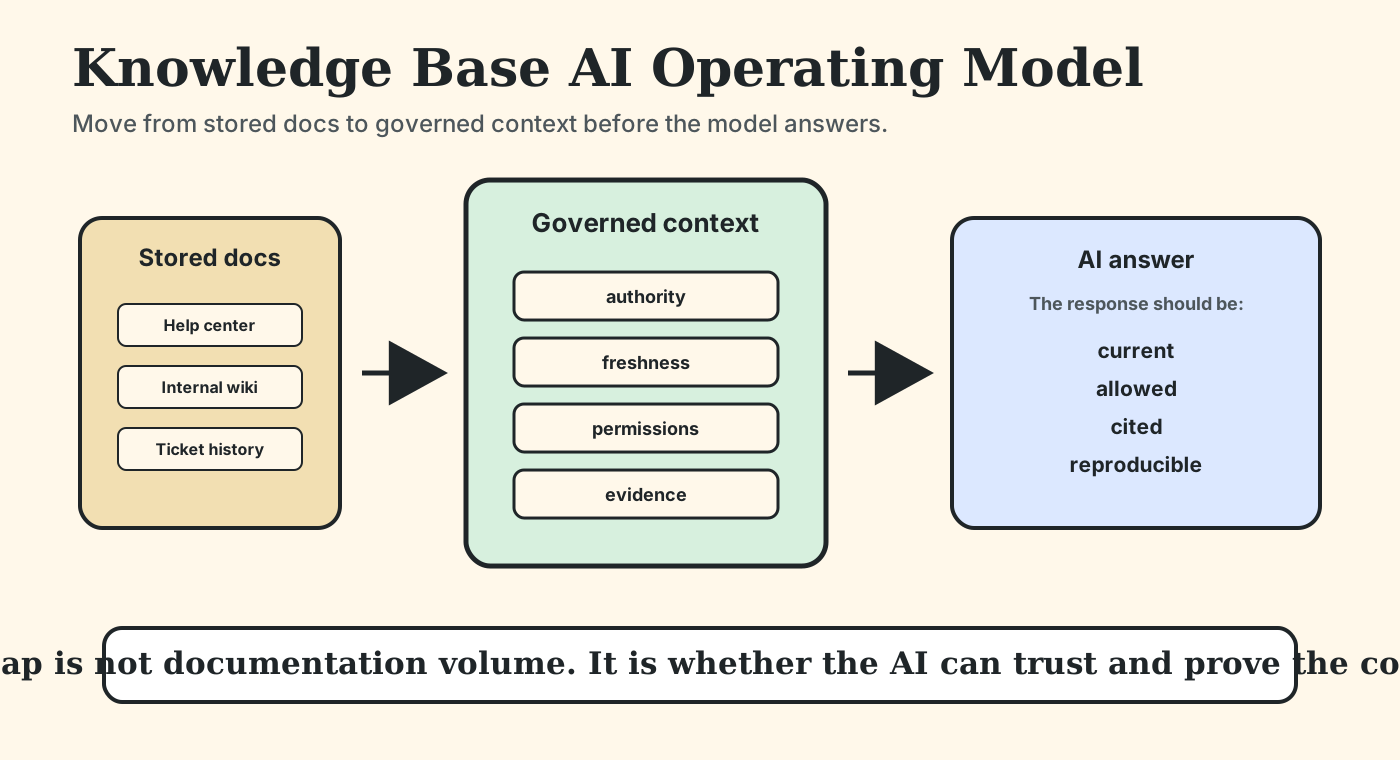
Docs solve storage. Knowledge base AI requires governed context.
What does knowledge base AI need to do in practice?
In practice, knowledge base AI needs to retrieve the right context for the right user at the right time with proof. That is the operating model leaders should expect before moving beyond a toy pilot.
Google Cloud describes retrieval augmented generation as retrieving facts about a question before generating an answer, and it frames enterprise grounding around reliable internal sources such as documents, databases, applications, and other company data. That retrieval step is useful, but it is only one part of the system.
For business use, the knowledge layer needs these controls:
| Control |
CEO translation |
What to ask before rollout |
| Source authority |
Which answer is official? |
What source wins when documents conflict? |
| Freshness |
Is the answer based on the current business state? |
How do source updates reach search, chunks, summaries, and caches? |
| Permissions |
Is the AI allowed to use this context for this person? |
Are role, tenant, customer, and sensitivity boundaries enforced before retrieval? |
| Evidence |
Can we explain the answer later? |
What receipt shows source, version, filters, and retrieved passages? |
| Escalation |
Does the AI know when not to answer? |
Which questions require human review or approval? |
This is where many AI knowledge base projects become uncomfortable. The vendor may provide search, embeddings, connectors, chat UI, or workflow tools. The company still has to decide source ownership, approval status, access boundaries, update rules, and escalation policy.
NIST's Generative AI Profile is useful for this leadership frame because it highlights lifecycle risk management, information integrity, data flows, upstream data sources, and provenance as part of responsible generative AI risk management (NIST AI 600-1).
The practical translation is simple: if AI depends on company knowledge, leaders need a way to manage where that knowledge came from, who owns it, who may use it, and how the answer can be challenged.
What does this look like in a real workflow?
Use a customer support refund workflow because the stakes are easy to see.
A customer asks:
"I was charged after cancellation. Can you refund me today?"
A weak knowledge base AI setup answers from whichever article looks most relevant. It may retrieve an old refund page, ignore the active billing record, miss a contract exception, and draft a confident answer. The customer sees a fast response. The business gets leakage, rework, and no clear explanation of why the answer happened.
An AI-ready workflow behaves differently:
- It retrieves the approved refund policy, not the closest stale page.
- It checks the customer's live billing state.
- It excludes deprecated docs and archived support macros.
- It applies the support agent's role and customer-account boundary.
- It identifies whether manager approval is required.
- It stores a receipt showing source, version, filters, customer state, and escalation reason.
The customer may still receive a simple answer. The company gets a controlled answer path.
That distinction matters across many executive workflows:
| Workflow |
Bad AI knowledge failure |
CEO-level requirement |
| Support |
Wrong refund, wrong escalation, wrong policy quote |
Current policy plus customer state plus approval rules |
| Sales |
Outdated packaging, discount promise, unsupported claim |
Approved pricing source plus segment rules |
| Customer success |
Exposure of another customer's notes |
Tenant-aware retrieval and account boundaries |
| Finance ops |
Incorrect invoice exception |
System-of-record check and approval threshold |
| Legal or compliance |
Unreviewed answer from stale policy |
Source version, reviewer, and escalation trail |
The value is not "AI can answer questions." The value is "AI can answer from the same controlled context a strong operator would check."
What should leaders require before buying or building?
Before approving a knowledge base AI pilot, leaders should require evidence that the system can survive one real workflow. Do not start with "Can it read our docs?" Start with "Can it answer this operational question with the right source, boundary, and proof?"
Use this checklist:
- Workflow owner: one accountable person owns the business workflow.
- Knowledge owner: each critical source has a team responsible for correctness.
- Source status: key content is marked as draft, approved, deprecated, archived, or experimental.
- Source hierarchy: the system knows which source wins when records disagree.
- Freshness rule: updates trigger re-indexing, re-chunking, summary refresh, or invalidation.
- Permission boundary: retrieval respects user role, workspace, tenant, customer, and sensitivity.
- Live-record check: the workflow can check systems of record when docs are not enough.
- Answer evidence: the AI response can cite sources or store an internal retrieval receipt.
- Escalation rule: high-risk, ambiguous, or exception-heavy questions move to human review.
- Failure review: the team can inspect wrong answers and fix the knowledge path, not only the prompt.
This is the minimum bar for operational trust. It does not require a giant governance program before every experiment. It does require one clear workflow where the company knows what "right" means.
The 15-minute CEO test
Run this before the next AI pilot meeting. Pick one workflow where a wrong answer would create real cost: support escalation, sales discounting, invoice exception, onboarding, compliance response, product launch, or incident triage.
Fill this out:
Workflow:
Question the AI must answer:
Business cost if the answer is wrong:
Approved source of truth:
System of record, if different:
Source owner:
Where stale or conflicting versions live:
Who is allowed to use this context:
What source the answer should cite:
What should trigger human review:
What receipt should be logged:
If the team cannot fill this out, the pilot is not blocked by a lack of AI ambition. It is blocked by an unclear knowledge path.
Do not start by tuning prompts. Do not start by comparing model benchmarks. Start by fixing the source truth, freshness, permissions, and evidence for one workflow.
For the broader operating model, read how to organize company knowledge before using AI. For the technical definition underneath this post, read what a knowledge base means in the AI agent world. For the retrieval layer that often powers this category, read RAG for CEOs.
Run the 15-minute test on one support, sales, finance, or operations workflow today. If the answer breaks at source truth, freshness, permissions, or evidence, DM Flow on X with the exact failure point. That failure point is where your company context audit should start.