Most AI rollouts do not break because the model is weak. They break because the company cannot answer a more basic question: which knowledge should the AI trust, who owns it, who is allowed to see it, when was it last validated, and what evidence should appear with the answer?
That is the context problem. If leaders do not solve it first, internal search becomes noisy, AI agents act on stale information, and teams lose confidence because nobody can trace why an answer happened.
By the end, you should be able to decide whether your company knowledge is ready for AI, and what operating model to put in place before scaling internal search, agentic workflows, or AI tools.
What this post covers
- Why AI-ready knowledge is an operating model, not a folder cleanup project.
- The five controls every company knowledge system needs before AI.
- How to organize knowledge from company source truth down to one use case.
- How to make content retrieval-ready without turning the business into a documentation bureaucracy.
- How to run a 30-minute context audit on one workflow.
Previous post: What is agentic AI?, which explains why AI needs goals, tools, context, review, and evidence before it should act.
The answer: organize knowledge around decisions, not documents
The practical recommendation is simple: organize company knowledge around the decisions and workflows it supports.
IBM defines knowledge management as identifying, organizing, storing, and disseminating information inside an organization (IBM, What is knowledge management?). That definition still matters, but AI raises the standard. A human can notice when a document looks old, ask a teammate for missing context, or ignore a questionable paragraph. An AI system will retrieve, rank, summarize, and act unless the operating model tells it what to trust.
The implication is direct: the question is not "Do we have documentation?" The better question is:
Can a person or AI system find the right source, prove it is current, respect permissions, and show evidence for the answer?
If the answer is no, the issue is not only knowledge management. It is AI readiness.
The five controls that make knowledge AI-ready
AI-ready knowledge needs five controls. These controls are tool-agnostic. They apply whether the company uses document drives, team wikis, intranet pages, data catalogs, a custom RAG system, or a managed context engine.
| Control |
Question it answers |
Failure if missing |
| Source truth |
Which source wins when documents disagree? |
AI blends stale, draft, and approved information. |
| Ownership |
Who is accountable for correctness? |
No one fixes outdated or conflicting knowledge. |
| Permissions |
Who is allowed to use this context? |
AI surfaces content the user should not see. |
| Freshness |
When was this last validated? |
Agents answer from old policies or obsolete process notes. |
| Evidence |
What should the answer cite or log? |
Teams cannot debug, audit, or explain the result. |
This is the latest practical direction across enterprise AI guidance. NIST's Generative AI Profile calls out governance, data provenance, information integrity, and lifecycle risk management as part of responsible GenAI deployment (NIST AI 600-1). Microsoft now tells Copilot customers to identify overshared, ownerless, inactive, and sensitive content before broad rollout because Copilot grounds responses in data users already have permission to access (Microsoft, secure and governed data foundation for Copilot).
That is the management lesson: AI exposes the quality of your existing knowledge controls. It does not quietly fix them.
Start with a source-of-truth map
Do not begin by moving folders. Begin by mapping the sources the business already trusts.
A source-of-truth map shows which system or document governs each important business area. It should be boring, explicit, and easy to challenge.
| Business area |
Source of truth |
Owner |
Refresh rule |
AI access posture |
| Pricing |
Pricing policy and billing system |
Revenue operations |
Review when packaging changes |
Restricted; cite approved policy |
| Customer support |
Support policy, help center, escalation rules |
Support lead |
Monthly or after policy change |
Allowed for support workflows |
| Product roadmap |
Roadmap system and PRDs |
Product lead |
Sprint or planning cadence |
Internal only; summarize carefully |
| Legal terms |
Approved legal templates and contract system |
Legal or founder |
Review on legal update |
Restricted; never invent terms |
| Engineering operations |
Runbooks, service catalog, incident history |
Engineering lead |
After every incident or architecture change |
Allowed by role and service |
This map does two things. First, it shows where knowledge lives. Second, it forces the leadership team to decide which source wins.
That second part is what most document systems avoid. They store content. They do not always resolve authority. AI needs authority.
Structure knowledge in layers
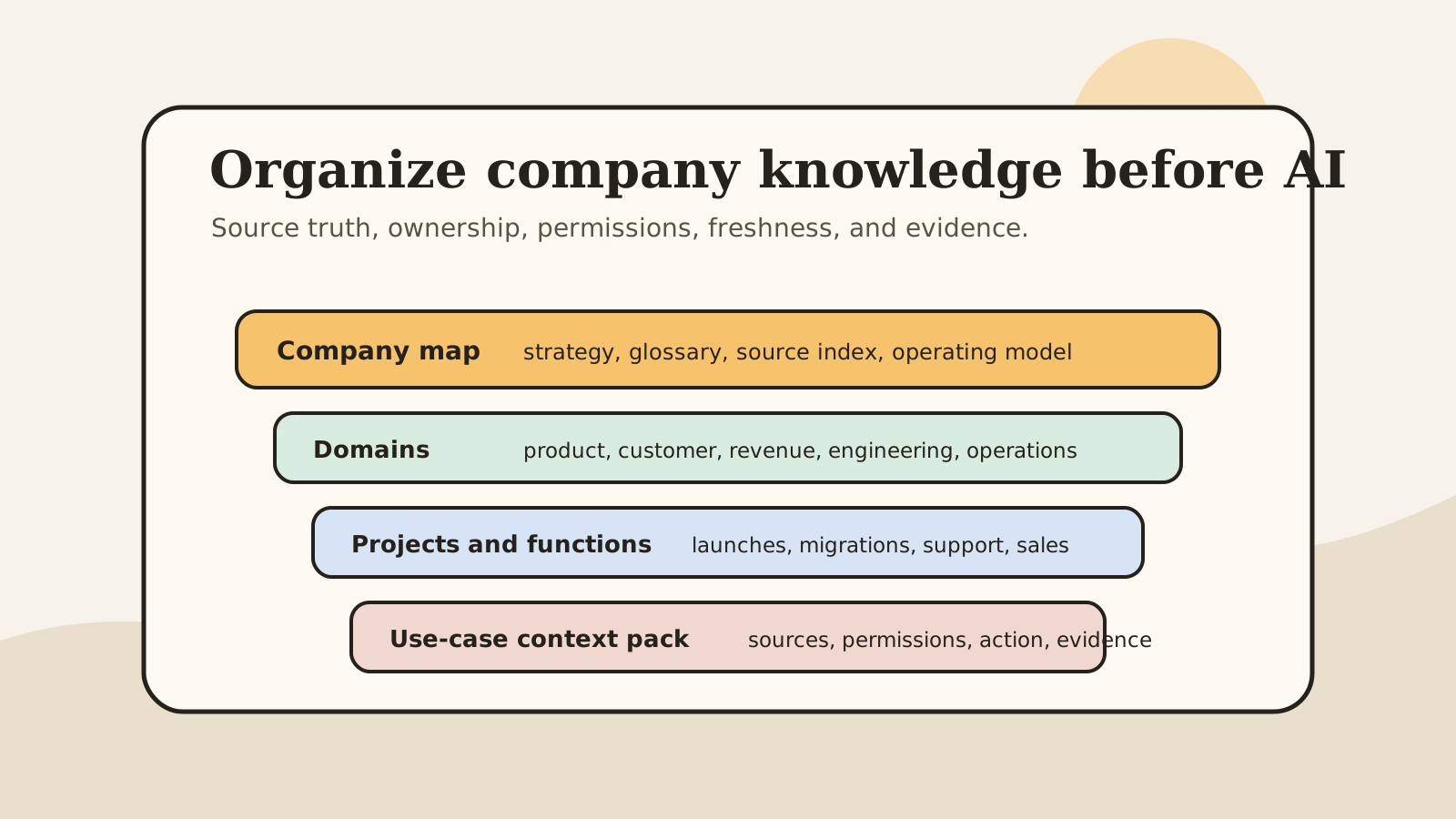
Once the source map exists, organize knowledge in layers. The layers should narrow from broad company context to a specific workflow.
Company context
  -> Domain context
  -> Function context
  -> Project context
  -> Use-case context pack
Each layer has a different job.
| Layer |
What it should contain |
What it should not contain |
| Company context |
Strategy, operating principles, glossary, org model, source-of-truth index |
Every meeting note |
| Domain context |
Product, customer, revenue, finance, legal, engineering, operations knowledge |
Temporary project chatter |
| Function context |
Team workflows, procedures, handoffs, quality rubrics, escalation paths |
Company-wide policies unless linked |
| Project context |
Scope, decisions, risks, milestones, assumptions, evidence |
Permanent knowledge without an owner |
| Use-case context pack |
The exact sources, rules, fields, permissions, and evidence needed for one workflow |
Everything remotely related |
This layered model matters because context has a cost. Anthropic describes context engineering as the work of curating what goes into the limited context window from a constantly changing universe of possible information (Anthropic, Effective context engineering for AI agents). Research on long-context models also shows that models can struggle to use relevant information when it sits in the middle of long inputs (Liu et al., Lost in the Middle).
The lesson is not "give AI more documents." The lesson is "give AI the right working set."
Make every page retrieval-ready
AI does not read a knowledge base the way a person does. It retrieves chunks, ranks passages, applies metadata filters, and assembles context for a model. That means important knowledge needs metadata that helps both search and governance.
Every important page, record, or policy should carry seven fields:
| Field |
Why it matters |
| Owner |
Someone is responsible for correctness. |
| Status |
Draft, approved, deprecated, archived, or experimental. |
| Decision governed |
The business decision this knowledge supports. |
| Scope |
Which team, customer segment, geography, product, or workflow it applies to. |
| Sensitivity |
Public, internal, confidential, regulated, customer-specific. |
| Review date |
The next date or event that should trigger validation. |
| Evidence requirement |
What an AI answer should cite, log, or show to a human. |
This is where the article's definition of context engineering becomes practical. Context engineering is not only prompt writing. It is the discipline of shaping the informational environment around an AI system: source truth, retrieval boundaries, permissions, freshness, and evidence.
OpenAI's agent guide makes a similar operating point: agents are not just model calls; they combine instructions, tools, guardrails, and handoffs to complete work safely (OpenAI, A Practical Guide to Building Agents). For a business, the knowledge layer is part of those guardrails.
Separate access from relevance
One of the easiest mistakes is to confuse "relevant" with "allowed."
A document can be highly relevant and still unsafe to use. A sales compensation plan may answer a question about pricing incentives. A legal redline may answer a question about contract terms. A customer escalation note may answer a support question. That does not mean every AI assistant should retrieve or summarize those documents.
Microsoft's Copilot guidance is useful here because it states the operational problem clearly: AI systems grounded in workplace data can surface what users already have permission to access, so organizations need to reduce oversharing, review permissions, and protect sensitive content before rollout (Microsoft, SharePoint Advanced Management for Copilot readiness).
So the operating rule should be:
Retrieval must pass two tests:
1. Is this content relevant?
2. Is this user, workflow, or agent allowed to use it?
Most teams optimize for the first test and discover the second test during rollout. That is backwards.
Build use-case context packs
The smallest useful unit is not the knowledge base. It is the use-case context pack.
A use-case context pack defines the exact knowledge an AI system needs for one workflow. It prevents the team from dumping the whole company into a retrieval system and hoping the ranking works.
Suppose the workflow is:
Help support answer a billing escalation.
The context pack should look like this:
| Pack element |
Billing escalation example |
| User intent |
Customer is disputing a charge or asking for a refund. |
| Authoritative sources |
Billing policy, subscription terms, refund rules, plan limits. |
| Live records |
Account status, invoice, payment status, plan, prior credits. |
| Permission boundary |
Support can view billing status; finance approves credits above threshold. |
| Action boundary |
AI may draft a response; AI may not issue a refund without approval. |
| Evidence requirement |
Answer must cite policy, invoice ID, and approval rule. |
| Review rule |
Escalate if amount is high, policy is unclear, or customer is enterprise. |
| Freshness rule |
Policy reviewed monthly; live account data required at answer time. |
Google Cloud uses the phrase "enterprise truth" when describing grounding generative AI in company data (Google Cloud, RAG and grounding on Vertex AI). The useful translation for leaders is this: do not ask AI to know the company. Ask it to use a controlled pack of truth for the workflow in front of it.
Keep the operating model lightweight
The risk is overcorrecting. A company does not need a six-month taxonomy project before testing AI. It needs a lightweight model that can be applied to one high-value workflow this week.
Use this rule for every workspace, folder, database, or knowledge area:
This knowledge area exists to help [role/team/agent] make [decision/workflow]
using [trusted sources], under [permission boundary], with [evidence].
Examples:
The Support knowledge area exists to help support agents resolve customer issues using approved policies, macros, escalation paths, and product limits, under role-based access, with source links in every answer.

The Product knowledge area exists to help product and engineering make roadmap and requirements decisions using customer evidence, strategy, PRDs, release history, and decision logs.

The Billing escalation context pack exists to help support draft safe customer responses using billing policy, invoice data, subscription terms, and approval rules.
That is enough structure to start. The goal is not perfect documentation. The goal is repeatable trust.
What to do today
Run a 30-minute context audit on one workflow.
Pick a workflow where an employee or AI assistant needs reliable knowledge: support escalation, sales RFP, invoice exception, product launch, onboarding, incident triage, compliance review, or research summary.
Then fill this out:
Workflow:
Decision the system must support:
Primary source of truth:
Supporting sources:
Owner:
Status of the source:
Freshness requirement:
Permission boundary:
Action boundary:
Evidence the answer must show:
Known stale, duplicated, or ownerless knowledge:
If you cannot fill this out, the company does not have a model problem yet. It has a context organization problem.
The next step is not to buy another AI tool. The next step is to make one workflow's knowledge explicit enough that a person can trust it and an AI system can use it without guessing.
If you want help applying this, run the worksheet above for one workflow and DM Flow on X with the line that was hardest to fill in. That is where your company context audit should start.