Every business owner is being told to use AI.
Retail teams hear that AI can fix inventory, customer support, staff training, and product recommendations. Law firms hear that AI can draft documents, summarize matters, review contracts, and answer client questions. Operators in finance, healthcare, insurance, real estate, and services hear the same pitch in different words.
The problem is that most of this advice starts in the wrong place.
It starts with tools. It starts with demos. It starts with "connect your files" or "automate your team." But before a business buys an AI tool, the operator needs to understand what AI is actually doing.
Key Takeaways
- Artificial intelligence in business is software that helps predict, classify, generate, or act based on patterns and instructions.
- AI is not a trusted employee, database, policy owner, or compliance system by default.
- The first useful AI question is not "which tool should we buy?" It is "what business context should AI be allowed to use?"
- Start by naming one workflow where AI would help and the sources a strong employee already checks.
This is Day 1 of a 30-day series on AI-ready company context. The goal is simple: take a non-technical operator from "we should do something with AI" to "we know what our business needs before AI can safely help."
What is AI in business?
Artificial intelligence in business is software that helps with tasks that normally require pattern recognition, judgment, language, prediction, or decision support. In plain English, AI can sort information, classify requests, draft text, summarize records, recommend actions, and sometimes use tools to complete a workflow.
That definition is intentionally boring.
AI is not magic. It is not a new employee who automatically understands your company. It is not a replacement for the source of truth in your business.
A useful way to think about AI is this:
AI takes an input, uses patterns and instructions, and produces an output.
The input might be a customer message, a contract clause, a product description, a sales note, a return request, or a store report. The output might be a summary, classification, answer, draft, recommendation, or next step.
The quality of that output depends on three things:
- What the AI model can do.
- What instructions you give it.
- What business context it can use.
Most companies obsess over the first part and ignore the third. That is why many AI pilots look good in a demo and fail in daily operations.
What can AI actually do?
AI usually helps businesses in four broad ways: prediction, classification, generation, and action support. These are not technical categories you need to memorize. They are a practical way to understand what an AI tool is promising.
| AI capability |
Plain-English meaning |
Business example |
| Prediction |
Estimate what may happen next |
Forecast which products may need reordering |
| Classification |
Sort something into a category |
Label a client intake as urgent, routine, or incomplete |
| Generation |
Create text, images, summaries, or drafts |
Draft a customer reply or matter summary |
| Action support |
Help complete a workflow |
Pull order details, check policy, and prepare a response |
Most business AI tools combine these abilities.
A retail support assistant might classify a customer message, retrieve the order, check the current return policy, and draft a reply. A law firm intake assistant might classify the matter type, check required fields, find related documents, and prepare a partner review note.
That sounds useful because it is.
But there is a catch: each useful answer depends on business context.
What is business context?
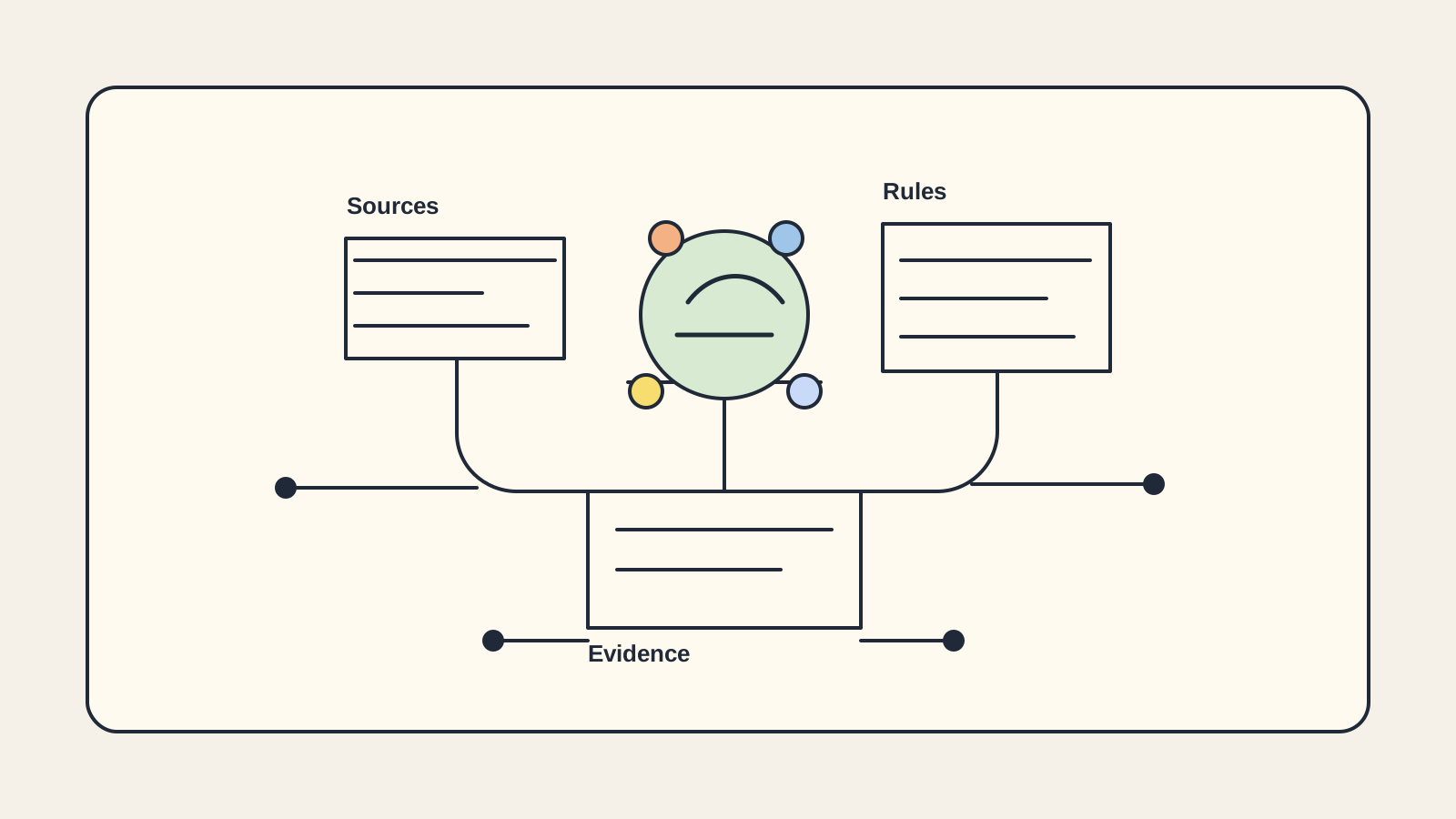
Business context is the information and rules a trained employee would check before answering or acting. It includes policies, product data, customer history, matter files, contracts, SOPs, inventory, pricing, permissions, and the small judgment rules that keep work from going wrong.
For a retail operator, business context might include:
- Product catalog
- Inventory levels
- Supplier lead times
- Return policy
- Promotion calendar
- Store SOPs
- Customer order history
- Regional rules
For a law firm, business context might include:
- Client file
- Matter type
- Engagement letter
- Contract versions
- Jurisdiction
- Prior advice
- Confidentiality rules
- Approval steps
This is the part most AI vendors rush past.
They show the AI answering a clean question from a clean document. Real work is messier. Your policy may have three versions. Your inventory may be split across systems. Your client file may contain confidential notes. Your best employee knows which source to trust. AI does not know that unless the business teaches it.
That is why the first AI project should not be "buy a chatbot." The first project should be mapping what the AI needs to know.
What AI is not
AI is easiest to misunderstand when people describe it like a person.
It can sound confident. It can write clean sentences. It can summarize a messy document. It can answer faster than a human. None of that means it understands your business the way a senior operator, store manager, partner, or compliance lead does.
For business use, treat AI with these boundaries:
- AI is not your source of truth.
- AI is not automatically current.
- AI is not automatically allowed to see every document.
- AI is not automatically correct because the answer sounds polished.
- AI is not a compliance trail unless it can show evidence.
This is not a reason to avoid AI. It is a reason to prepare the business before asking AI to make or support decisions.
The important question is not "can AI answer?"
AI can almost always answer.
The important question is "can AI answer from the right context?"
Why do AI demos feel better than real AI projects?
AI demos feel better than real AI projects because demos usually control the context. The vendor chooses the documents, the examples, the workflow, and the happy path. Real business work has stale files, missing owners, conflicting rules, permission boundaries, and edge cases.
That gap explains a lot of failed pilots.
In a demo, a retail AI assistant sees one clean return policy. In the business, it may need to know whether the product was bought online, returned in store, marked final sale, damaged in transit, or covered by a regional exception.
In a demo, a legal AI assistant summarizes one contract. In the firm, it may need to know which version is current, which client it belongs to, whether the user is allowed to see it, and whether a partner must approve the output.
The model may be strong. The tool may be well designed. But if the business context is not ready, the AI will still fail in ways that look random.
The first AI worksheet for operators
Do not start by listing every AI idea your company has.
Start with one workflow.
Use this simple worksheet:
| Question |
Your answer |
| What workflow do we want AI to help with? |
|
| What question or task comes up repeatedly? |
|
| What would our best employee check first? |
|
| What five sources decide the correct answer? |
|
| Who owns each source? |
|
| Which source changes most often? |
|
| Which source has permission or confidentiality rules? |
|
| What proof would we need if the AI gave the wrong answer? |
|
If you cannot fill this out, you are not behind. You have found the actual starting point.
This worksheet is the beginning of AI readiness.
What to do today
Pick one workflow where AI would help if it were reliable.
Do not pick the biggest workflow in the company. Pick one that is frequent, annoying, and easy to understand. A store return question. A customer support escalation. A legal intake summary. A contract status update. A policy lookup.
Then write down the five sources your best employee would check before answering.
That list is more valuable than a list of AI tools.
Tomorrow's chapter explains enterprise AI without the hype: what leaders are actually buying, why tool-first decisions fail, and how to start with the workflow outcome instead.
For a deeper technical version of this idea, read What Is a Context Engine for AI Agents?. If you want the business version, keep following this series and build the context map one day at a time.
If you want help applying this to your company, run the worksheet above and DM Flow on X with the five sources your workflow depends on.