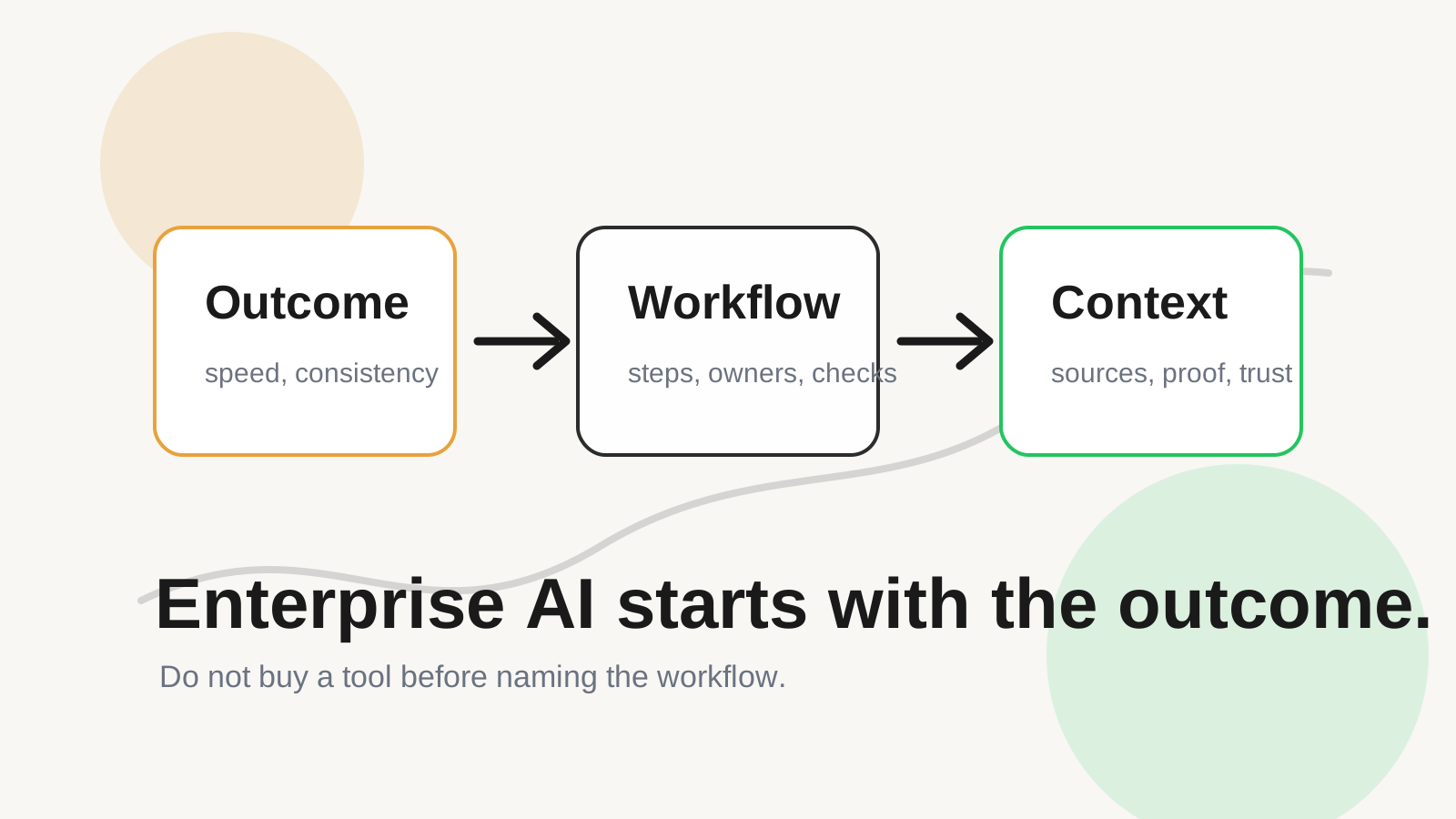
Enterprise AI sounds like a technology purchase.
In practice, leaders are usually buying something more specific: faster workflows, clearer decisions, lower operating drag, and better leverage from the information the company already has.
That distinction matters. If a founder, CEO, or operator starts with "we need enterprise AI," the conversation usually turns into tools, models, vendors, and demos. If the same leader starts with "we need this workflow to move faster without losing control," the buying decision becomes much clearer.
Key Takeaways
- Enterprise AI is most useful when it is tied to a business outcome, not a generic tool category.
- The real purchase is usually workflow speed, decision leverage, consistency, or risk reduction.
- The hard part is not only model quality. It is whether the AI has access to the right context, permissions, owners, and evidence.
- Before naming vendors, write down the outcome you want and the business sources that decide whether the answer is trustworthy.
This is Day 2 of a 30-day series on AI-ready company context. Day 1 explained what AI in business actually means: software that predicts, classifies, generates, or supports action. Today is about what companies are really trying to buy when they say they want enterprise AI.
Enterprise AI is a business capability, not a software category
Enterprise AI is the use of AI inside business workflows where reliability, permissions, evidence, and operating context matter. It is not just a chatbot, model, copilot, search tool, or automation platform. Those may be parts of the system, but they are not the business capability by themselves.
The useful question is not "which AI tool should we buy?"
The useful question is "which business capability should become faster, more consistent, or easier to operate?"
That capability might be customer support triage, contract review, sales research, claim intake, employee onboarding, inventory planning, internal policy search, or product requirement analysis. Each one has a different success condition. Each one depends on different source systems. Each one has different risks if the AI gives a confident but wrong answer.
This is why enterprise AI decisions get messy. The technology is horizontal, but the value is local. A model can generate text across many domains. A business only gets value when that output fits a specific workflow with the right facts, approvals, and boundaries.
IBM's 2025 CEO study found that CEOs see proprietary data and integrated enterprise-wide data architecture as central to generative AI value, which reinforces the point that the hard work sits around context, data, and operating integration, not only model access (IBM Institute for Business Value CEO Study 2025).
What are leaders actually buying?
Leaders are usually buying one of four outcomes: speed, consistency, decision leverage, or control. The AI tool is only the delivery mechanism. The outcome is what determines whether the purchase was worth it.
| Outcome leaders want |
What it means in plain English |
What AI needs before it can help |
| Speed |
Work moves with fewer manual handoffs |
Clear workflow steps and accessible source records |
| Consistency |
Similar questions get similar treatment |
Shared policies, examples, and review rules |
| Decision leverage |
Managers spend less time gathering context |
Trusted summaries, source links, and exception signals |
| Control |
The business can see why an answer happened |
Permissions, ownership, logs, and evidence |
This table is useful because it changes the buying conversation.
If the goal is speed, the company should inspect handoffs. If the goal is consistency, it should inspect policies and examples. If the goal is decision leverage, it should inspect the sources leaders already ask teams to compile. If the goal is control, it should inspect permissions, review points, and audit trails.
The AI vendor can help with part of this. The company still has to know which outcome matters most.
That is why "enterprise AI" should be evaluated against workflow adoption, not demo fluency. In professional services, Thomson Reuters reported that most professionals expect GenAI to become central to organizational workflow within five years, while adoption still varies across public tools, industry-specific tools, and true organizational integration (Thomson Reuters 2025 Generative AI in Professional Services Report). Deloitte's enterprise GenAI research also frames sustainable value around governance, collaboration, and iteration rather than one-time tool rollout (Deloitte, State of Generative AI in the Enterprise Q4).
Why demos make enterprise AI look easier than it is
Enterprise AI demos often look clean because the context is controlled. The demo has a defined user, selected documents, a narrow workflow, and a friendly question. Real companies have conflicting documents, stale policies, permission boundaries, incomplete records, and exceptions that depend on human judgment.
This does not mean the demo is fake. It means the demo is incomplete.
A customer support demo can show an AI assistant drafting a helpful refund response. The live business needs to know which return policy is current, whether the item is final sale, whether the customer is in a restricted region, whether a manager must approve the exception, and whether the answer should cite the policy.
A legal operations demo can summarize a contract. The live firm needs to know which contract version is current, who can see the matter, whether the summary is privileged, whether a partner must review the output, and which clause supports the answer.
The gap is not always the model. Often, the gap is the company's context layer.
The fastest way to waste an enterprise AI project is to start with tool selection. Tool-first buying encourages teams to compare features before they have defined the workflow, risk, or success condition.
An outcome-first decision sounds different:
- "We want support escalations classified before the morning queue review."
- "We want account managers to see the three facts that changed since the last customer call."
- "We want product leaders to compare customer requests against the current roadmap and known constraints."
- "We want operators to know whether an internal answer came from the current policy or an old document."
Those statements are easier to evaluate than "we need an AI agent."
They tell the team what the AI must do, what context it needs, and where a human should stay in control. They also make vendor evaluation more practical. You are no longer asking whether the product has AI. You are asking whether it can support the specific workflow with the right source truth, permissions, and evidence.
Use an outcome-first worksheet before buying enterprise AI
Before evaluating tools, write down the outcome in operational terms. This worksheet is intentionally simple. If the leadership team cannot fill it out, the project is not ready for vendor comparison.
| Question |
Your answer |
| What workflow should become faster, clearer, or more reliable? |
|
| What business outcome should improve if AI works? |
|
| Who owns the workflow today? |
|
| What does a good answer or action look like? |
|
| Which sources decide whether the answer is correct? |
|
| Which source is the system of record? |
|
| Which permissions or approvals matter? |
|
| What evidence would we need if the AI answer was challenged? |
|
| What should the AI never do without review? |
|
This worksheet does two things.
First, it turns enterprise AI from a vague investment into a business decision. Second, it exposes the context gaps that will break the project later. If no one owns the source system, if the trusted policy is unclear, or if the approval path is informal, the AI will inherit that ambiguity.
Enterprise AI readiness starts with context ownership
The companies that benefit from enterprise AI are not just the companies with access to strong models. They are the companies that can tell the model what matters, what is current, who owns it, who can see it, and what proof should appear in the answer.
That is the beginning of a company context graph.
Do not start by naming it that in a board meeting. Start with the operating problem. Map the workflow, the sources, the owners, the permissions, the freshness requirements, and the evidence trail. Once that map exists, the AI project becomes much easier to reason about.
The practical rule is simple: if a strong employee would need context before acting, the AI needs that context too.
What to do today
Pick one AI project your company is considering.
Do not list vendors yet. Write the outcome in one sentence: "We want AI to help [team] do [workflow] so that [business result] improves."
Then list the five sources that decide whether the AI answer would be trustworthy.
If the sources are unclear, stale, unowned, or permission-sensitive, you have found the real work. The enterprise AI purchase can wait until the workflow and context are clearer.
Tomorrow's chapter covers AI agents vs workflows: how to decide what should be delegated to software, what should stay deterministic, and where human review belongs.
Related: a field-engineer's take on the same problem — Enterprise AI Without the Hype: Lessons From Jet Engines.
If you want help applying this to your company, run the worksheet above and DM Flow on X with the outcome sentence and the five sources behind it. That is the start of a company context audit.