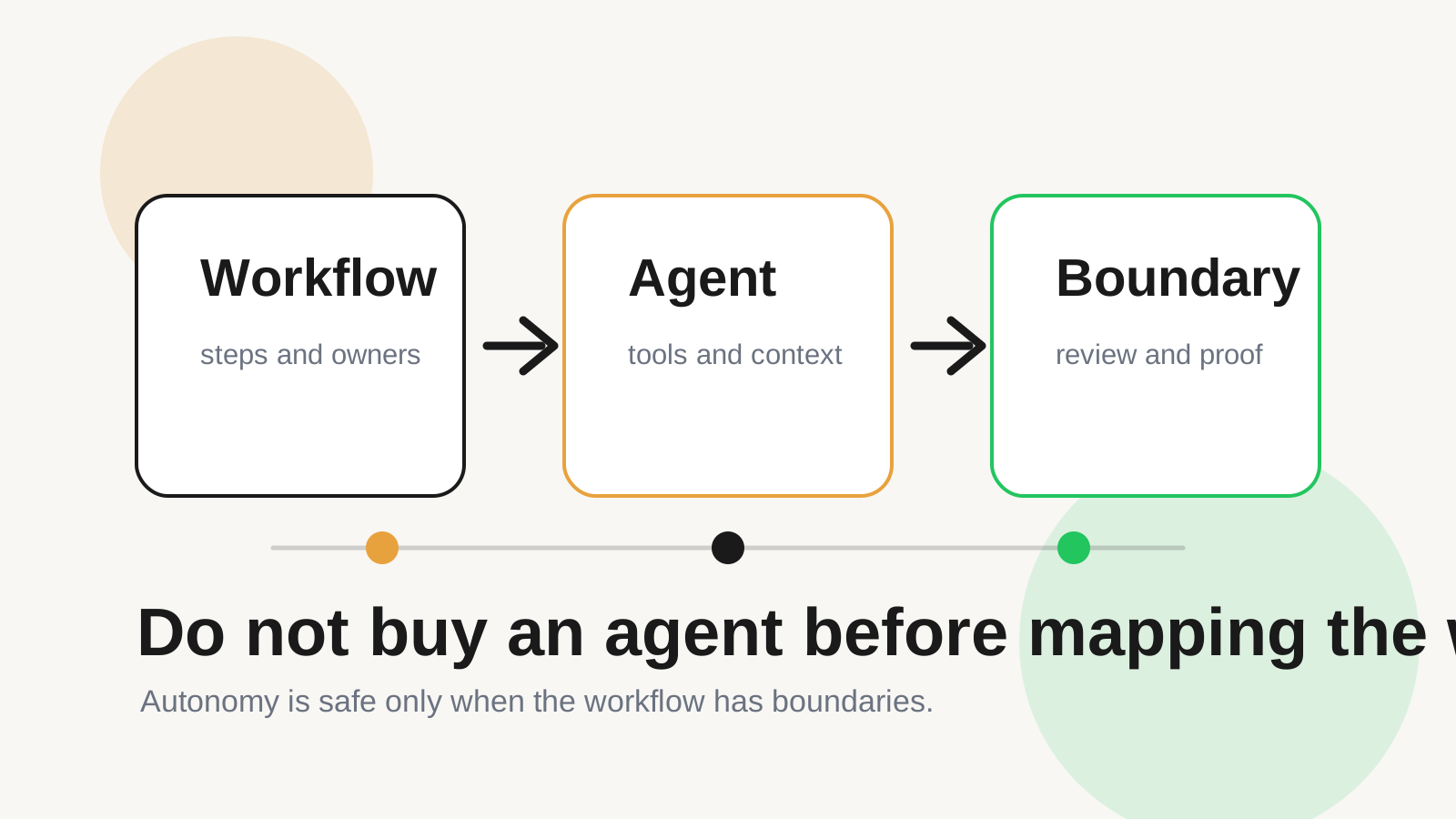
AI agents sound like a shortcut to delegation.
The founder version of the promise is simple: give software a goal, connect a few tools, and let it handle work that would otherwise need a person. That is attractive because founders are always short on time, attention, and operating leverage.
The risk is also simple: if you cannot describe the workflow, you are not ready to delegate it to an AI agent.
Key Takeaways
- AI agents are useful when software can pursue a goal through tools, context, and decisions inside defined boundaries.
- A workflow is the safer starting point because it exposes steps, inputs, owners, exceptions, and review points.
- Do not ask whether a process needs an agent first. Ask which parts are deterministic, which require judgment, and which require human approval.
- Before building or buying an agent, rewrite the idea as a workflow with goals, tools, context, boundaries, and evidence.
This is Day 3 of a 30-day series on AI-ready company context. Day 1 explained AI in business. Day 2 explained enterprise AI buying. Today is about the handoff: how to decide what should be delegated to software before calling it an AI agent.
AI agents are delegated workflows with more autonomy
An AI agent is software that can pursue a goal, reason over context, call tools, and decide what step to take next within a boundary. The important phrase is "within a boundary." Without boundaries, an agent is not leverage. It is an unpredictable operator with access to your systems.
OpenAI's agent-building guidance frames agents as systems that combine models, tools, instructions, and guardrails to accomplish tasks, with human handoff where risk or uncertainty requires it (OpenAI, A Practical Guide to Building Agents). Anthropic makes a similar distinction between workflows, where code orchestrates predefined paths, and agents, where models have more control over process and tool use (Anthropic, Building Effective Agents).
That distinction matters for founders.
If the path is known, use a workflow. If the path has legitimate variation, clear boundaries, and useful context, an agent may help. If the path is unclear, political, permission-sensitive, or full of hidden judgment, the right first step is not an agent. It is workflow design.
Most agent ideas should start as workflow maps
A workflow map is the operating plan an agent would need before doing useful work. It names the trigger, goal, steps, source systems, tools, decision points, exceptions, approvals, and proof required at the end.
This is the practical founder test: can you explain what a strong employee does before you ask software to do it?
If the answer is no, the agent will inherit the ambiguity. It may still produce an output, but the output will be hard to trust, hard to debug, and hard to scale across the team.
| Agent idea |
Workflow version |
What this reveals |
| "Build an AI sales agent" |
Qualify inbound lead, enrich account, summarize fit, draft reply, wait for approval |
Data sources, tone rules, qualification criteria, review point |
| "Build an AI support agent" |
Classify ticket, retrieve account and policy, draft response, escalate exceptions |
Permissions, current policy, refund boundaries, manager approval |
| "Build an AI ops agent" |
Monitor daily exception report, group anomalies, assign owners, prepare status note |
Source freshness, ownership, escalation rules, audit trail |
| "Build an AI product agent" |
Compare feedback against roadmap, tag themes, flag contradictions, summarize tradeoffs |
Product context, customer priority, roadmap source, decision evidence |
The workflow version is less exciting than the agent idea. It is also more useful. It shows where autonomy is safe and where the business still needs control.
The agent boundary is the real product decision
The hard question is not whether AI agents can act. The hard question is where they should stop.
LangChain's agent documentation emphasizes durable execution, human-in-the-loop control, memory, and observability as production concerns around agent systems (LangChain Agents Docs). Microsoft also describes business agents in terms of concrete work processes, such as sales, service, finance, and operations tasks, rather than abstract autonomy (Microsoft Copilot Studio agents).
For a founder, that means the boundary is a business design choice.
An agent might be allowed to draft a refund response, but not send it above a dollar threshold. It might summarize a contract, but not mark the review complete. It might enrich a lead, but not change CRM status without a rule. It might assemble a weekly operating note, but not assign blame or trigger a customer communication.
The boundary should be explicit before the agent is built.
Use the delegation map before building an AI agent
Use this worksheet before buying or building an AI agent. It forces the agent idea back into operational language.
| Question |
Your answer |
| What job do we want software to help with? |
|
| What starts the workflow? |
|
| What outcome should exist when the workflow is done? |
|
| Which steps are deterministic? |
|
| Which steps require judgment? |
|
| Which tools or systems would the agent need? |
|
| Which sources decide the correct answer? |
|
| Which actions require human approval? |
|
| What should the agent cite, log, or hand off as evidence? |
|
| What must the agent never do? |
|
If this worksheet feels hard, that is the signal. The agent idea is not ready. The workflow needs more structure.
Company context decides whether agents can be trusted
AI agents need more than instructions and tool access. They need trustworthy company context: current policies, customer records, product constraints, approval rules, permissions, and evidence.
This is where many agent projects fail quietly.
The model may reason well. The tool calls may work. The orchestration may be clean. But if the agent retrieves an old policy, misses a permission boundary, uses the wrong customer record, or cannot show why it made a recommendation, the business cannot delegate real work to it.
That is why company context is not a nice-to-have layer. It is the operating boundary for useful autonomy.
What to do today
Pick one AI agent idea your company has discussed.
Rewrite it as a workflow with five parts:
- Goal
- Trigger
- Steps
- Tools and sources
- Human review boundary
Then write one sentence that starts with: "The agent is allowed to..." and one sentence that starts with: "The agent must not..."
Those two sentences are more useful than a vendor shortlist. They tell you whether the work is ready for autonomy, where the context gaps are, and what your company context audit should inspect first.
Tomorrow's chapter explains agentic AI for CEOs: how to think about autonomy, orchestration, and control without treating agents like magic employees.
If you want help applying this to your company, run the delegation map above and DM Flow on X with the one action your agent should be allowed to take and the one action it must never take. That is a practical starting point for a company context audit.