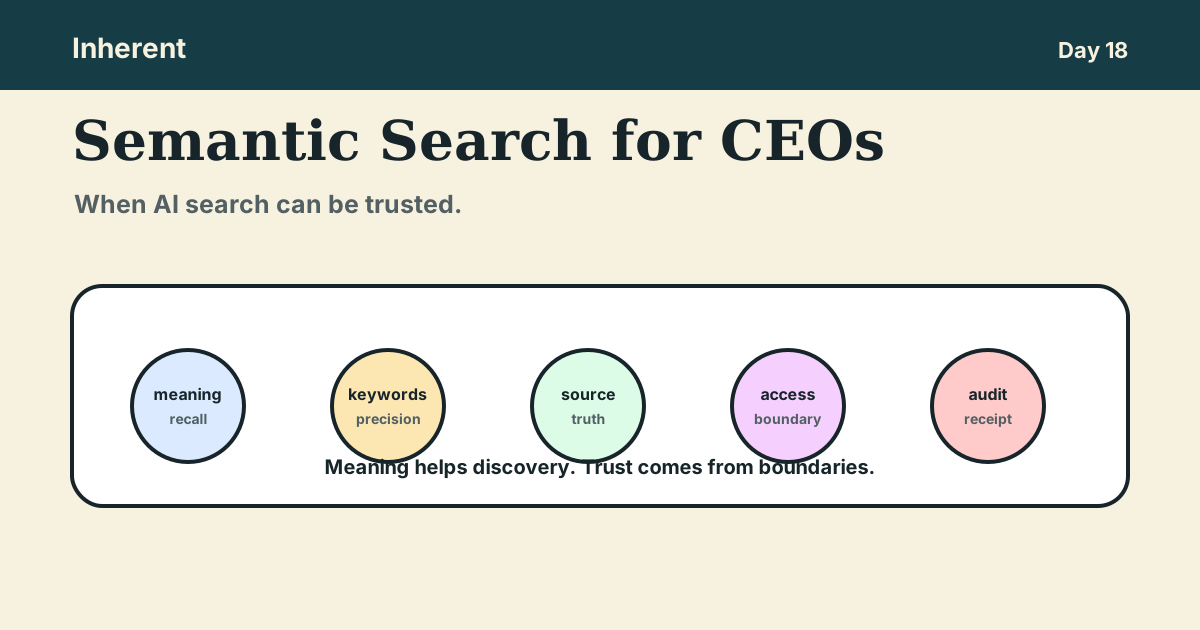
Semantic search helps AI find information by meaning, not only by exact words. That is useful when company knowledge is messy, users ask questions in plain language, and the right answer may live in a document that uses different terms.
So what: semantic search can make AI search feel smarter, but it does not make the answer trustworthy by itself. CEOs should approve semantic search only when the system also handles source truth, permissions, freshness, exact-match needs, citations, and audit.
Previous post: RAG Architecture Tradeoffs in Plain English.
For the retrieval pipeline behind this, read RAG Pipeline: A CEO Guide to Reliable AI Answers.
What this post covers
By the end, you should be able to decide when semantic search improves an AI workflow and when the business needs keyword search, hybrid search, or stronger governance around retrieval.
- What semantic search does in plain English.
- Why semantic search is not the same as trustworthy AI search.
- Where keyword search is still safer.
- Why hybrid search is usually the business default.
- What trust controls CEOs should require before launch.
- A search QA test you can run today.
Semantic search finds meaning, not just matching words
Semantic search retrieves content that is conceptually related to a query, even when the exact words do not match. In a company setting, that matters because employees rarely ask questions using the same wording as policies, tickets, contracts, or runbooks.
Elastic's semantic search documentation describes semantic search as using NLP models and vector search to find results based on meaning rather than just keywords. Microsoft's semantic ranker overview explains semantic ranking as a relevance layer that uses language understanding models to improve search results.
Technical explanation
The system turns text into representations that capture meaning. A user query such as "Can we give money back after renewal?" can match content about "refund eligibility," "billing exceptions," or "contract reversal terms" even if the document never uses the exact phrase "give money back."
Business explanation
Imagine a new support manager asking:
"What do we do when a customer wants to cancel after renewal?"
Keyword search may miss the answer if the approved policy says "post-renewal refund exception." Semantic search can bridge that language gap. That is the benefit: the AI can find useful knowledge even when the user does not know the company's exact vocabulary.
The CEO question is not "does semantic search work?" The better question is: what happens when it finds content that is relevant but not authoritative?
Better discovery is not the same as safer answers
Semantic search improves recall. It helps the system find more potentially relevant material. But business trust depends on whether the retrieved material is allowed, current, and defensible.
That difference matters. A semantic search system may retrieve:
- a persuasive sales deck instead of an approved policy,
- an old runbook that still sounds relevant,
- a private contract exception the current user should not see,
- a near-match that answers a different customer segment, or
- a broad passage that looks useful but does not prove the answer.
Those are not model problems alone. They are source truth, permission, freshness, and evidence problems.
This is where semantic search connects to RAG vs MCP: A Practical Guide. MCP can give an agent access to systems. RAG can retrieve knowledge. Semantic search can improve discovery. None of those layers replaces the need to decide which source the business trusts.
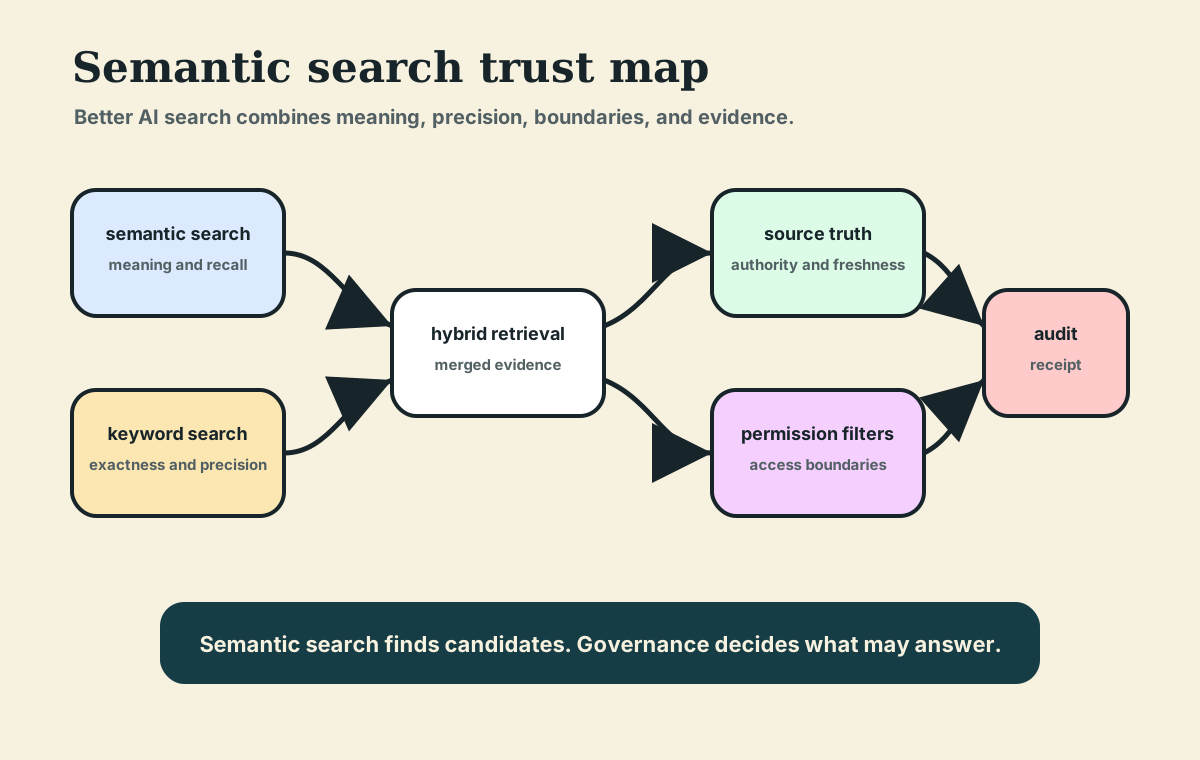
For a CEO, the operating principle is simple: semantic search can find candidates, but governance decides what may answer.
Keyword search still matters when precision matters
Keyword search is not obsolete. It is often the safer choice when exact words, IDs, names, dates, legal terms, SKUs, contract clauses, or policy codes matter.
Microsoft's hybrid search overview frames keyword or full-text search as useful for precision, while vector search helps find conceptually similar information even without keyword matches. That is the practical distinction CEOs should understand.
Use keyword-heavy search when:
- the user knows the exact document, policy, ticket, SKU, or customer ID,
- exact terms carry legal or operational meaning,
- the workflow needs deterministic filtering,
- the source system already handles lookup well, or
- a false positive would create real business damage.
Use semantic search when:
- users ask in natural language,
- documents use inconsistent wording,
- the answer may live across many long documents,
- the goal is discovery rather than exact lookup, or
- support, sales, or operations teams need to find the "closest useful policy."
The mistake is treating semantic search as a universal upgrade. It is a better discovery tool, not a replacement for exact matching, source filters, or workflow boundaries.
Hybrid search is usually the safer CEO default
For serious AI search, the practical default is often hybrid search: combine meaning-based retrieval with keyword or full-text search, then rank the combined results.
Google Cloud's hybrid search documentation explains hybrid search as combining semantic and keyword search to improve search quality. Microsoft's hybrid query guide describes hybrid search as running keyword and vector queries in a single request, then merging and reordering the results into one response.
The business reason is straightforward:
- semantic search improves recall,
- keyword search improves precision,
- filters enforce boundaries,
- ranking chooses the most useful evidence, and
- citations let humans inspect the answer.
Hybrid search is not automatically "more complex for the sake of complexity." It is often the operating compromise between user convenience and business control.
For example, a finance assistant answering "Can this customer get a credit?" may need semantic search to find the relevant policy family, keyword search to match the plan code or region, filters to enforce permissions, and citations to show the approved exception rule.
If the answer affects customers, money, policy, or compliance, the CEO should assume semantic-only search is incomplete until proven otherwise.
Semantic search fails when source truth is weak
Semantic search depends on the quality of the corpus. If the company indexes messy knowledge without ownership, the system can retrieve messy knowledge faster.
The failure mode is familiar:
- no one knows which document is authoritative,
- old versions stay indexed,
- private sources leak into broad retrieval,
- metadata is too weak to filter by region, plan, or role,
- citations point to the right-looking paragraph but not the approved rule, and
- the team cannot reconstruct why the answer happened.
That is why semantic search belongs inside a governed retrieval pipeline, not beside it. The search layer should know source authority, freshness, permissions, and evidence requirements.
This is the same operating model behind RAG Pipeline: A CEO Guide to Reliable AI Answers: source truth before retrieval, scoped memory during the workflow, and an audit receipt after the answer.
When teams skip that layer, semantic search becomes a confidence amplifier. It finds plausible context and gives the model enough language to sound useful, even when the business should have refused, escalated, or asked for a clearer query.
The CEO decision table for AI search
Use this table before approving semantic search for a real workflow.
| CEO question |
Safer search choice |
Why it matters |
| Does the user know the exact file or ID? |
Native or keyword search |
Exact lookup is simpler and more predictable. |
| Does wording vary across documents? |
Semantic search |
Meaning-based retrieval can bridge vocabulary gaps. |
| Does the answer need exact constraints? |
Keyword plus filters |
Legal terms, plan codes, and IDs need precision. |
| Does the answer affect customers or money? |
Hybrid search plus audit |
The business needs recall, precision, and traceability. |
| Are permissions or source versions risky? |
Governed retrieval layer |
Search quality is unsafe without boundaries. |
| Must the answer be defended later? |
Citations and receipts |
The team needs to reproduce what the AI saw and why. |
The goal is not to pick the most advanced search technique. The goal is to choose the smallest retrieval design that makes the answer safe enough for the workflow.
Run this search QA test today
Pick one AI search workflow your team wants to launch. Test five queries before choosing the architecture.
Workflow:
Business owner:
Consequence if the answer is wrong:

1. Exact-match query
Can the system find a known policy, customer ID, ticket, SKU, or clause?

2. Semantic query
Can the system find the right answer when the user asks in plain language?

3. Stale-source query
Does the system exclude old or deprecated content?

4. Permissioned query
Does the system hide private context from users who should not see it?

5. No-answer query
Does the system refuse or escalate when evidence is weak?

Decision:
Keyword search is enough:
Semantic search is needed:
Hybrid search is needed:
Audit receipt is required:
If this test fails, the risk is not that semantic search is bad. The risk is that the business has not defined what "trusted search" means.
The practical benchmark is simple: before AI search touches customers, money, policy, or compliance, the team should prove five things: the right answer can be found, unsafe answers are filtered, stale answers are excluded, private answers stay private, and weak evidence triggers refusal or escalation.
Inherent is built around that operating model: source truth, governed retrieval memory, and audit receipts for answers that need to be defended later.
Small action for today: run the five-query search QA test on one workflow. If you are building this yourself, DM Flow with the query type that fails first. That failure is probably the next architecture decision.