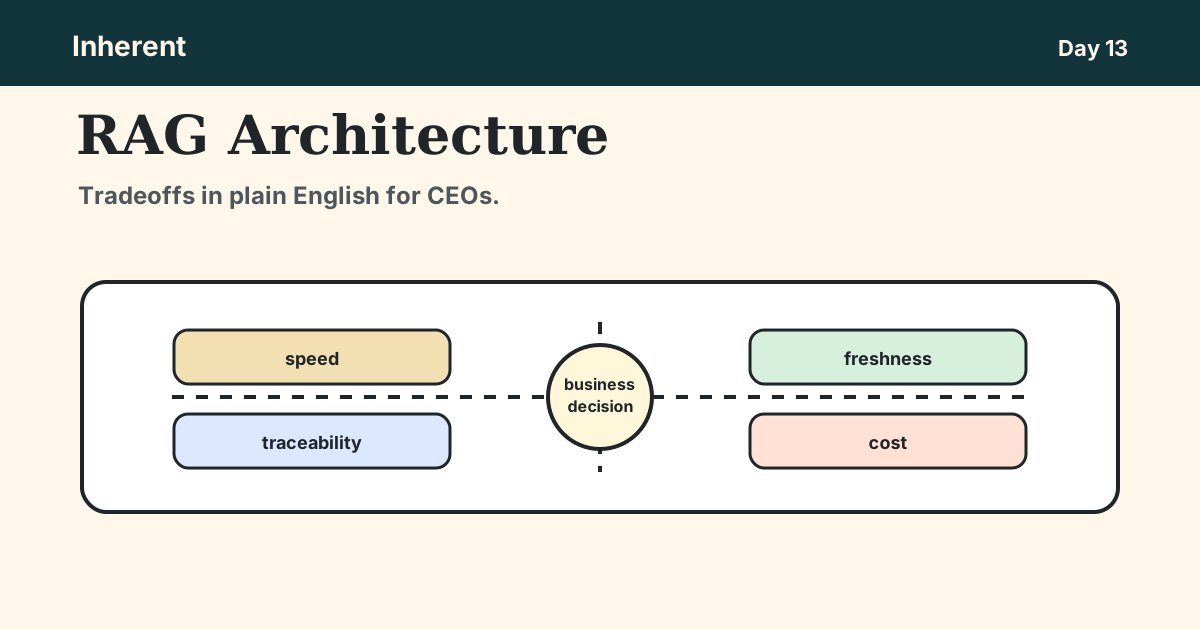
RAG architecture is not an engineering diagram a CEO can delegate completely. It is a set of business tradeoffs: how fast answers should be, how fresh the source truth must be, how much evidence the team needs, and how much complexity the company is willing to operate.
Before funding a RAG AI workflow, leaders should ask which tradeoff they are buying first. A fast internal search tool, a traceable compliance assistant, and a live customer-support copilot may all use retrieval augmented generation, but they should not have the same architecture.
By the end, you should be able to decide which RAG architecture tradeoff your business should accept first: speed, freshness, traceability, or cost.
Previous post: RAG for CEOs: What Retrieval Augmented Generation Actually Solves.
For the series starting point, read What Is AI in Business? A Plain-English Guide.
What this post covers
- Why RAG architecture is a business tradeoff, not just a technical design.
- The basic RAG architecture in plain English.
- The four tradeoffs CEOs should understand before approving production use.
- How those tradeoffs change a real support workflow.
- A one-page RAG architecture tradeoff sheet to run today.
RAG architecture is the answer path your business is willing to trust
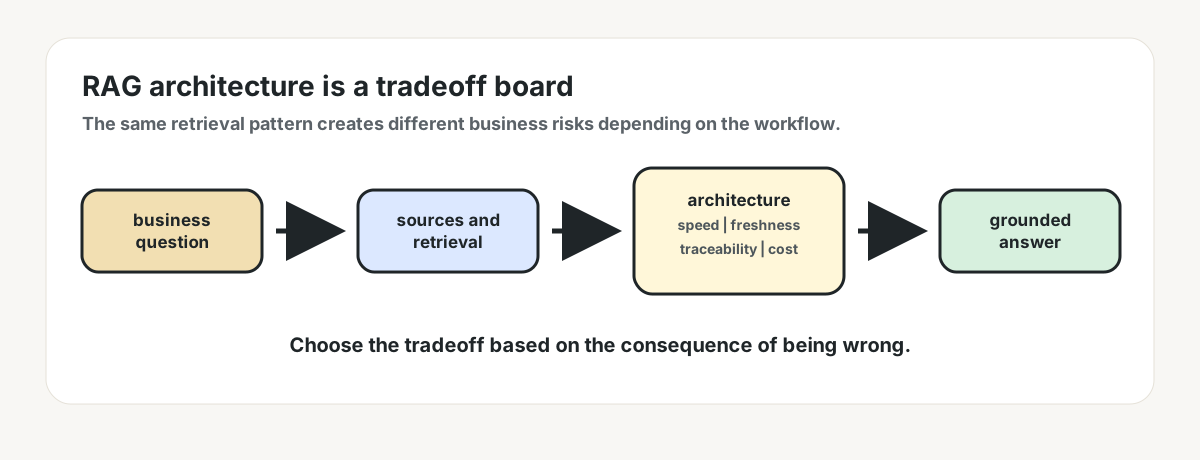
RAG architecture is the path between a business question and a grounded AI answer: source systems, ingestion, chunks, embeddings, retrieval, filters, model context, answer generation, and evidence. The original RAG paper by Lewis et al. framed retrieval augmented generation as combining a model's learned knowledge with retrieved external memory. Production RAG turns that pattern into an operating decision.
Technical explanation
A basic RAG system usually works like this: documents are ingested, split into chunks, embedded into a searchable index, retrieved for a user question, and passed to a model as context. AWS Prescriptive Guidance describes production-level RAG as broader than that simple path, including connectors, data processing, embeddings, vector databases, retrievers, guardrails, orchestration, user experience, and identity management.
Business explanation
The business question is not "do we have retrieval?" The better question is:
Which answer path are we willing to trust when a customer, employee, auditor, or executive acts on it?
That path changes depending on the workflow. A sales research assistant may prioritize speed and breadth. A refund assistant may prioritize permissions and evidence. A compliance assistant may prioritize source authority and traceability.
The same RAG architecture should not serve all three without careful boundaries.
The four CEO-level tradeoffs are speed, freshness, traceability, and cost
Most RAG architecture tradeoffs collapse into four business decisions. If the team cannot state which one matters most, architecture debates become tool debates.
| Tradeoff |
What the business gains |
What the business gives up |
| Speed |
Faster answers and lower user friction. |
Less time for verification, reranking, or live checks. |
| Freshness |
Answers reflect current policies, records, and docs. |
More ingestion, invalidation, and source ownership work. |
| Traceability |
Teams can inspect sources, chunks, filters, and decisions. |
More logging, metadata, storage, and UI complexity. |
| Cost |
Lower infrastructure and operating spend. |
Fewer checks, narrower coverage, or slower improvement loops. |
None of these choices is automatically right. The right choice depends on the consequence of a wrong answer.
If the workflow is internal brainstorming, speed may matter most. If the workflow touches customers, money, policy, or regulated knowledge, traceability and freshness usually move up the list.
Speed is valuable only when the answer is allowed to be lightweight
Fast RAG architecture works when the answer does not need heavy verification. That might be an internal knowledge lookup, a product-doc search, or a low-risk drafting assistant. The system can retrieve a few relevant chunks, generate a short answer, and show citations without checking many live systems.
The risk is that speed can hide weak source quality.
A fast answer from an outdated policy is not operational leverage. It is a faster way to create the wrong decision. For CEOs, the question is simple: would a fast but partially wrong answer create real business damage?
If the answer is no, optimize for speed. If the answer is yes, the architecture needs more controls.
Freshness matters when source truth changes faster than the index
Freshness is the gap between the source of truth and the retrieval index. If policies, account records, prices, permissions, or product states change often, a stale RAG pipeline can give confident answers from old context.
Microsoft's Azure AI Search guidance emphasizes content preparation, retrieval, grounding, governance, and access control for RAG systems. That matters because a RAG system is only as current as the context it is allowed to retrieve.
For a CEO, freshness is not an embedding issue. It is an ownership issue:
- Who owns the source?
- How quickly do changes reach the index?
- Which stale versions are excluded?
- Who is accountable when the answer uses old context?
If nobody owns those answers, the architecture is not production-ready.
Traceability is the price of using RAG in serious workflows
Traceability means the team can reconstruct why an answer happened: source documents, chunks, versions, retrieval filters, permissions, timestamps, and the final response. This matters when the AI influences a customer answer, an internal policy decision, or a workflow handoff.
Without traceability, teams debug only the final answer. They cannot tell whether the problem came from bad ingestion, bad retrieval, missing permissions, prompt truncation, or model behavior.
This is where RAG architecture connects to production RAG needing truth and memory. The business needs source truth before the answer, scoped memory during the workflow, and an audit receipt after the answer.
Traceability adds complexity. It is still the tradeoff leaders should choose when an answer must be defensible.
A real support workflow shows the tradeoff
Imagine a customer asks:
"Can you refund the renewal charge from yesterday?"
A speed-first RAG architecture retrieves the most relevant refund article and drafts a reply. It feels efficient, but it may miss the customer's contract exception, the latest billing state, or the support agent's approval limit.
A freshness-first architecture checks the current policy and live account state before answering. It is safer, but slower and harder to operate.
A traceability-first architecture logs the policy version, customer record, permission filter, retrieved chunks, and answer. It may add UI and storage complexity, but the team can explain what happened later.
A cost-first architecture narrows the source set and reduces checks. It may be fine for internal search, but risky for customer-facing decisions.
The CEO decision is not "which RAG architecture is best?" It is "which tradeoff matches the consequence of being wrong?"
Use this RAG architecture tradeoff sheet
Run this before approving a RAG system for a live workflow.
Workflow:
Who uses the answer:
Who is affected if the answer is wrong:

Primary tradeoff to optimize:
speed / freshness / traceability / cost

Speed:
Maximum acceptable answer time:
Can the answer be partial or draft-only:

Freshness:
Sources that must be current:
Maximum acceptable staleness:
Source owner:

Traceability:
What evidence must be logged:
Who can inspect the receipt:
How would the team replay a bad answer:

Cost:
What checks can be deferred:
What sources can be excluded:
What risk does that introduce:

Decision:
Architecture tradeoff we accept first:
Architecture tradeoff we will not compromise:
If the team cannot fill this in, do not start by choosing a vector database or a framework. Start by naming the business risk.
What should you do today?
Pick one RAG workflow your company is considering: internal search, support copilot, sales research, finance exception handling, onboarding, or policy lookup.
Write one sentence:
In this workflow, we will optimize for ___ first, but we will not compromise on ___.
That sentence will make the architecture discussion sharper immediately.
If you want a structured review of source truth, freshness, permissions, evidence, and cost for one AI workflow, run a company context audit.