By the end, you should be able to decide whether an AI initiative has a real RAG pipeline or only a demo path.
- What a RAG pipeline does in plain English.
- Why CEOs should care about source truth before models.
- How ingestion, chunking, and retrieval shape business risk.
- Why freshness, permissions, and evidence belong in the launch gate.
- A practical RAG pipeline decision table.
- A retrieval path map you can run with your team today.
A RAG pipeline is the answer path, not the vector database
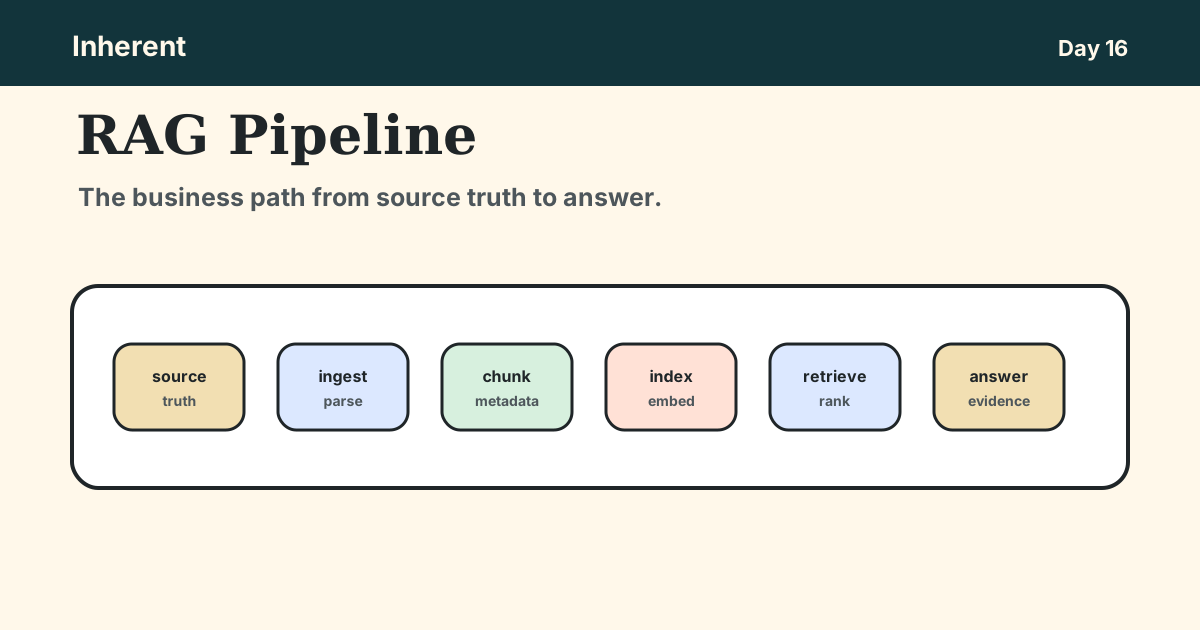
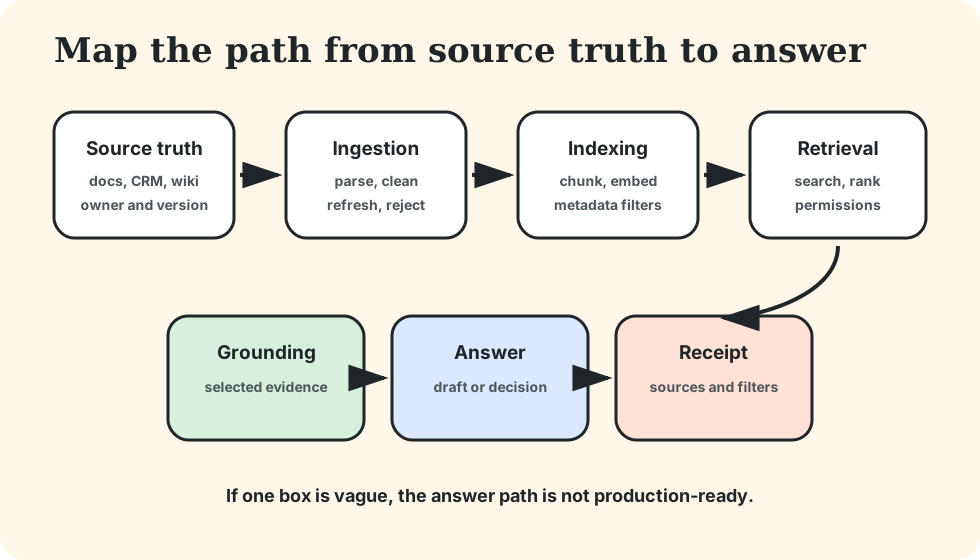
A RAG pipeline is the sequence that prepares company knowledge, retrieves the right context, and gives the model enough evidence to answer. It usually includes source selection, ingestion, parsing, chunking, embedding or indexing, retrieval, ranking, grounding, generation, and evidence.
AWS describes retrieval augmented generation as a way for a model to reference an authoritative knowledge base outside its training data before generating a response. Microsoft's Azure AI Search RAG overview emphasizes content preparation, indexing, retrieval, grounding, and access control as parts of the system.
Technical explanation
Documents or records enter the pipeline from systems such as Google Drive, Confluence, product docs, support articles, contracts, or databases. The system parses the content, splits it into chunks, creates searchable representations, stores metadata, retrieves matching context for a query, and passes selected evidence to the model.
Business explanation
Imagine a support copilot answering:
"Can we refund this customer?"
The answer depends on the current refund policy, customer tier, region, contract exception, billing state, and approval threshold. If the pipeline indexed an old policy, skipped account metadata, or retrieved the wrong exception, the model can sound confident and still be wrong.
The implication for a CEO is direct: the issue is not whether the AI can generate an answer. The issue is whether the business can trust the path that produced it.
Source selection is a CEO-level risk decision
The first decision is not the model. It is which company sources are allowed to influence business answers.
Use source selection to answer:
- Which systems are authoritative?
- Which sources are draft, deprecated, or low trust?
- Who owns each source?
- How often does each source change?
- Which permissions must survive retrieval?
Ingestion is the operating process that brings those sources into the retrieval system. Google's RAG Engine overview frames the process around data ingestion, indexing into a corpus, and retrieval when a user asks a question. That high-level flow is useful, but leadership still needs to define the business rules behind it.
For example, a public docs site may be stable but incomplete. A contract folder may be authoritative but sensitive. A support macro may be useful but not approved policy. A sales deck may explain positioning but should not answer legal or billing questions.
Those differences belong in the launch requirements. If leadership does not define source authority, engineering will often connect whatever content is easiest to access.
Chunking and indexing turn documents into business behavior
Chunking is not only an engineering detail. It changes which facts the AI can see.
Microsoft's chunking guidance explains that large documents are subdivided so portions can be matched independently, often with vectorization for semantic search. The business implication is straightforward: the chunk is often the unit of evidence the AI sees.
If chunks are too small, they can lose context. If they are too large, retrieval may return broad passages that bury the answer. If metadata is weak, the system may retrieve relevant but unsafe content. If document versions are not tracked, the model may cite stale truth.
CEOs do not need to design chunking logic, but they should ask:
- What counts as one piece of evidence?
- Does the system preserve headings, sections, tables, or page hierarchy?
- Which metadata is required for filtering?
- How are stale or deprecated passages excluded?
- What evidence will a human see when the answer matters?
The customer experience later is shaped here. A weak chunking and indexing strategy usually appears as a business problem: irrelevant answers, missing citations, inconsistent trust, or support teams refusing to rely on the AI.
Retrieval quality decides whether the AI earns trust
The retrieval stage decides what context reaches the model. That is why leaders should define retrieval success before launch.
At minimum, retrieval quality depends on:
- whether the right source is included,
- whether the right passage is retrieved,
- whether filters enforce permissions and freshness,
- whether ranking prefers authoritative evidence, and
- whether citations show enough context for a human to trust the answer.
Pinecone's RAG overview frames RAG around retrieval from authoritative external data to improve model output. The leadership lesson is not "choose a vector database." The lesson is that retrieval must consistently bring the model the right evidence for the workflow.
Before launch, ask the team to show test questions for:
- easy questions with exact-match answers,
- ambiguous questions where the system should ask for clarification,
- stale-source questions where old content must be excluded,
- permissioned questions where private content must not appear, and
- no-answer questions where the system should refuse or escalate.
If those cases are not tested, "the demo worked" becomes the launch gate. That is not a safe operating standard.
Freshness, permissions, and evidence are launch requirements
A RAG pipeline is not production-ready until it handles freshness, permissions, and evidence.
Freshness answers: how quickly does source truth reach retrieval?
Permissions answer: who is allowed to retrieve which context?
Evidence answers: can the team explain why the answer happened?
AWS Bedrock Knowledge Bases positions RAG around connecting foundation models to company data sources so responses can use up-to-date and proprietary information. That business promise depends on the pipeline keeping source changes, metadata, and access boundaries intact.
For low-risk internal search, a simple pipeline may be enough. For workflows involving customers, money, policy, regulated knowledge, or operational decisions, the pipeline needs a stronger control model.
That is where Inherent's framing matters: source truth before retrieval, scoped memory during the workflow, and an audit receipt after the answer. The business does not need to expose every technical detail, but the system should be able to reconstruct the path.
The practical RAG pipeline decision table
Use this table before approving a retrieval workflow.
| CEO question |
Pipeline decision |
Risk if vague |
| Which sources may answer this workflow? |
Source authority and ownership |
The system retrieves relevant but unofficial content. |
| How does content enter and update? |
Ingestion and freshness |
The AI answers from stale documents. |
| What counts as evidence? |
Chunking and metadata |
The model sees fragments without enough context. |
| How is the best context selected? |
Retrieval, filters, and ranking |
The answer is plausible but unsupported. |
| What happens when evidence is weak? |
Fallback and escalation |
The model guesses instead of stopping. |
| How do we debug the answer? |
Citations and retrieval receipts |
The team cannot reproduce why the answer happened. |
The point is not to turn CEOs into retrieval engineers. The point is to make hidden retrieval choices explicit before customers, employees, or auditors depend on the answer.
Run this retrieval path map today
Pick one AI workflow that will use company knowledge and map the path before choosing tools.
Workflow:
Business owner:
Consequence if the answer is wrong:

Source truth:
Which systems are allowed to answer?
Which sources are draft, deprecated, or low trust?
Who owns each source?

Ingestion:
How does content enter the pipeline?
How often does it update?
How are stale versions removed?

Retrieval:
What should count as evidence?
Which filters enforce permissions and freshness?
What test questions prove retrieval quality?

Answer:
What should the model cite?
When should it refuse, ask, or escalate?
What receipt should the team keep?
If this map is blank, the risk is not technical complexity. The risk is that nobody owns the path from source truth to answer.
The practical benchmark is simple: for any AI answer that touches customers, money, policy, or compliance, your team should be able to name the source owner, update path, permission boundary, evidence artifact, and escalation rule.
Inherent is built around that operating model: source truth, managed retrieval memory, and audit receipts for answers that need to be defended later.
Small action for today: choose one planned AI workflow and draw the retrieval path from source system to answer. If you are building this yourself, DM Flow with the one box that is hardest to fill. That box is probably where the production risk lives.
Next read: RAG Architecture Tradeoffs in Plain English.