Key takeaway: Pinecone and Inherent are not the same layer. Pinecone is an excellent managed vector database — it stores and searches embeddings fast. Inherent is managed context infrastructure — it owns the work before and after search: ingestion, freshness, deterministic retrieval, and audit. Choosing between them is the wrong question. The real question is whether you want to own the context pipeline around a vector store, or buy it.
If you are searching for a "Pinecone alternative," you are usually not unhappy with vector search. You are unhappy with everything around it: documents that changed but still return the old chunk, the same query returning different context on two runs, and no way to prove to a customer or auditor why the AI answered the way it did.
So the decision is not "which vector database wins." It is: is your production problem storage and similarity search, or is it the context system that feeds and governs that search? Pick the layer that matches the consequence of being wrong.
Previous post: RAG vs MCP: A Practical Guide. For the architecture frame, read RAG Architecture Tradeoffs in Plain English.
What this post covers
By the end, you should be able to decide whether your next build needs a vector database, a managed context layer, or both — and stop comparing tools that live on different layers.
- What Pinecone actually is, described fairly.
- What Inherent is, and why "context engine" is a different layer than "vector database."
- Where the two overlap, and where they do not.
- The three failure modes a vector database alone does not solve: stale context, non-deterministic retrieval, and missing audit.
- A build-vs-buy worksheet for the context layer.
- A concrete next step you can run today.
Pinecone is a managed vector database, and a very good one
Start with a fair description, because comparison content that strawman's the incumbent is worthless to a technical buyer.
Pinecone is a fully managed vector database. You send embeddings in, choose a distance metric, and it handles indexing, replication, scaling, and query optimization (Pinecone). Its serverless architecture decouples compute from storage, so you skip pod sizing and capacity planning and pay for variable workloads (Pinecone Serverless). It supports metadata filtering evaluated inside the query rather than after it, plus namespaces to segment one index into logically separate partitions (Pinecone Docs, namespaces vs metadata filtering).
That is a strong product. If your problem is "I have embeddings and I need low-latency similarity search at scale," a managed vector database is the right buy, and Pinecone is a credible default.
The point of this post is not that Pinecone is weak. It is that a vector database is one band in a taller stack — and most production RAG pain lives in the bands above and below it.
Inherent is a context engine, which is a different layer
Inherent is not a faster index. It is managed context infrastructure that sits above vector storage and below your orchestration. Its job is the pipeline a vector database assumes you already built: managed ingestion, deterministic retrieval, and an immutable audit trail.
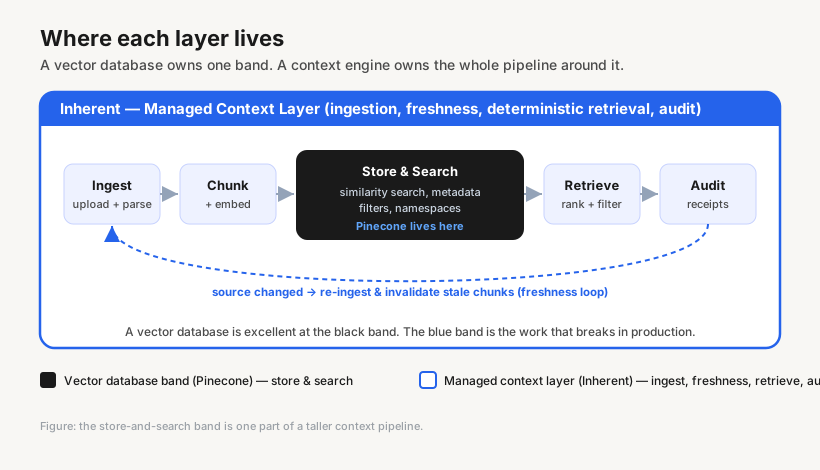
The distinction matters because of what breaks in production. A vector database answers "which vectors are nearest this query." It does not decide which document is the current source of truth, re-process a file the moment it changes, enforce which tenant may see which chunk, or hand you a receipt showing exactly which sources and chunks shaped an answer. Those are context problems, not search problems.
Put simply: RAG is a technique; AI memory is an architecture. The vector store is the storage primitive. The context engine is the operating system around it.
Where they overlap, and where they do not
They overlap on exactly one band: storing embeddings and running similarity search. Everything else is different work.
| Concern |
Pinecone (vector database) |
Inherent (context engine) |
| Store embeddings + similarity search |
Core product |
Uses a vector store underneath |
| Metadata filtering, namespaces |
Yes, mature |
Yes, plus tenant-safe boundaries by default |
| Managed ingestion (parse, chunk, re-process on change) |
You build and operate it |
Managed |
| Freshness / invalidation when a source changes |
Your responsibility |
Managed |
| Deterministic retrieval (same docs + query → same context) |
Not guaranteed by the store alone |
Design goal |
| Audit trail / retrieval receipts |
Not its job |
Immutable audit log |
| What you operate |
The index, plus the whole pipeline around it |
The API |
The honest read: Pinecone does its band extremely well and does not claim to do the others. Inherent takes ownership of the full band so you ship the product feature instead of rebuilding the plumbing. Margin is in the product, not the plumbing.
The three failure modes a vector database alone does not solve
If you have run RAG in production, you have met at least one of these. None of them are fixed by a faster or cheaper index.
Stale context. A policy PDF changed on Tuesday. The embedding for the old version is still in the index, so the agent confidently answers from last week's rule. A vector database stores what you gave it; keeping it current is your ingestion job. This is the stale context tax — the hidden cost of unmanaged retrieval state.
Non-deterministic retrieval. The same question returns different supporting context on two runs — because of re-embedding drift, index updates mid-flight, or ranking that is not reproducible. For a demo that is a shrug. For a regulated workflow it is a defect, because you cannot reproduce why the answer happened.
No audit. A customer asks why the AI told them they were eligible for a refund. Your team cannot show which document, which chunk, which version, and which permissions produced that answer. Similarity search returns vectors; it does not return a receipt. Every answer needs a receipt.
The pattern across all three: the failure looks like a model hallucination but starts upstream, in the context layer. Debug the context before blaming the model.
A build-vs-buy worksheet for the context layer
Do not pick a tool first. Score your workflow, then choose the smallest layer that makes the answer trustworthy.
| Question |
If yes → |
Implication |
| Do you only need similarity search over embeddings you already manage? |
Vector database |
A managed index (Pinecone or similar) is enough. |
| Do sources change often and must never answer stale? |
Context engine |
You need managed ingestion + invalidation, not just storage. |
| Must the same query reproduce the same context? |
Context engine |
Determinism is a pipeline property, not an index feature. |
| Will a customer, auditor, or regulator ask "why did it answer that?" |
Context engine |
You need retrieval receipts and an immutable audit trail. |
| Are you rebuilding ingestion/chunking/embedding for every project? |
Context engine |
Buy the pipeline; spend your time on the product. |
| Do you have the team to operate ingestion, freshness, and audit yourself? |
Vector database + your own pipeline |
Build is viable if you will own the operational load. |
If you checked mostly the top row, buy a vector database. If you checked the context-engine rows, a faster index will not save you — the work you are avoiding is the work that breaks.
The bottom line
Inherent is not a "Pinecone alternative" in the way "cheaper index" implies. It is the layer most teams accidentally rebuild around a vector database: ingestion, freshness, deterministic retrieval, and audit. If your problem is storage and search, use a vector database. If your problem is trustworthy, reproducible, provable context, you need the layer above it.
Small action for today: take one AI workflow and mark, for each of the three failure modes — stale context, non-deterministic retrieval, missing audit — whether your current stack solves it or you are quietly hoping it will not come up. That five-minute test tells you which layer you actually need.
If those failure modes are live in your product, start with the Inherent Public API (early access) and wire deterministic, auditable retrieval into one workflow: get started in the docs. Prefer to map the problem before you build? Book a company context audit and we will trace one workflow's source truth, retrieval path, permissions, and evidence together.
Next read: Production RAG Needs Truth and Memory.