Key takeaway: pgvector and Inherent are not the same level of abstraction. pgvector is an excellent open-source Postgres extension — it adds vector storage and similarity search to a database you already run. Inherent is the managed context pipeline that sits around that store: ingestion, freshness, deterministic retrieval, and audit. The decision is not "which is better." It is build-vs-buy: do you want to operate the context pipeline yourself, or buy it?
If you are searching for a "pgvector alternative," you are usually not unhappy with the extension. pgvector does its job. You are unhappy with the weeks of pipeline you had to build around it — the ingestion jobs, the re-embedding on every document change, the tenant isolation, the audit logging — and the fact that you now have to keep all of it running in production.
So the real question is not "pgvector or something else." It is: is your remaining problem vector storage, or is it the pipeline that feeds and governs that storage? Pick the level of abstraction that matches the work you actually have left.
Previous post: Inherent vs Pinecone: Vector Database or Managed Context Layer?. For the architecture frame, read RAG Architecture Tradeoffs in Plain English.
What this post covers
By the end, you should be able to decide whether your next build needs a vector extension you operate, a managed context pipeline you buy, or both — and stop comparing tools that live at different levels of the stack.
- What pgvector actually is, described fairly.
- What Inherent is, and why a "context pipeline" is a different level of abstraction than a "vector extension."
- Where the two overlap, and where they do not.
- The real build-vs-buy math: what you own when you choose pgvector alone.
- The three failure modes a vector extension alone does not solve: stale context, non-deterministic retrieval, and missing audit.
- A build-vs-buy worksheet for the context layer, and a concrete next step you can run today.
pgvector is a Postgres extension, and a very good one
Start with a fair description, because comparison content that strawman's the incumbent is worthless to a technical buyer.
pgvector is an open-source extension that adds a vector data type to PostgreSQL, so you can store embeddings in the same database as your relational data and query them with SQL (pgvector). It supports exact and approximate nearest-neighbor search, the three distance metrics you actually use — L2, inner product, and cosine — and two index types, IVFFlat and HNSW, for trading recall against speed (pgvector indexing). Because it is "just Postgres," you get transactions, joins, backups, and access control you already understand, with no new datastore to run (PostgreSQL extensions).
That is a strong choice. If your problem is "I have embeddings and I want them next to my relational data without adopting a separate vector database," pgvector is a credible default and often the right one.
The point of this post is not that pgvector is weak. It is that a vector extension is one primitive — storage and search — and most production RAG pain lives in the pipeline you have to build around that primitive and then operate forever.
Inherent is a context pipeline, which is a different level of abstraction
Inherent is not a faster index or a hosted Postgres. It is managed context infrastructure that sits above vector storage and below your orchestration. Its job is the pipeline a vector extension assumes you already built and will keep running: managed ingestion, deterministic retrieval, tenant-safe boundaries, and an immutable audit trail.
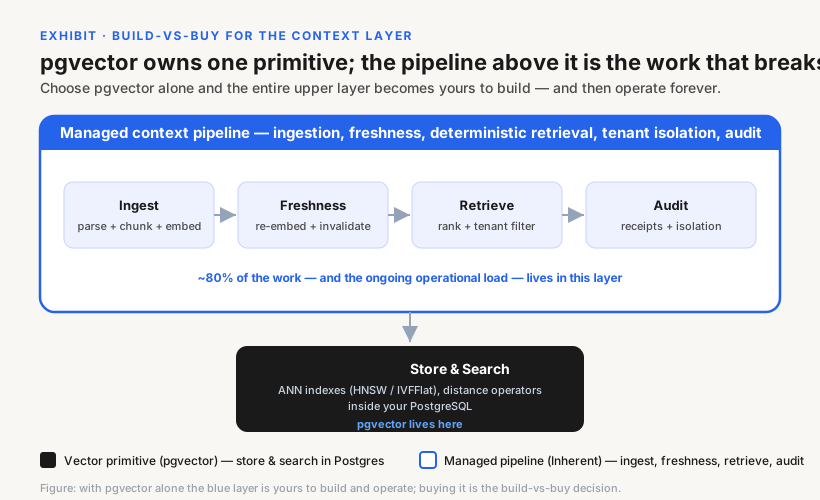
The distinction matters because of what you sign up to operate. pgvector answers "which vectors are nearest this query, inside my Postgres." It does not decide which document is the current source of truth, re-process a file the moment it changes, enforce which tenant may see which chunk, or hand you a receipt showing exactly which sources and chunks shaped an answer. Those are pipeline problems, not storage problems — and with pgvector alone, all of them are yours.
Put simply: pgvector gives you the table; the context pipeline is the operating system around it. Or, in the framing from the strategy work: comparing pgvector to Inherent is like comparing a SQL table to a data warehouse — same raw capability at the bottom, very different level of abstraction on top.
Where they overlap, and where they do not
They overlap on exactly one primitive: storing embeddings and running similarity search. Everything else is different work — and most of it is work you would otherwise operate yourself.
| Concern |
pgvector (Postgres extension) |
Inherent (context pipeline) |
| Store embeddings + similarity search |
Core feature |
Uses a vector store underneath |
| Distance metrics, ANN indexes (HNSW/IVFFlat) |
Yes, mature |
Yes, managed under the hood |
| Managed ingestion (parse, chunk, re-process on change) |
You build and operate it |
Managed |
| Freshness / invalidation when a source changes |
Your jobs, your cron |
Managed |
| Multi-tenant isolation |
You build it yourself |
Workspace isolation by default |
| Deterministic retrieval (same docs + query → same context) |
Not guaranteed by the store alone |
Design goal |
| Audit trail / retrieval receipts |
You build it yourself |
Immutable audit log |
| What you operate |
Postgres, the extension, and the whole pipeline around it |
The API |
The honest read: pgvector does its primitive extremely well and does not claim to do the others. Inherent takes ownership of the full pipeline so you ship the product feature instead of rebuilding — and then babysitting — the plumbing. Margin is in the product, not the plumbing.
The real build-vs-buy math: what you own with pgvector alone
pgvector's headline advantage is that it is "free and already in your database." That is true for the extension. It is not true for the system you need in production. The cost moved; it did not disappear.
When you choose pgvector alone, you are quietly signing up to build and then permanently operate: an ingestion service that parses and chunks every source format; an embedding pipeline that re-runs whenever a document changes; invalidation logic so stale chunks stop being returned; row-level or schema-level isolation so tenant A never retrieves tenant B's data; and an audit log that can reconstruct why any given answer was produced. The internal rule of thumb from our own competitive work: ingestion, chunking, multi-tenancy, and audit are roughly 80% of the work — and none of it is the part pgvector does for you.
Technical view: the extension is a storage-and-search primitive. Production RAG is a pipeline with at least six stages — upload, parse, chunk, embed, retrieve, audit. pgvector owns one. Your team owns the other five, plus the operational load of keeping them running, versioned, and observable.
Business view: imagine a support-automation feature. pgvector will happily return the nearest chunks to a customer's question. But when a refund policy PDF is updated on Tuesday, your ingestion job has to notice, re-embed, and invalidate the old chunks — or the agent quotes last week's policy. When a customer asks "why did the AI tell me I qualified," your audit log has to prove which document and version answered. Build is a real option — but only if you will own that operational load, not just the first commit.
The three failure modes a vector extension alone does not solve
If you have run RAG on pgvector in production, you have met at least one of these. None of them are fixed by a better index or a bigger Postgres instance.
Stale context. A policy PDF changed on Tuesday. The embedding for the old version is still in the table, so the agent confidently answers from last week's rule. pgvector stores exactly what you inserted; noticing the change and refreshing it is your ingestion job. This is the stale context tax — the hidden cost of unmanaged retrieval state.
Non-deterministic retrieval. The same question returns different supporting context on two runs — because of re-embedding drift, an index rebuild mid-flight, or ranking that is not reproducible. For a demo that is a shrug. For a regulated workflow it is a defect, because you cannot reproduce why the answer happened.
No audit. A customer asks why the AI told them they were eligible for a refund. Your team cannot show which document, which chunk, which version, and which permissions produced that answer. A SELECT ... ORDER BY embedding <=> query returns rows; it does not return a receipt. Every answer needs a receipt.
The pattern across all three: the failure looks like a model hallucination but starts upstream, in the context pipeline. Debug the context before blaming the model.
A build-vs-buy worksheet for the context layer
Do not pick a tool first. Score your workflow, then choose the smallest level of abstraction that makes the answer trustworthy.
| Question |
If yes → |
Implication |
| Do you only need similarity search over embeddings, next to relational data you already manage? |
pgvector |
The extension is enough; keep vectors in Postgres. |
| Do sources change often and must never answer stale? |
Context pipeline |
You need managed ingestion + invalidation, not just a table. |
| Must the same query reproduce the same context? |
Context pipeline |
Determinism is a pipeline property, not an index feature. |
| Will a customer, auditor, or regulator ask "why did it answer that?" |
Context pipeline |
You need retrieval receipts and an immutable audit trail. |
| Do you serve multiple tenants who must never see each other's data? |
Context pipeline |
You need isolation by default, not row-level rules you maintain. |
| Do you have the team to build and operate ingestion, freshness, isolation, and audit? |
pgvector + your own pipeline |
Build is viable if you will own the ongoing operational load. |
If you checked mostly the top row, pgvector is a fine buy — keep it. If you checked the context-pipeline rows, a better index will not save you: the work you are avoiding is the work that breaks, and then the work you maintain at 2am.
The bottom line
Inherent is not a "pgvector alternative" in the way "swap one index for another" implies. It is the pipeline most teams accidentally build around pgvector — ingestion, freshness, deterministic retrieval, tenant isolation, and audit — and then have to run forever. If your problem is vector storage next to your relational data, keep pgvector. If your problem is trustworthy, reproducible, provable context at production scale, you need the layer above it.
Small action for today: take one AI workflow and mark, for each of the three failure modes — stale context, non-deterministic retrieval, missing audit — whether your current pgvector setup solves it or you are quietly hoping it will not come up. Then add a fourth mark: who on your team operates the fix when it does. That five-minute test tells you whether you are choosing an extension or signing up to run a pipeline.
If those failure modes are live in your product, start with the Inherent Public API (early access) and wire deterministic, auditable retrieval into one workflow instead of rebuilding the pipeline: get started in the docs. Prefer to map the problem before you build? Book a company context audit and we will trace one workflow's source truth, retrieval path, permissions, and evidence together.
Next read: RAG vs MCP: A Practical Guide.