A RAG ingestion pipeline is the system that turns source documents into retrievable, permission-aware context for a retrieval-augmented generation application. It selects sources, parses content, enriches metadata, chunks documents, creates embeddings, writes indexes, and records enough lineage to debug the answer later.
The important word is "system."
In a prototype, ingestion is often a notebook.
In a deployment, that notebook becomes an operational service. It has retries, version checks, permissions, owner mappings, failed-document queues, index health, drift alerts, and rollback paths.
Databricks' RAG data pipeline guide breaks the pipeline into corpus selection, preprocessing, chunking, embedding, indexing, and storage. That sequence is useful, but it is not enough for a customer environment unless every step is observable and repeatable.
My rule for FDEs is simple: if you cannot replay how one answer got its context, the ingestion pipeline is not production-ready.
Why do forward deployed engineers hit ingestion first?
Forward deployed engineers hit ingestion first because customer knowledge changes in place. The model call is usually stable. The source estate is not. Documents move, owners change, permissions drift, scanned PDFs appear, tables break, and the customer's definition of the authoritative source changes after the first workshop.
That is the field reality.
The customer does not care that your demo retrieved the right chunk last week. They care that today's answer reflects today's policy, today's contract, and today's access boundary.
When you are deployed with the customer, the failure reports arrive as product questions:
- Why did the agent use the old onboarding guide?
- Why did it ignore the new pricing page?
- Why did it cite a duplicate PDF?
- Why can this team see another team's notes?
- Why can nobody prove where the answer came from?
Those are ingestion questions before they are LLM questions.
Anyscale's RAG ingestion guidance puts it bluntly: a retrieval system cannot find information that is missing or wrong. It recommends update pipelines for time-sensitive domains and quality controls before indexing. That maps exactly to the FDE job: keep the customer source of truth current enough to trust.
Why does the normal RAG ingestion pipeline break in production?
The normal RAG ingestion pipeline breaks in production because it assumes documents are clean, static, globally readable, and semantically chunkable with one strategy. Real enterprise sources are none of those. The breakage is usually silent until retrieval quality or governance fails in front of a user.
There are five common breaks.
First, source freshness is invisible. A document changes but the old chunks stay live. Users see a confident answer from retired policy.
Second, parsing quality is uneven. IBM's RAG cookbook notes that non-text documents, PDFs, repeating headers, columns, and tables complicate ingestion before embedding even begins. In the field, this is where "the model hallucinated" often means "the parser lost the row header."
Third, chunking is treated as universal. Databricks says chunking has no one-size-fits-all answer, and arbitrary fixed-size chunks rarely hold up for production-grade applications. Legal agreements, implementation guides, tickets, API docs, and tables need different boundaries.
Fourth, permissions are applied too late. If access rules only live at the UI layer, retrieval can still assemble context the user should not receive.
Fifth, there is no receipt. The system can show the answer but not the source version, chunk ID, permission filter, retriever settings, or model call that produced it.
What should managed ingestion track?
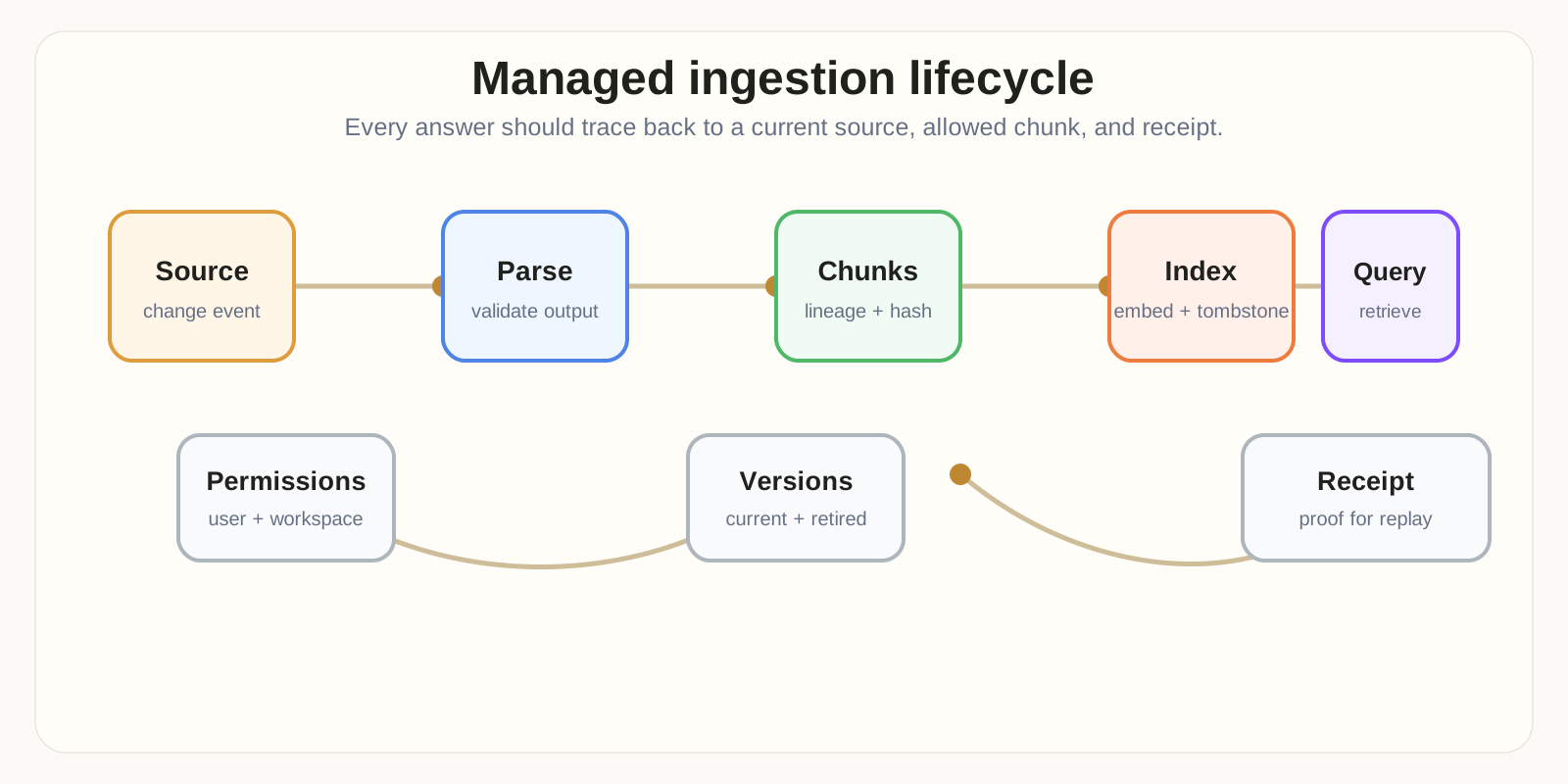
Managed ingestion should track source identity, version, parser output, chunk lineage, embedding model, permission scope, index state, and retrieval receipts. The goal is not to store more metadata for its own sake. The goal is to make each answer traceable back to allowed, current source material.
Here is the minimum metadata I expect:
- Source system and connector.
- Canonical document ID.
- Source owner or owning workspace.
- Content hash or source version.
- Last modified time and last indexed time.
- Parser used and parser status.
- Chunk strategy and chunk IDs.
- Parent document relationship.
- Embedding model and embedding timestamp.
- Permission scope at document and chunk level.
- Index collection, namespace, or tenant.
- Deprecation and tombstone state.
Databricks recommends storing raw source data in a target table for preservation, traceability, and auditing. That is the right instinct even if your stack is not Databricks. Keep the source record. Keep the parsed record. Keep the chunk record. Keep the retrieval record.
Without that chain, you cannot distinguish a stale-source problem from a parser problem, a chunking problem, a retriever problem, or a generation problem.
How should an FDE debug stale embeddings?
An FDE should debug stale embeddings by tracing one wrong answer backward from response to retrieved chunk, chunk to source version, source version to connector event, and connector event to the current customer system. Do not start by changing the prompt. Start by proving whether the retrieved context was current.
Use this order:
- Capture the exact user question and workspace.
- Pull the retrieval receipt for that answer.
- Inspect the chunk IDs and parent document IDs.
- Compare chunk content hash with current source content hash.
- Check whether the source emitted an update event.
- Check whether the parser succeeded on the new version.
- Check whether old chunks were tombstoned.
- Check whether the vector index contains both old and new chunks.
- Re-run retrieval with the same filters and retriever settings.
The key is to preserve the failed state long enough to inspect it.
If your only remediation is "reindex everything," you do not have managed ingestion. You have a batch job with hope attached. Reindexing everything may unblock the customer, but it does not tell you why the system missed the update.
What does a production-ready ingestion loop look like?
A production-ready ingestion loop detects source changes, fetches the current document, parses it, validates extraction quality, chunks it by structure, embeds only valid chunks, applies permission metadata, tombstones replaced chunks, updates the index, and records an audit event for every state transition.
The loop should look closer to this:
NVIDIA's continuous ingestion blueprint uses an event-driven pattern: object storage emits upload events, a consumer retrieves files, sends them for processing, and indexes them into the vector database. You do not need to copy that exact stack, but the shape is right. Source change should become ingestion work automatically.
The detail FDEs should add is governance.
Every step needs a state:
seen: source changed.fetched: current source captured.parsed: text and structure extracted.validated: extraction quality accepted.chunked: chunk lineage created.scoped: permissions attached.embedded: embeddings created with model version.indexed: retriever can see the chunks.retired: old chunks cannot be retrieved.receipted: the system can prove the transition.
That state machine is more valuable than another prompt template.
When should you build this yourself?
Build managed ingestion yourself when source authority, permissions, tenant boundaries, audit requirements, or document structure are core to the customer outcome. Buy or use managed components when the problem is generic parsing, connector coverage, OCR, vector storage, or batch orchestration.
The build-versus-buy line is not "do we like infrastructure?"
It is whether the ingestion rules encode customer-specific truth.
Build the logic that decides:
- Which source wins when two systems conflict.
- Which document owner can approve a source.
- Which chunks must be invalidated after a source update.
- Which permissions travel from document to retrieval.
- Which audit receipt is required before an answer is trusted.
Buy or reuse the commodity parts:
- File connectors.
- OCR and layout extraction.
- Embedding infrastructure.
- Vector storage.
- Queue infrastructure.
- Job retries and scheduling.
The best FDEs do not hand-roll everything. They own the parts where field knowledge becomes production policy.
What is the 10-minute managed ingestion audit?
The 10-minute managed ingestion audit is a fast way to find the weakest point in a production RAG system. Pick one critical answer, trace its source path, and check whether the system can prove freshness, permissions, chunk lineage, and retrieval evidence without relying on a human's memory.
Run this with the customer in the room.
- Choose one answer that must be correct.
- Identify the authoritative source.
- Change a harmless sentence in that source.
- Watch whether the connector detects the change.
- Confirm the parser captured the changed text.
- Confirm old chunks were retired.
- Confirm new chunks inherited permissions.
- Ask the agent the same question again.
- Inspect the retrieval receipt.
- Verify the final answer cites the current source.
If step 9 is impossible, that is the first fix.
Do not start with a grand ingestion platform. Start by making the next wrong answer explainable.
FAQ
Is managed ingestion different from a vector database?
Yes. A vector database stores and searches embeddings. Managed ingestion controls how source content becomes those embeddings, which versions stay active, which permissions attach, and which receipts prove the system used current context. The vector database is one component inside the managed ingestion loop.
What belongs in an ingestion receipt?
An ingestion receipt should capture the source ID, source version, content hash, parser status, chunk IDs, embedding model, permission scope, index write, tombstoned chunks, and timestamp. A retrieval receipt should then connect the answer back to those active chunks.
How often should a RAG ingestion pipeline reindex?
Reindex based on source change, not a fixed calendar alone. Some sources need event-driven indexing, some need scheduled polling, and some need manual approval before publication. Track source version and content hash so unchanged documents do not create duplicate chunks.
What is the first thing to instrument?
Instrument retrieval and ingestion receipts first. For every important answer, capture the source document, source version, chunk IDs, permission filters, retriever settings, model call, and timestamp. Receipts turn vague quality complaints into debuggable engineering work.
What to do next
Take one customer answer that feels unreliable and trace it backward.
If you cannot name the current source version, parser output, active chunk IDs, permission filter, and retrieval receipt, the work is not prompt tuning. The work is managed ingestion.
For the broader architecture, read What Is a Context Engine for AI Agents?. For the source-truth layer underneath it, read What is a Knowledge Base in the AI Agent World?.