Key takeaway: Inference engineering interviews test whether you can reason from two physical constraints (compute-bound prefill, memory-bandwidth-bound decode) plus memory capacity, cost, and failure handling. Memorized vLLM flags score nothing. The ten questions below are grouped by the constraint they probe. Each comes with what the interviewer is actually checking, an answer skeleton, and the trap. The decision this post helps you make: which of the five areas you are weakest in, and which deep dive to read before the loop.
Inference engineering interview questions have converged on a short list of physics-based problems, even though job postings list a long stack of tools. Together AI's "LLM Inference Frameworks and Optimization Engineer" posting asks for vLLM, SGLang, TensorRT-LLM, or TGI, CUDA or Triton, quantization, GPU scheduling, "deep understanding of KV cache systems" like PagedAttention, MoE and tensor parallelism, and speculative decoding. Interviewers rarely quiz that list item by item. They pick one question that forces first-principles reasoning, and listen for whether your answer changes with the workload: a short chat, a long document, a batch job. Tools change every few months; the physics does not, so that is what gets scored.
Previous post: Tensor vs Pipeline Parallelism: Splitting Models Across GPUs.
What this post covers
By the end you should be able to: (a) explain why prefill and decode need different hardware, (b) size a KV cache and explain what PagedAttention fixes, (c) rank cost levers by risk and name what MoE and reasoning models break.
- Where the role came from and what the loop probes
- Prefill compute (Q1, Q2)
- Decode memory bandwidth (Q3, Q4)
- KV cache capacity (Q5, Q6)
- Cost and quality tradeoffs (Q7, Q8)
- Systems ownership and failure handling (Q9, Q10)
An inference engineer is paid to fight two bottlenecks, so that is what the loop tests
The role runs trained models in production: the engine and the serving layer, "from CUDA to Kubernetes" in Gergely Orosz's phrase, and it excludes training. His March 2026 Pragmatic Engineer piece notes that three years earlier this work sat almost entirely inside frontier labs; now every company serving an LLM at scale needs someone who owns it.
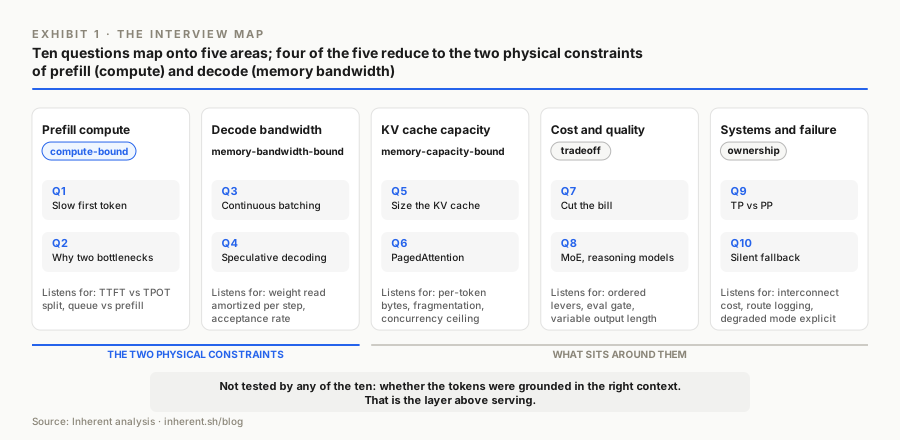
The interview format borrows from infrastructure hiring: systems design, performance debugging, and a coding round on CUDA/Triton kernels or scheduler logic. Every question maps to one of five areas: prefill compute, decode bandwidth, KV cache capacity, cost and quality, systems and failure. Four of the five trace back to one split.
Technical explanation: prefill processes every prompt token in parallel across every layer and saturates FLOPS. Decode produces one token per step and must stream the weights (or active experts) from HBM each step, so memory bandwidth sets the limit. Batching, quantization, parallelism, and KV cache sizing are all decisions about which side of that split you are optimizing.
Business explanation: a company pays for this role because the per-token bill and the latency users feel are both set by how well these constraints are managed; the installed framework matters far less. A bad hire means GPUs bought for the wrong bottleneck: FLOPS-heavy chips for decode-bound chat, bandwidth-heavy hardware for prefill-heavy documents. That mistake is a wasted capital commitment with a multi-year depreciation schedule.
Prefill compute decides how fast the first token arrives
Q1. A user says the model takes forever to start responding. Walk me through what you check.
What they are testing: whether you separate TTFT (time-to-first-token) from TPOT (time-per-output-token), and check queueing before compute.
Answer skeleton:
- Split TTFT from TPOT; they have different causes.
- TTFT = queue wait + prefill time + first-token delivery.
- Check the prompt length distribution; long prompts inflate prefill time.
- Prefix caching removes repeated work when requests share a prefix.
- Tensor parallelism only if prefill compute, not queueing or length, is the bottleneck.
The trap: buying more GPUs when the real problem is queue depth or prompt length.
Go deeper: Inference Engineering: TTFT, TPOT, and Two Clocks
Q2. Why is prefill compute-bound and decode memory-bound? What does that imply for hardware choice?
What they are testing: the core asymmetry that explains almost every other serving decision.
Answer skeleton: prefill processes all prompt tokens in parallel through every layer, saturating FLOPS. Decode generates one token per step and must read the full weights (or active experts) from HBM each step, so bandwidth, not compute, is the limit (Pope et al. 2022). Implication: FLOPS-heavy chips help prefill, bandwidth helps decode, and disaggregating the two phases lets you match hardware to each.
The trap: saying "more FLOPS makes everything faster," which ignores the bandwidth ceiling on decode.
Go deeper: Prefill and Decode: Why One Model Has Two Bottlenecks
Decode bandwidth decides how many tokens per second one GPU can produce
Q3. Explain continuous batching. Why does it raise throughput, and what does it do to per-request latency?
What they are testing: understanding that batching amortizes the weight read across requests during decode.
Answer skeleton: static batching waits for the slowest sequence to finish before starting the next batch. Continuous (iteration-level) batching, introduced by Orca (Yu et al., OSDI 2022), admits and retires requests every decode step, so the weight read is shared across more tokens per step. Throughput rises with batch size until KV cache or compute saturates. Per-request TPOT gets slightly worse as batch size grows, and naming that tradeoff is the point.
The trap: claiming batching is free for latency; it is a throughput-latency tradeoff.
Go deeper: Continuous Batching Is How One GPU Serves a Crowd
Q4. How does speculative decoding produce identical outputs while running faster? When does it fail to help?
What they are testing: whether you understand the rejection-sampling step underneath "a small model helps a big model."
Answer skeleton: a small draft model proposes several tokens; the target model verifies all of them in one parallel forward pass. Accepted tokens plus the resampled token on rejection reproduce the target's output distribution exactly (Leviathan et al. 2023), so output matches running the target alone. Speedup depends on the acceptance rate and on how cheap the draft is per token. It fails when the draft is misaligned, when batches are already large enough that compute is the limit, or on outputs the draft cannot predict.
The trap: describing it as "a smaller model answers and the big one checks the meaning," when verification checks token probabilities.
Go deeper: Speculative Decoding: Faster Tokens, Identical Answers
KV cache capacity decides how many users fit on one GPU
Q5. Size the KV cache for a given model and context length. What decides how many concurrent users one GPU can serve?
What they are testing: whether you can do the arithmetic and connect it to a concurrency ceiling.
Answer skeleton:
- Per token: KV size = 2 (K, V) x layers x kv_heads x head_dim x bytes per element.
- Multiply by context length to get KV size per request.
- (GPU memory minus weights minus activation workspace) / KV size per request = the concurrency ceiling.
- GQA/MQA cut kv_heads, KV quantization cuts bytes per element, paged allocation cuts fragmentation waste (Kwon et al. 2023).
The trap: sizing only the model weights and forgetting the KV cache grows with every token generated, for every concurrent request.
Go deeper: The KV Cache Is Your Concurrency Ceiling
Q6. What problem does PagedAttention solve, and what does it cost?
What they are testing: whether you know it is a memory management fix rather than a speed fix.
Answer skeleton: before PagedAttention, systems allocated KV cache contiguously per request and reserved the maximum possible sequence length up front, which wasted memory to fragmentation. Paged blocks allocate on demand through a block table, the way virtual memory works for an operating system. The cost is indirection in the attention kernel and block-table overhead; it also enables prefix sharing across requests.
The trap: saying "it makes attention faster," when it makes memory usage more efficient at a small indirection cost.
Go deeper: The KV Cache Is Your Concurrency Ceiling and The Serving Layer Sets Your RAG Latency Floor
Cost and quality tradeoffs decide whether your answer survives a budget review
Q7. We need to cut the inference bill by a lot without changing the model. Order your options and name the quality risk of each.
What they are testing: whether you can rank levers by risk instead of jumping straight to the most aggressive one.
Answer skeleton: raise utilization first, through batching and right-sized replicas; near-zero quality risk. Add prefix caching, also close to free. Move to weight quantization, INT8/FP8 first, INT4 only with an eval gate, since accuracy risk grows as precision drops. Consider KV cache quantization for the same reason. Add model routing for requests that do not need the largest model. Every step past caching needs an eval gate.
The trap: jumping straight to INT4 with no evaluation because it is the biggest number on paper.
Go deeper: Quantization Is the Cheapest Way to Cut Your Inference Bill and Model Routing and Fallbacks Without Silent Degradation
Q8. How do MoE models and reasoning models each break the assumptions behind your serving plan?
What they are testing: whether your mental model includes what shipped since the dense, fixed-output models of 2023.
Answer skeleton: MoE models activate only a fraction of parameters per token, so compute is cheap, but every expert still has to be resident in memory, so the footprint is expensive; imbalanced expert load also hurts batching. Reasoning models choose their own output length, so cost and TPOT-dominated latency become variable per request; a plan built on fixed output tokens is wrong for this class of model.
The trap: quoting the active-parameter count as if it were the memory footprint.
Go deeper: Mixture of Experts: Cheap to Compute, Expensive to Hold and Test-Time Compute: The Model Decides Your Bill
Q9. The model does not fit on one GPU. Tensor or pipeline parallelism, and what does each cost?
What they are testing: whether you can price each technique, since anyone can name them.
Answer skeleton: tensor parallelism shards each weight matrix across GPUs; every GPU computes part of every layer and synchronizes twice per layer (after attention and after the MLP), so it pays in interconnect bandwidth on every layer and needs NVLink-class links. Pipeline parallelism assigns whole blocks of layers per GPU and pays in pipeline bubbles (idle time) at stage boundaries instead. Engines combine both depending on interconnect; disaggregated prefill and decode is a third split, along the phase axis.
The trap: proposing tensor parallelism across nodes on ordinary Ethernet, which lacks the per-layer synchronization bandwidth it needs.
Go deeper: Tensor vs Pipeline Parallelism: Splitting Models Across GPUs and Disaggregated Inference: When KV Cache Crosses the Network
Q10. A fallback route silently switched models under load and nobody noticed for a week. Design the guardrails.
What they are testing: production ownership: observability and determinism, beyond "add more monitoring."
Answer skeleton: log the route and exact model version per request. Pin context and prompt so a route change is the only variable that moved. Alert on model-mix drift and quality-metric drift alongside latency and error rate. Canary new routes before full traffic, and make degraded mode visible to the caller instead of silent.
This is also where inference engineering stops. Fast, cheap, correctly routed tokens can still be grounded in a stale document, or a retrieval step that returns something different between two runs of the same query. That gap sits in the context layer above the serving stack, where Inherent works: managed ingestion, deterministic retrieval, and retrieval receipts that say which document an answer came from.
Go deeper: Model Routing and Fallbacks Without Silent Degradation
How to use this list before the loop
| Area |
Questions |
Read first |
Time |
| Prefill compute |
Q1, Q2 |
Prefill and Decode |
15 min |
| Decode bandwidth |
Q3, Q4 |
Continuous Batching |
15 min |
| KV cache capacity |
Q5, Q6 |
KV Cache Concurrency Ceiling |
15 min |
| Cost and quality |
Q7, Q8 |
Quantization + MoE Economics |
20 min |
| Systems and failure |
Q9, Q10 |
Tensor vs Pipeline Parallelism |
15 min |
Practice saying, for each question, what changes when the workload changes: interactive chat where TTFT dominates, document work where prompt length dominates, offline batch where only throughput matters. That is the signal interviewers listen for, more than the vocabulary.
TLDR
- Interviews test reasoning from two physical constraints: prefill is compute-bound, decode is memory-bandwidth-bound.
- Ten questions map onto five areas: prefill compute, decode bandwidth, KV cache capacity, cost and quality, systems and failure.
- KV cache size per token is 2 x layers x kv_heads x head_dim x bytes per element; multiply by context length and concurrency for the ceiling.
- Continuous batching and speculative decoding both raise throughput, and each carries a tradeoff you should be able to name.
- MoE and reasoning models break assumptions built for dense, fixed-output models: footprint versus active parameters, fixed versus variable output length.
- Serving-layer correctness is where inference engineering ends and the context layer, deterministic retrieval, begins.
Where to start
Pick the one area where you could not write the answer skeleton from memory, read its two deep dives today, then explain Q2 out loud in under two minutes without notes.
Hiring for this role or building the loop? DM Flow on X and I will share how I score answers to these ten.
Next read: What Is Inference Engineering? A First-Principles Map