Key takeaway: Quantization stores a model's weights in fewer bits — 8-bit or 4-bit integers instead of 16-bit floats — so the same model needs roughly two to four times less memory and runs faster and cheaper, usually with quality loss small enough that users never notice. For most teams it is the single highest-leverage cost cut available, and it requires no retraining: you download a pre-quantized checkpoint or run a one-time conversion. The decision this post helps you make is not whether to quantize — you almost certainly should — but how far to push it before quality degradation stops being invisible, and, more importantly, understanding the one expensive problem quantization does nothing about: a cheaper, faster model still answers from whatever context your retrieval hands it, so if that context is stale or wrong, quantization just makes you wrong faster and cheaper.
If AI inference is a line item you have started to notice, quantization is the first lever to pull, and it is almost embarrassingly effective. A large language model is mostly a big pile of numbers — its weights — and by default each of those numbers is stored in 16 bits. Quantization stores them in 8 or even 4 bits instead. Fewer bits per number means the model occupies less GPU memory, moves less data on every token it generates, and therefore costs less and runs faster. The reason this works at all is that neural networks are remarkably tolerant of imprecision: rounding each weight to a coarser value barely moves the output, so you get most of the savings for very little quality cost.
So the "so what": quantization is the rare optimization with a genuinely favorable trade — a step-change in cost and speed for a quality loss most users cannot detect — and it is available today without touching your training pipeline. NVIDIA's own inference stack recommends reaching for it first, noting that 8-bit-float (FP8) inference is near-indistinguishable from full precision for most tasks (TensorRT-LLM quantization guide). This post is the operator's map of that lever: what quantization actually does, how far down the precision ladder you can safely go, the one decision that separates a free win from a risky one, and the expensive problem it leaves completely untouched.
Previous post: Prompt Caching Cuts Cost. Semantic Caching Cuts Corners..
What this post covers
By the end, you should be able to decide how aggressively to quantize the models in your stack — and, just as important, recognize when a cheaper model is solving the wrong problem, because the cost you actually feel is coming from bad context, not expensive compute.
- What quantization really is — lossy compression for a model's weights, in plain terms.
- The precision ladder — FP16 to FP8 to INT8 to 4-bit, and what each rung buys and costs you.
- The one decision that matters — pick a pre-quantized method, don't invent one; when to stop pushing.
- A business-life example — the same support assistant, before and after, and where the savings really are.
- What quantization does not fix — a faster wrong answer is still a wrong answer.
- A quantization readiness scorecard — a worksheet to decide how far to go, safely.
- Where Inherent fits — why the context layer, not the model, is the cost you can't quantize away.
Quantization is lossy compression for a model's weights
Start with the mechanism, because everything else follows from it. A model's weights are numbers, and quantization is the decision to store those numbers in a smaller, coarser format — trading a little numerical precision for a lot of memory and speed. By default weights are 16-bit floating point (FP16 or BF16). Quantizing to 8-bit integers (INT8) halves the storage; quantizing to 4 bits quarters it. The model is the same model — same architecture, same learned behavior — just described in fewer bits per parameter.
The technical explanation: each weight sits somewhere in a continuous range of values, and quantization snaps it to the nearest point on a much coarser grid, storing the grid index instead of the full-precision number. Hugging Face's implementation of the GPTQ method, for instance, stores weights as 4-bit integers and restores them to 16-bit precision on the fly during inference, which is what lets it cut memory use by roughly 4x without changing what the model computes in principle (Hugging Face GPTQ docs). The 8-bit path via the bitsandbytes library is the standard way to roughly halve a model's memory footprint, and its 4-bit path even quantizes the quantization constants themselves to squeeze out more (Hugging Face bitsandbytes docs).
The business explanation you can picture in a day: your model is a reference manual, and quantization reprints it on thinner paper with slightly smaller type. It is the same manual — every page, every instruction — but it fits in a smaller bag, is faster to flip through, and costs less to ship. The type is a hair harder to read, but not enough to change any decision a reader makes from it. That "not enough to matter" is the whole game, and it is why quantization is usually free money — right up until you print the type so small that people start misreading it.
The precision ladder: how far down can you safely go?
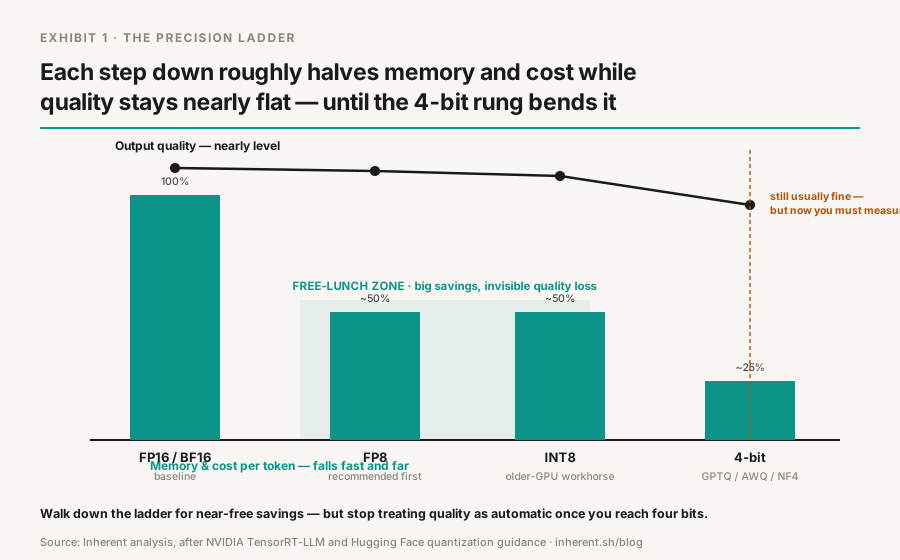
Here is the pattern that turns quantization from a scary word into a dial you control: quantization is not on-or-off, it is a ladder of precisions, and each rung down roughly halves memory again while spending a little more of your quality budget. The operator's job is to walk down the ladder only as far as the quality holds.
FP16 / BF16 — the full-precision baseline. This is where most models ship. No compression, no risk, highest cost. It is the reference point every saving is measured against.
FP8 — the recommended first step. Eight-bit floating point keeps enough dynamic range that quality stays near the baseline for most tasks, which is exactly why NVIDIA's inference stack recommends trying it first, backed natively by recent Hopper and Blackwell GPU hardware (TensorRT-LLM quantization guide). For teams on current hardware, this is often the best default: roughly half the memory, negligible quality loss.
INT8 — the compatibility workhorse. Eight-bit integers deliver a similar ~2x memory cut and run on older GPUs that lack FP8 support. There is a real and studied trade between INT8 and FP8 in how each handles the range of values inside a model (FP8 vs INT8 for inference, arXiv); the practical read is that INT8 is the safe choice when your hardware can't do FP8.
4-bit (GPTQ, AWQ, NF4) — the aggressive rung. Four bits quarters memory versus the baseline and is what makes it possible to run genuinely large models on a single, affordable GPU. This is the frontier of "usually fine": the popular methods are engineered specifically to protect the weights that matter most, so quality holds far better than naive rounding would suggest — but this is also the rung where degradation starts becoming detectable on harder tasks, and where you must actually measure rather than assume.
The exhibit makes the trade literal: each step down the ladder buys another large cut in memory and cost, while the quality line stays nearly flat — until, low enough, it starts to bend.
The one decision that matters: use a proven method, and know when to stop
The answer first: you do not design a quantization scheme — you pick one of a few battle-tested methods that ship as pre-quantized checkpoints or one-command conversions, and the only real judgment call is how far down the ladder to push before you measure. Nearly all of the risk in quantization comes from people either hand-rolling something naive or pushing to 4 bits on a quality-sensitive task without checking. Both are avoidable.
Two families, both off-the-shelf. The first family quantizes after training with a small calibration pass — post-training quantization, which includes GPTQ and AWQ. These produce a compact checkpoint you download and serve; AWQ in particular is built to be hardware-friendly and fast at inference (Hugging Face quantization overview). The second family, exemplified by bitsandbytes, quantizes on load — you point it at a normal model and it serves in 8-bit or 4-bit with a config flag, no separate conversion step (bitsandbytes docs). For most teams the decision is simply: is there already a well-regarded quantized build of the model I want? If yes, use it. If not, bitsandbytes-on-load is the low-effort path.
The honest tradeoff, stated plainly. Quantization is lossy, and at the aggressive end the loss is real, not theoretical — a careful study of accuracy-versus-performance across quantization formats found that the answer genuinely depends on the model and the task, which is a polite way of saying you have to test yours (Give Me BF16 or Give Me Death?, arXiv). The base-versus-advanced rule that keeps you safe: FP8 and INT8 are close enough to free that you can adopt them on faith; 4-bit is close enough to free that you should adopt it, but only after running your own evaluation on your own hardest cases. The failure mode is not "quantization breaks the model" — it is "quantization quietly shaves a few points off exactly the hard queries you care about, and nobody measured, so nobody noticed."
The business-life example: where the savings actually are
Picture a customer-support assistant answering from your help center. On full precision it needs a large, expensive GPU and returns answers in, say, a couple of seconds. Quantize the model to FP8 or INT8 and two things happen at once: it now fits on a smaller GPU (or more copies fit on the same one, so you serve more traffic per dollar), and each answer comes back faster because there is less data to move per token. You did not retrain anything, you did not change the product, and your users cannot tell the difference. That is the win, and it is a large one — often the difference between "this feature is too expensive to keep on" and "we can leave it on for everyone."
But now watch where the remaining cost hides. The same assistant, quantized and cheap, is asked about your refund policy — and it confidently quotes last quarter's policy because the help-center article was updated but the retrieval index still holds the old chunk. Quantization made that wrong answer arrive faster and cheaper. The expensive event — an angry customer, a support escalation, a compliance question you can't answer — was never about the model's compute cost. It was about the context the model was handed. Quantization optimizes the cheap part of the system and does nothing for the part that actually generates your worst outcomes. That is not an argument against quantizing. It is the reason quantizing is necessary but nowhere near sufficient.
What quantization does not fix
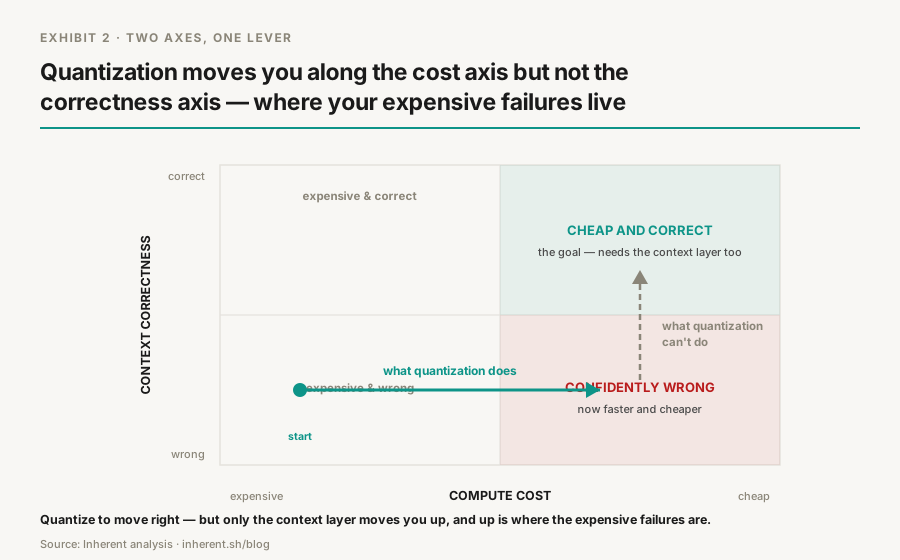
Here is the pattern that reorganizes how you think about AI cost: there are two different bills in a production AI system — the compute bill for running the model, and the correctness bill for getting the answer wrong — and quantization only touches the first one. Compress the model all you like; you have not changed which documents retrieval pulls, whether they are current, whether the same query returns the same context twice, or whether you can explain after the fact what the model was shown.
The relevance bridge, stated directly: a 4-bit model retrieving stale, duplicated, or unprovenanced context is just a cheaper way to be confidently wrong. The failure modes that produce real business pain — an answer grounded in a deleted policy, an eval you can't reproduce because the index mutated underneath it, a disputed answer you cannot replay — all live in the context layer, which quantization does not touch by design. It compresses the compute; the correctness of what goes into that compute is a separate axis entirely.
The exhibit makes the two axes explicit: quantization moves you left along the cost axis but not one inch along the correctness axis — and your worst outcomes live on the axis it can't move.
A quantization readiness scorecard
Use this to decide how far down the ladder to go, and to catch the case where you are optimizing the wrong bill. Each row is a decision; a row you cannot clear is a specific, named gap — not a vague "we should optimize inference."
| Control |
The question |
You're ready if |
If not |
| Baseline cost |
Do you know your per-request inference cost and latency today? |
You have a real number to measure savings against |
"It feels expensive" is your only metric |
| Method choice |
Are you using a proven, off-the-shelf quantization method? |
FP8/INT8 via your serving stack, or GPTQ/AWQ/bitsandbytes |
Someone hand-rolled rounding logic |
| Precision target |
Have you chosen a rung and a reason for stopping there? |
FP8/INT8 by default; 4-bit only where memory forces it |
You picked 4-bit for the headline and hoped |
| Quality gate |
Did you evaluate the quantized model on your hard cases? |
A held-out set of your toughest queries passed |
You assumed "usually fine" applies to you |
| Hardware fit |
Does your precision match your GPU's native support? |
FP8 on Hopper/Blackwell; INT8 on older cards |
You're paying for a precision the hardware emulates |
| Context correctness |
Is the context you feed the model fresh, deduped, provenanced? |
Retrieval is versioned and reproducible |
You just made a stale-context system cheaper |
| Replayability |
Can you reconstruct what a past answer was grounded in? |
Retrieval is pinnable and auditable |
A dispute ends at "the model said so" |
The pattern the scorecard exposes: the top five rows are about compute — pick a proven method, choose the right rung, measure quality, match the hardware. The bottom two rows are about context, and they are the ones a quantization project silently skips, because they are not what quantization is for. You can clear every compute row perfectly and still ship a system whose expensive failures come entirely from the two rows quantization doesn't cover.
Where Inherent fits
Only now, with the cost model built, does the product framing earn its place — and it lands squarely on the bottom two rows of the scorecard, Context correctness and Replayability, because those are the rows quantization cannot touch and most teams therefore never close. Compressing the model is the easy, well-trodden win; keeping the context that model reasons over fresh, deterministic, and auditable is the half that decides whether your cheap, fast answers are also right.
That is precisely the layer Inherent provides: it sits above your vector storage and below your orchestration, making ingestion managed and retrieval governed rather than best-effort — on a different axis from the model entirely. The truth layer version-stamps and hashes every source at ingestion, so the context feeding your (now quantized) model reflects the current state of the world, not a stale snapshot. The memory layer makes retrieval deterministic and version-pinned, so the same query returns the same context — which is what makes a quantized model's answers reproducible enough to evaluate and trust. The audit layer issues a retrieval receipt per request — which sources, versions, and chunks produced the context — so when a cheap, fast answer is disputed, you can replay exactly what the model was shown. Quantize the compute all you want; this is the correctness axis quantization leaves untouched.
To be clear about where we are: Inherent is early, and this is an architecture argument, not a claim that context infrastructure makes quantization unnecessary. You should absolutely quantize — it is the best compute-cost lever there is. The point is narrower and it holds: compressing the model and correcting the context are two different jobs, and doing the first one well does not do the second one at all.
The bottom line, and where to start
Quantization is the cheapest, highest-leverage cut on your AI inference bill: store the model's weights in 8 or 4 bits, get two-to-four-times less memory and real speedups, and pay a quality cost most users never perceive — no retraining required. Reach for FP8 or INT8 by default, push to 4-bit where memory forces it, and measure your hard cases before you ship the aggressive rung. But do not mistake a smaller compute bill for a correct system: a faster wrong answer is still a wrong answer, and your most expensive failures live in the context layer, which quantization does not touch.
Small task for today: take the single AI feature costing you the most, and answer two questions. First — what precision is its model running at right now, and is there a proven FP8 or INT8 build you could switch to this week? That is likely a fast, large saving sitting unclaimed. Second — of the last ten wrong or embarrassing answers that feature produced, how many were the model's fault versus stale or wrong context it was handed? If most were context, you just learned that the expensive bill isn't the one quantization pays down. Fix the cheap one first — then close the context axis: start with the Inherent Public API — get started in the docs. Quantizing your stack and finding the savings are real but the wrong answers didn't go away? DM Flow on X with what broke — that's the gap we're building against.
Next read: Speculative Decoding: Faster Tokens, Identical Answers — the other free-lunch inference lever, and why it can't touch the context axis either.