The AI advantage is not in the model. It is in the context.
Every AI workflow your company deploys accesses some business context before producing an answer or taking an action. What the model can access, what it is allowed to trust, and what it can prove to a reviewer: those are context engineering decisions.
Most CEOs treat those decisions as technical implementation details. That is the mistake.
Context engineering is the operating discipline that determines how reliable, trustworthy, and explainable your AI is in production. A strong model with weak context produces confident wrong answers. A well-governed context layer makes even a mid-tier model perform reliably in real business workflows.
Key Takeaways
- The quality of your AI output depends more on what it accesses than on which model you chose.
- A context contract — defining access, trust, citation, and avoid boundaries — is a CEO-level decision, not only a technical spec.
- Context systems have three business layers: truth, memory, and audit. Each layer has a business owner.
- Context degrades over time without governance. The stale context tax is real.
- You can define your first context contract in under 30 minutes.
What this post covers
After reading this, you will be able to define a context contract for one high-value AI workflow and know which questions to ask your team before that workflow goes to production.
- Why the AI advantage is a context advantage, not a model advantage
- What a context contract is and what four dimensions it defines
- The three business layers of a context system: truth, memory, and audit
- Why context degrades silently and what that costs the business
- How to map your first context contract in 30 minutes
This post builds on What Is Context Engineering? A CEO-Level Guide, which covers the foundational definition, and AI Context: The Missing Layer Between a Model and a Useful Answer, which explains why context matters before the model runs. Here we move from definition to strategy.
The AI advantage your competitors are chasing sits in the context layer
Model quality has largely converged on standard business reasoning tasks. GPT-4, Claude, and Gemini handle complex reasoning with similar competence on well-defined problems. The differentiation in 2026 is not which model reasons best — it is which company has cleaner, fresher, and better-governed context feeding its AI.
That is the context advantage. And it compounds.
A company that invests in managed, governed context today will have AI that gets more reliable as its source documents improve, its permissions tighten, and its audit trails deepen. A company that treats context as a one-time setup will have AI that drifts: answering from stale chunks, losing source provenance, producing outputs that cannot be traced.
The implication for CEOs: your AI strategy should be a context strategy.
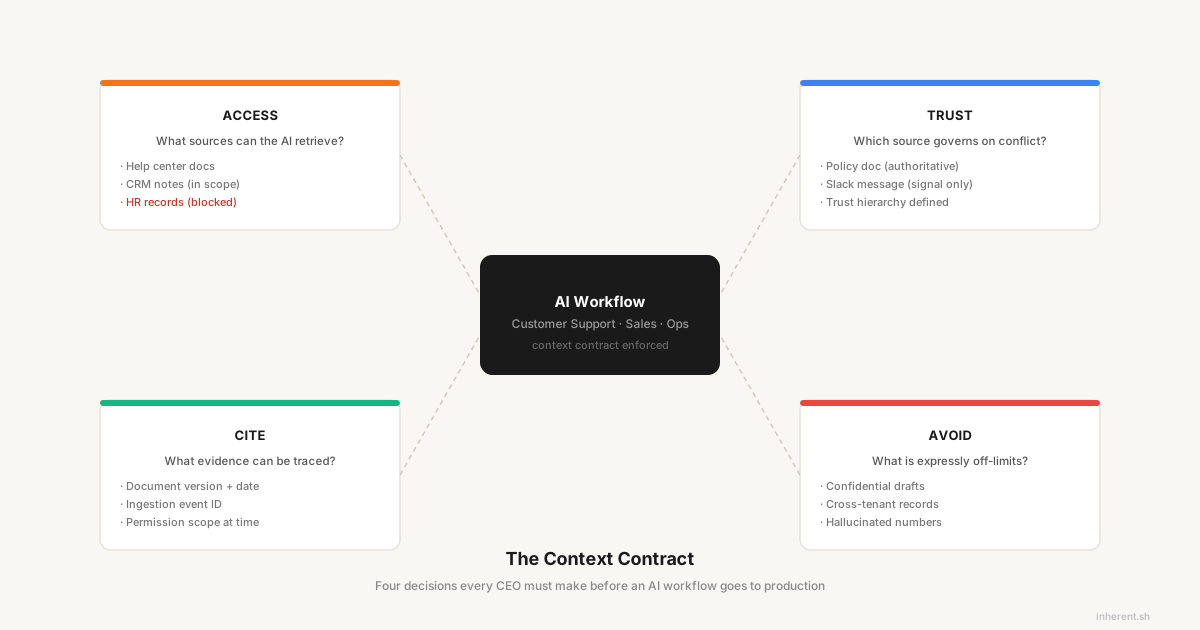
A context contract defines what your AI can access, trust, cite, and avoid
Before any AI workflow goes to production, four questions need answers. Most teams answer them implicitly, or not at all. Making them explicit is what a context contract does.
Access: What sources is the AI allowed to retrieve from? A customer support agent might access your help center, product changelog, and CRM notes — but not HR policy documents or executive communications. The access boundary is a business decision, not just a technical filter.
Trust: Which sources are authoritative? If the help center and a Slack message both mention a refund policy, which one governs? Trust decisions determine which version of reality your AI operates from.
Cite: What can the AI reference as evidence? A useful answer in a regulated or high-stakes workflow is one where the reader can trace it back to a specific document, ingestion date, and permission scope. If the AI cannot cite, the human cannot verify.
Avoid: What is the AI expressly prohibited from using? Confidential records, unreviewed drafts, inferences it must never draw (medical diagnosis, legal conclusions), and values it must never assume when no source exists.
Together those four dimensions form a context contract. They are not a technical specification written for engineers alone. They are a business decision that the engineering team then implements.
Context decisions live at three layers of your business
Truth layer — who keeps the source documents current? The truth layer is the set of authoritative source documents your AI retrieves from: policies, contracts, product documentation, approved training materials. The question is: who owns each source, who updates it, and how long after an update does the AI see the new version? Business owner: operations or legal.
Memory layer — what does the AI remember across sessions? The memory layer determines what context the AI carries forward — previous support conversations, research conclusions, session state. Memory decisions determine AI continuity. They also determine data risk. An AI that retains context too long or shares memory across users who should be isolated is a governance failure waiting to surface. Business owner: product and privacy leads.
Audit layer — which decisions can be traced and explained? When an AI made a decision, what evidence can the team produce? Which document version was retrieved? Which permission scope applied? Without an audit layer, AI operates as a black box. Business owner: compliance or legal.
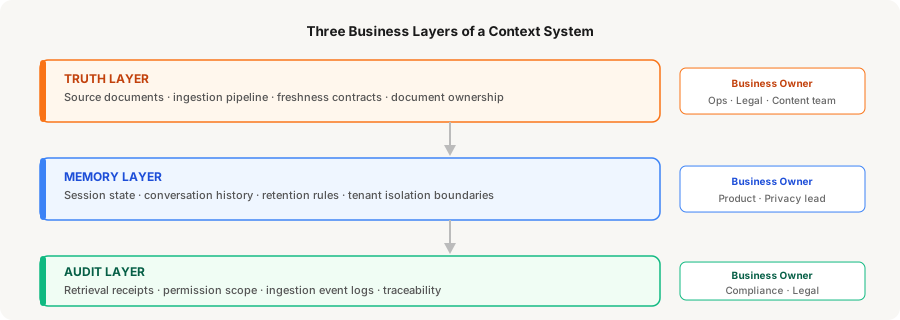
If any layer is unowned, the context system drifts.
Unmanaged context degrades — and the cost is invisible until it is not
Context engineering is not a one-time setup. When it is not practiced, three failure modes accumulate.
Stale context tax. Documents change. If ingestion does not keep pace, the AI answers from outdated context — a sales copilot quoting a deprecated pricing sheet, a contract assistant citing a draft instead of the executed version. The stale context tax is the cumulative cost of business decisions made on old information.
Permission drift. Access controls configured at deployment loosen over time. New document types get added without explicit permission rules. The AI begins answering from context the business did not intend to authorize.
Source authority erosion. When the business maintains overlapping versions of the same policy, the AI has no reliable way to know which source governs. Without an explicit trust hierarchy, it retrieves based on similarity — and similarity is not authority.
How to define your first context contract in 30 minutes
You do not need a technical team to run this exercise. You need one high-value AI workflow and 30 minutes.
Step 1: Name one workflow. Choose an AI workflow that is already in use or planned — customer support Q&A, internal policy assistant, sales research copilot, contract review.
Step 2: List the sources it accesses. Write every data source the AI currently retrieves from, or is planned to retrieve from. Do not filter yet — just list.
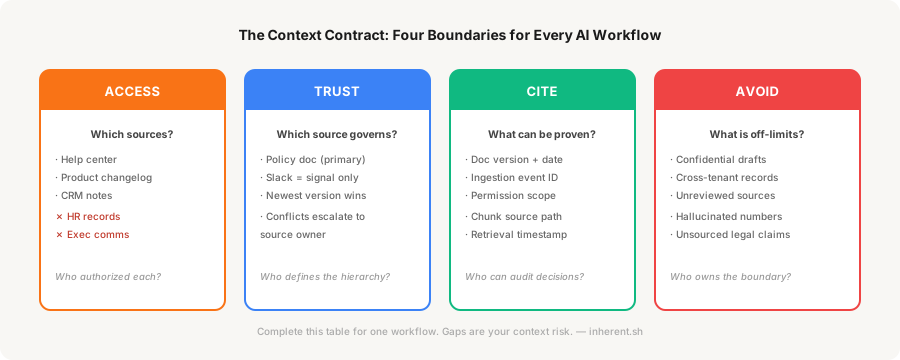
Step 3: Apply the four questions.
| Question |
What to decide |
| Access |
Should the AI retrieve from this? Who authorized it? |
| Trust |
If this source conflicts with another, which one governs? |
| Cite |
Can the team trace an answer back to this source with a date and version? |
| Avoid |
Are there document types within this source the AI must never retrieve? |
The gaps — sources with no clear owner, permissions assumed rather than decided, answers that cannot be traced — are your context risk. Write a one-page contract and share it with the engineering team as the spec. Revisit it quarterly.
How Inherent operationalizes the context contract
The context contract is the business decision. Inherent is the infrastructure that enforces it: managed ingestion keeps the truth layer current with source provenance attached to every chunk; deterministic retrieval enforces the trust hierarchy so answers are reproducible and tenant boundaries hold; retrieval receipts make the audit layer usable so compliance teams can trace any answer back to its document, ingestion event, and permission scope.
For the underlying architecture, see RAG Pipeline: A CEO Guide to Reliable AI Answers.
Define your context contract today
The question is not "which AI model should we use?" It is: "for this workflow, what context should the AI access, which sources should it trust, what evidence can it cite, and what must it never touch?"
Answer those four questions for your highest-stakes AI workflow. Write it down. Share it with the team that owns the data and the team that owns the AI. That is a context contract — and it is the most concrete AI strategy document a CEO can produce right now.
If you work through the exercise and hit a gap — a source with no clear owner, a permission that was never decided — DM Flow on X @human_in_loop with what you found. That gap is worth understanding before it becomes an incident.