Whether AI can be trusted in a given workflow is not a question about the model — it is a question about the context the model is standing on, and you can answer it in thirty minutes. Pick one workflow, ask five questions about the information the AI depends on — where the truth lives, who owns it, who may see it, how fresh it is, and what proves each answer — and score each red, amber, or green. Any red means the workflow is not ready for AI to act unattended, no matter how good the model is. That is the whole audit, and it is the fastest way a leader can separate an AI feature that will hold up in production from one that will quietly hand out confident, wrong answers.
The decision this gives you is concrete: after thirty minutes you know whether to let AI run this workflow, keep a human in the loop, or fix the context first. That is a far better use of a leadership hour than another vendor demo — because the demo shows you the model, and the model is rarely where things break.
This is the finale of a thirty-day series that began with What Is AI in Business, Really? and, most recently, how to introduce a company context graph without the jargon. This post turns the whole argument into one thing you can do today: a repeatable audit.
Key Takeaways
- AI readiness in a workflow is a property of its context, not its model. The audit measures the context, which is the variable you actually control.
- Five dimensions decide it: source of truth, ownership, permissions, freshness, evidence. Any one of them failing is enough to make AI unsafe in that workflow.
- Score each dimension red / amber / green for one workflow. The lowest score is your verdict — a single red caps the whole workflow at "not ready to act unattended."
- The finding is usually the same: the model is fine; the context is stale, unowned, over-shared, or unprovable. That is fixable engineering, not a reason to abandon AI.
What this post covers
After reading, you will be able to run a thirty-minute audit on one real workflow with your team and leave with a clear verdict: AI can act here, AI needs a human check here, or fix the context before AI touches this at all.
- Why the audit measures context, not the model
- The five dimensions that decide whether AI can be trusted
- How to score one workflow red / amber / green in thirty minutes
- A worked example: a support-refund assistant
- The audit worksheet you can copy for any workflow
- What each failing dimension tells you to fix next
New to treating context as its own layer? Read AI Context: The Missing Layer Between a Model and a Useful Answer first, then run the audit.
The audit measures context, not the model
The reason so many AI initiatives stall is not that the models are weak. MIT's The GenAI Divide: State of AI in Business 2025 found that roughly 95% of enterprise generative-AI pilots delivered no measurable P&L return, despite an estimated $30–40 billion in spending. The report attributes the gap not to model quality but to systems that do not retain, adapt to, or ground themselves in an organization's actual context (Fortune on MIT NANDA, 2025). The model is a commodity you rent; the context is the asset you own, and it is where the failures live.
So the audit deliberately ignores the model. It asks, for one workflow, whether the information the AI would rely on is authoritative, owned, access-controlled, current, and provable. Those five properties are the difference between a system that gives the same correct, defensible answer every time and one that returns whatever text embedded nearest to the question. You do not need to understand transformers to run it. You need to know how information moves through your business — which is exactly what a leader already knows better than anyone.
Thirty minutes is not arbitrary. The audit is deliberately shallow-but-decisive: one workflow, five questions, three colors. It is a triage tool, not a data-governance program. The point is to get a verdict fast enough that you will actually do it — on this workflow, this week — rather than schedule an assessment that never happens.
The five dimensions that decide trust
AI can be trusted in a workflow only when all five of these hold. They are MECE — each measures a different, non-overlapping failure — so a green on four does not compensate for a red on the fifth.
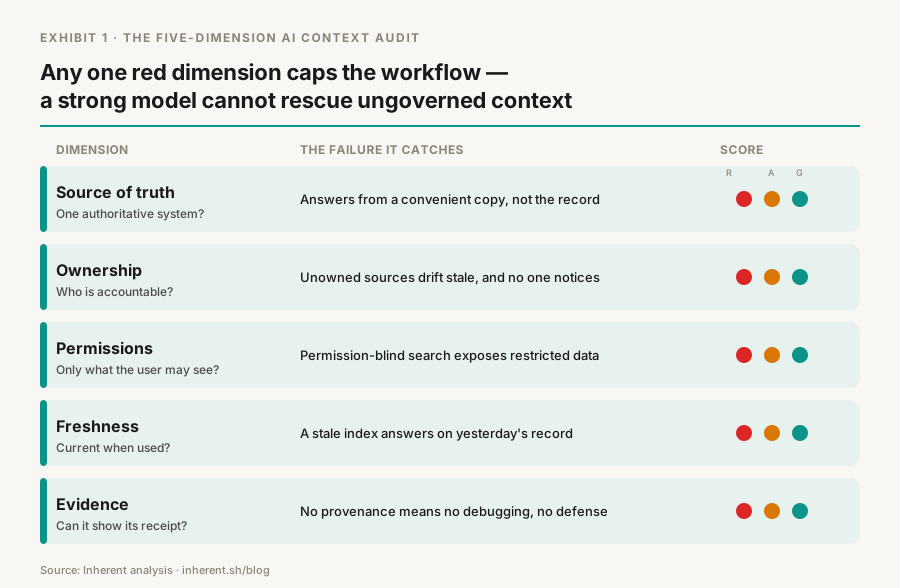
1. Source of truth — does each answer trace to one authoritative system? If the AI could answer from a wiki copy, a Slack thread, and the system of record, and those disagree, it will sometimes pick the wrong one. Green means every question maps to a single, named system of record. This is the highest-leverage dimension: most "hallucinations" in production are really authority errors — the answer was retrieved from a convenient copy, not the source.
2. Ownership — is someone accountable when the source drifts? Every source the AI reads needs a named human who defines "correct" and is on the hook when it goes stale. Unowned sources are how staleness survives: every team assumes another reconciles the record, and none does. Amber if ownership is informal; red if no one owns it.
3. Permissions — can the AI only surface what the requester is allowed to see? Semantic search is permission-blind by default — it returns the nearest match, not the authorized one. If access rules are not enforced at retrieval time, a helpful assistant becomes a data-exposure incident. Green means access is checked per request, against the same rules a human would face.
4. Freshness — is the context current when the AI uses it? An index built last week does not know about the price change this morning. Poor and stale data is not a cosmetic problem: Gartner estimates it costs organizations $12.9 million a year on average. Green means the sources this workflow depends on are re-read or re-indexed on a cadence faster than they change.
5. Evidence — can each answer show its receipt? For any consequential answer, the AI should be able to attach what proves it: the record, the document, the timestamp. Without evidence you cannot debug a wrong answer, and you cannot defend a right one to a customer or auditor. Green means every answer carries its source and time.
The rule that makes this an audit rather than a checklist: the workflow's verdict is its lowest score. One red is enough to say AI should not act unattended here, because a single ungoverned dimension is all it takes to produce a confident, wrong, unprovable answer.
How to score one workflow in thirty minutes
Timebox it so it stays a triage, not a project. Do it live with the two or three people who actually know the workflow.
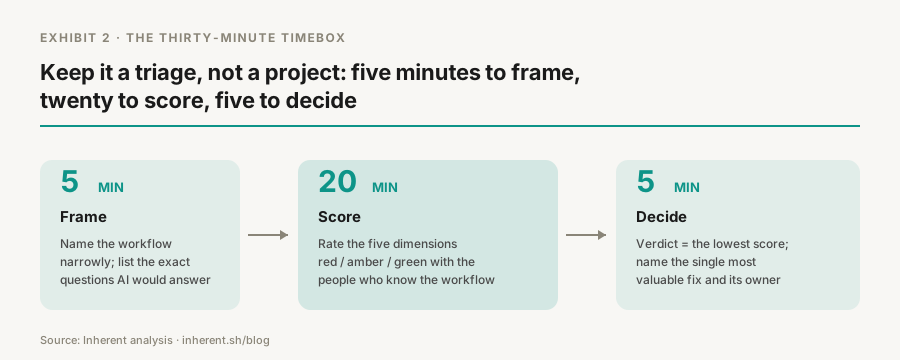
Spend the first five minutes naming the workflow narrowly and writing down the handful of questions the AI would answer inside it — "what was this customer promised," "is this refund within policy," not "help with support." Spend the next twenty scoring each of the five dimensions red, amber, or green against those specific questions; the disagreements in the room are the audit's real output, because they surface where the team only assumed the context was governed. Spend the last five setting the verdict from the lowest score and naming the single most valuable fix. One workflow, one page, one decision.
A worked example: a support-refund assistant
A support team ships an assistant that tells agents whether a refund is within policy. It is right often enough to be trusted and wrong often enough to cause chargebacks. Run the audit on the one question — is this refund within policy?
Source of truth: the assistant reads the policy from a Confluence page, but Finance maintains the authoritative policy in a separate doc that was updated after a fraud incident. Red — two sources, and it is reading the stale one. Ownership: no one owns the Confluence copy; it was written once by a PM who has since left. Red. Permissions: refund policy is not sensitive, and the assistant only exposes policy text, not customer financials. Green. Freshness: the Confluence page is indexed weekly; policy changed twice this quarter. Amber. Evidence: the assistant quotes a policy line but does not link the source or its date. Amber.
Verdict, by the lowest-score rule: not ready to act unattended. The fix is not a better model — it is pointing retrieval at Finance's authoritative policy doc, assigning it an owner, re-indexing on change, and attaching the policy version to every answer. That is a sprint, not a research charter, and it converts an assistant that causes chargebacks into one that prevents them.
The audit worksheet
Copy this for any workflow. Fill one row per dimension; the verdict is the worst cell.
| Dimension |
The question to ask |
Green |
Amber |
Red |
| Source of truth |
Does each answer trace to one authoritative system? |
One named system of record per question |
Multiple sources, usually agree |
Conflicting sources, no clear authority |
| Ownership |
Who is accountable when the source drifts? |
Named owner defines "correct" |
Informal / shared ownership |
No owner |
| Permissions |
Can it only surface what the requester may see? |
Access checked per request |
Access checked coarsely |
No access control at retrieval |
| Freshness |
Is the context current when the AI uses it? |
Re-read faster than it changes |
Periodic, sometimes lags |
Stale / unknown refresh |
| Evidence |
Can each answer show its receipt? |
Source + timestamp on every answer |
Source sometimes attached |
No provenance |
| Verdict |
(lowest score above) |
AI can act unattended |
Keep a human in the loop |
Fix the context first |
The worksheet is intentionally boring. Boring is what makes it repeatable — you can run it on the next workflow, and the next, and build a portfolio view of where AI is actually safe to operate.
What each failing dimension tells you to fix
A red is not a verdict against AI; it is a precise pointer at the weakest part of your context layer. A source-of-truth red means consolidate authority: pick the system of record and point retrieval only at it. An ownership red means assign a human to the data contract before you automate on top of it. A permissions red means the access rule has to move into the retrieval layer, so it is enforced per request rather than assumed. A freshness red means the source must be re-indexed on the cadence it changes — daily prices need daily ingestion, not weekly. An evidence red means every answer must carry its source and timestamp, so answers are debuggable and defensible.
This is the point where the audit meets architecture. Making those five properties true and durable in production is real engineering: change-data-capture so the index tracks the source of truth, an authorization model that travels with the data, and deterministic retrieval so a fixed workflow stays fixed. You can build that layer in-house — it is finite, known work — but it is undifferentiated, and it is exactly what Inherent is built to be: managed ingestion keeps each source current, deterministic retrieval returns the same authoritative context for the same query, and every chunk carries its source, access rules, and ingestion timestamp. In audit terms, that turns source of truth, ownership, permissions, freshness, and evidence from a whiteboard scorecard into properties enforced on every answer. Whichever way the build-vs-buy call goes, the audit tells you which property to make durable first.
The next step
Block thirty minutes this week. Pick the one AI workflow you would most like to trust — the one a wrong answer would most embarrass or cost you — and run the five-dimension audit with the people who know it. Score each dimension red, amber, or green, and take the lowest score as your verdict. You will almost certainly find that the workflow's weakness is not the model; it is a red on source of truth, ownership, permissions, freshness, or evidence.
Run it today, then DM Flow on X @human_in_loop with which dimension scored reddest across your workflow. That reddest dimension is where your AI is most likely to fail in production — and where fixing the context returns the most trust per hour of engineering.
This closes the AI readiness series, which began with What Is AI in Business, Really?. To go deeper on the architecture behind the audit, read Introduce a Company Context Graph Without the Jargon; for the strategy view, see Context Engineering for CEO Strategy.