Key takeaway: A model with a million-token context window can, in principle, read your entire knowledge base in one prompt — which makes it tempting to conclude that retrieval, chunking, and the whole "RAG" apparatus are now obsolete. They are not. Loading everything is expensive (you pay per token, every request), unreliable (models measurably lose accuracy on facts buried in the middle of a long context, and their effective usable length is smaller than the advertised one), and — this is the part that gets skipped — a big window does nothing to decide what to load, keep it current, make the same query reproducible, or leave an audit trail. The decision this post helps you make is not "long context or retrieval" — it is where to spend each: use the bigger window to stop over-engineering chunk sizes and to hand the model richer, more complete context, and keep a retrieval-and-ingestion layer to choose the right sources, keep them fresh, and prove what the answer was grounded in.
If your team has started asking "now that context windows are huge, do we still need RAG?", the short answer is yes — but for reasons most of the hype skips. A long context window is a genuine capability upgrade: it lets you hand the model more complete information and stop fighting with tiny chunk boundaries. What it is not is a replacement for the layer that decides which documents to load, keeps them current, and can reconstruct what any given answer was based on. Those are different jobs on a different axis, and the window size doesn't touch them.
So the "so what": a bigger context window changes how much you can load, not whether you should load blindly — and treating it as "just put everything in the prompt" quietly trades a retrieval problem you can see for three problems you can't. You pay for every token on every request, so stuffing the full corpus in is a recurring cost, not a one-time convenience. Accuracy degrades on information positioned in the middle of long inputs — a robust, replicated finding, not a rough edge (Lost in the Middle, Liu et al., 2023). And a model's effective context is measurably shorter than the number on the box (RULER, Hsieh et al., 2024). This post is the operator's map: what long context actually buys you, where it silently fails, and the four jobs retrieval still has to do no matter how big the window gets.
Previous post: Quantization Is the Cheapest Way to Cut Your AI Inference Bill.
What this post covers
By the end, you should be able to decide — for each AI feature you run — how much to lean on a long context window versus a retrieval layer, and recognize the failure modes that a bigger window hides rather than fixes.
- What a context window actually is — the model's working memory, in plain terms, and why "bigger" felt like the end of RAG.
- What long context genuinely fixes — the real, worth-having wins, so we're not strawmanning it.
- Where long context silently fails — cost per token, accuracy loss in the middle, and effective-vs-advertised length.
- A business-life example — the same support assistant, "just load everything" vs. retrieval, and where the bill and the errors actually land.
- The four jobs retrieval still does — selection, freshness, determinism, and provenance, none of which a window size touches.
- A long-context readiness scorecard — a worksheet to decide where to spend context and where to keep retrieval.
- Where Inherent fits — why the context layer, not the window, is what makes big-context answers correct and defensible.
A context window is the model's working memory, not its knowledge
Start with the mechanism, because the whole "RAG is dead" argument rests on a misreading of it. A context window is the amount of text a model can hold in front of it while it answers a single question — its short-term working memory for that one request, not a place where knowledge is stored. Everything the model "knows" durably lives in its trained weights; everything else has to be placed into the window at request time. Retrieval-augmented generation (RAG) is just the discipline of choosing which text to place there.
The technical explanation: when a window was small — a few thousand tokens — you physically could not fit a large document set into it, so you had to retrieve the most relevant slices first. Now that windows have grown by orders of magnitude, the physical constraint relaxes: you can fit far more, sometimes an entire small knowledge base. That is what makes it tempting to say "just put everything in the prompt and let the model sort it out." The window got big enough that selection feels optional.
The business explanation you can picture in a day: the context window is the model's desk, not its filing cabinet. A bigger desk means you can spread out more documents at once — genuinely useful. But a bigger desk does not decide which files to pull from the cabinet, does not notice that one of them was superseded last week, and does not keep a record of which pages you actually consulted. "Just put everything on the desk" is only a strategy until the desk is expensive to keep loaded, until the pile is too tall to read the middle of, and until someone asks you to prove what you were looking at. That is the whole tension of this post.
What long context genuinely fixes (this part is real)
Give the upgrade its due, because the honest case is stronger than the hype and it tells you where to actually use the window. A large context window removes a set of real, annoying constraints that small windows forced on every RAG system — and those wins are worth taking.
First, it dissolves the chunk-size wars. With a small window you agonized over splitting documents into pieces small enough to retrieve but large enough to stay coherent, and you lost information at every boundary. A big window lets you pass whole documents or long sections intact, so the model sees full context instead of a fragment that starts mid-argument. Second, it enables genuinely long single inputs — a full contract, an entire call transcript, a long technical spec — where the whole thing is the unit of analysis and chopping it up was always the wrong move. Third, it makes retrieval more forgiving: you can afford to pass a few extra candidate passages rather than betting everything on retrieving the one perfect chunk, which reduces the "we retrieved the wrong slice" failure mode.
The base-versus-advanced framing that keeps you honest: a big window is a better desk, and a better desk is worth having. The mistake is not using the window — it is concluding that a better desk means you no longer need a filing system, a librarian, or a checkout log. Those are the next three sections.
Where long context silently fails
Here is the pattern that turns "just load everything" from a shortcut into a liability: the three costs of stuffing a giant context are all invisible at demo time and all show up in production — you pay per token every request, accuracy sags on anything buried in the middle, and the usable length is shorter than the advertised one.
You pay for every token, on every request. A context window is not a one-time upload; it is priced input, re-sent each time the model answers. Loading a 500K-token corpus to answer a one-line question means paying to process 500K tokens for that one answer — and again for the next question, and the next. Retrieval exists partly because it is cheaper to send the model the ten passages that matter than the ten thousand that don't. The bigger the window, the bigger the bill you can accidentally run up by treating it as free.
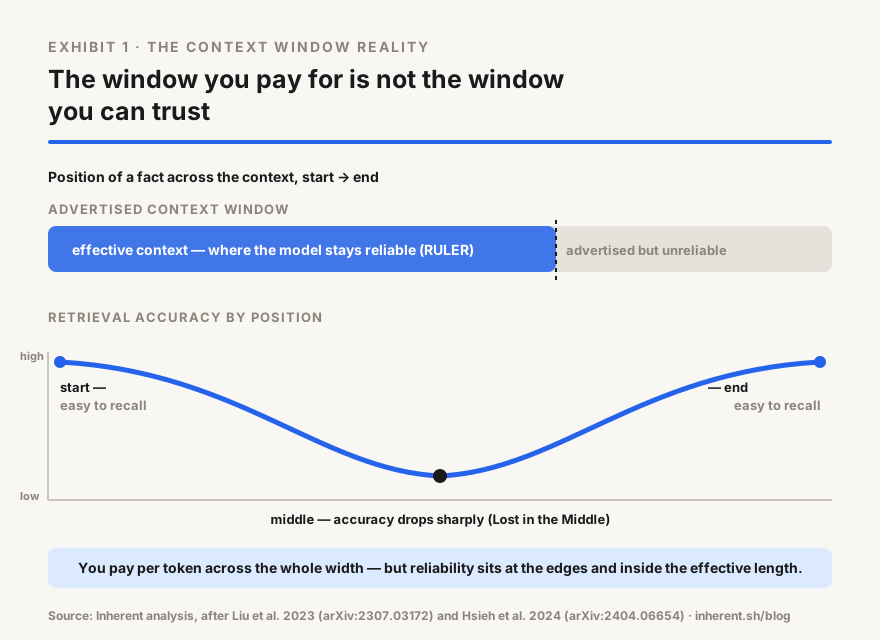
Accuracy degrades in the middle. Models do not read a long context uniformly. Performance is highest when the relevant fact sits near the beginning or the end of the input and drops sharply — on the order of twenty percentage points in the original study — when the same fact is positioned in the middle, a U-shaped curve replicated across GPT-4, Claude, and other model families (Lost in the Middle, Liu et al., 2023). "Put everything in and let the model find it" assumes uniform attention the model does not have.
Effective context is shorter than advertised. A model that passes the simple "needle in a haystack" test — find one planted sentence in a long document — can still fail the harder tasks of actually reasoning over that length. The RULER benchmark found that of models claiming 32K tokens or more, only about half sustained satisfactory performance at 32K, with real capability falling off well before the advertised maximum (RULER, Hsieh et al., 2024). The number on the box is a ceiling, not a promise.
The exhibit makes the gap concrete: the advertised window is not the reliable window, and accuracy is not flat across the space you are paying for.
The business-life example: the same assistant, two strategies
Picture a customer-support assistant answering from a help center of a few thousand articles. Strategy A, "just load everything": you concatenate the whole help center into the prompt and ask the model to answer. In the demo it works and it feels magical — no retrieval pipeline to build. In production, three things happen. Every single question now pays to process the entire corpus, so your per-answer cost is enormous and constant regardless of how trivial the question is. The answer to a question whose source article happens to sit in the middle of the concatenation is measurably worse than one near the top. And when an article is updated, you are re-sending a giant blob that may still contain the old text alongside the new, with no mechanism deciding which wins.
Strategy B, retrieval plus a generous window: you retrieve the handful of articles relevant to the question and pass them — now comfortably, using the bigger window to include full articles rather than clipped fragments. Cost scales with the question, not the corpus. The relevant text sits in the small, high-attention part of the context. And because you selected sources deliberately, you know exactly which articles fed the answer. The big window made Strategy B better — richer, less fragmented context — without making Strategy A wise. The window is a multiplier on good retrieval, not a substitute for it. And note where the expensive failures live in both strategies: not in the model's cleverness, but in whether the loaded articles were the right ones, whether they were current, and whether you could later prove which one was used.
The four jobs retrieval still does — no matter how big the window gets
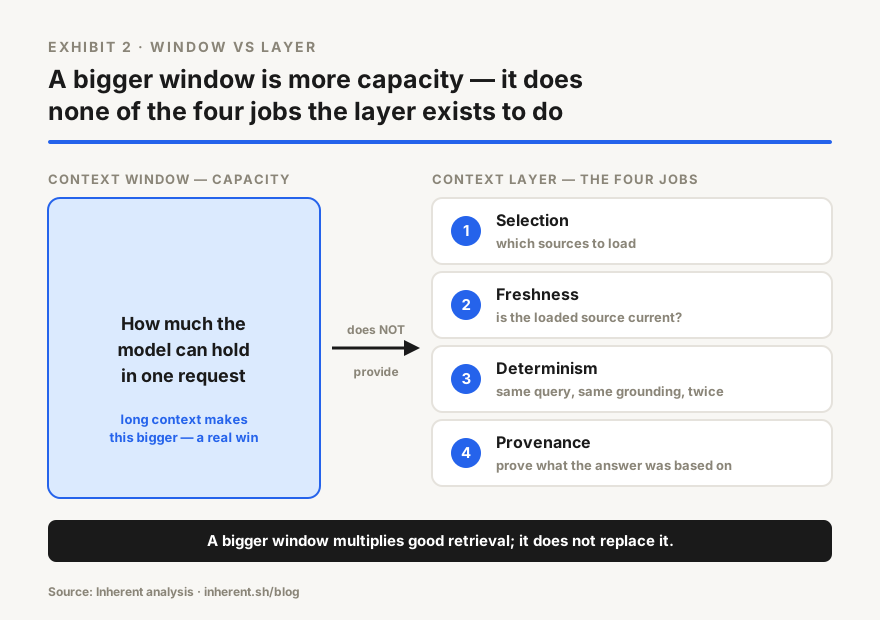
Here is the pattern that reorganizes the whole debate: "context window" and "context layer" are different things. The window is capacity — how much the model can hold. The layer is a set of jobs — what to hold, whether it's current, whether it's reproducible, and whether it's provable — and a bigger window does not do a single one of those jobs.
Selection. Something has to decide which sources go into the window. Even a million-token window is finite, your knowledge base will eventually exceed it, and — per the reliability data above — you want to send less, not more, so the important text lands in the high-attention zone. Choosing well is retrieval's core job and it does not disappear.
Freshness. A window is filled at request time from somewhere. If that somewhere is a stale index or an un-reprocessed document, the model reads yesterday's truth confidently. The window has no opinion about whether what you loaded reflects the current state of the world; keeping the source current is an ingestion job.
Determinism. Ask the same question twice and you want the same grounding, especially if you are evaluating quality or debugging a complaint. "Load everything" is not deterministic if the corpus is changing underneath you, and naive retrieval isn't either unless it's version-pinned. Reproducible context is a property you have to engineer, not a property of window size.
Provenance. When an answer is disputed — a wrong refund quoted, a compliance question answered from a deleted policy — you need to reconstruct exactly what the model was shown. A giant undifferentiated prompt is the worst case for this: "it was somewhere in the 500K tokens we sent" is not an audit trail. Provenance is a job the window actively makes harder, not easier.
The relevance bridge, stated directly: selection, freshness, determinism, and provenance are the context layer, and they are exactly the jobs a large context window leaves undone. The exhibit maps the split.
A long-context readiness scorecard
Use this to decide, feature by feature, where to spend the window and where to keep retrieval. Each row is a decision; a row you cannot clear is a specific, named gap — not a vague "we should use long context."
| Control |
The question |
You're ready if |
If not |
| Cost per answer |
Do you know the token cost of your loading strategy per request? |
You size context to the question, not the corpus |
You pay to process everything for every query |
| Position safety |
Does the critical fact land near the edges, not buried in the middle? |
You pass few, targeted passages |
You dump the whole corpus and hope |
| Effective length |
Are you operating inside the model's reliable length, not its max? |
You stay well under the advertised ceiling |
You assume the box number is the usable number |
| Selection |
Is there a deliberate step choosing which sources to load? |
Retrieval picks sources by relevance |
"Load everything" is the selection strategy |
| Freshness |
Is the loaded context guaranteed current? |
Sources are re-ingested and versioned on change |
The index can silently hold stale text |
| Determinism |
Does the same query return the same grounding twice? |
Retrieval is version-pinned and reproducible |
Grounding drifts as the corpus changes |
| Provenance |
Can you reconstruct what a past answer was grounded in? |
Each answer carries a source/version record |
"It was in the prompt somewhere" is your audit |
The pattern the scorecard exposes: the top three rows are about using the window well — right cost, right position, right effective length. The bottom four are about the context layer — selection, freshness, determinism, provenance — and they are the rows a "big window solves it" plan silently skips, because they are not what a window is for. You can have the largest context window on the market and still fail every one of the bottom four.
Where Inherent fits
Only now, with the split made explicit, does the product framing earn its place — and it lands squarely on the bottom four rows of the scorecard, the ones a bigger window cannot touch. Using the window well is the easy, well-understood half; keeping the context you load selected, fresh, reproducible, and provable is the half that decides whether your big-context answers are also right and defensible.
That is precisely the layer Inherent provides: it sits above your vector storage and below your orchestration, making ingestion managed and retrieval governed rather than best-effort — on a different axis from the window entirely. The truth layer version-stamps and hashes every source at ingestion, so the context you place in the window reflects the current state of the world, not a stale snapshot (that's the freshness row). The memory layer makes retrieval deterministic and version-pinned, so the same query returns the same grounding — which is what makes a long-context answer reproducible enough to evaluate and trust (the determinism and selection rows). The audit layer issues a retrieval receipt per request — which sources, versions, and chunks produced the context — so when a big-context answer is disputed, you can replay exactly what the model was shown instead of gesturing at half a million tokens (the provenance row). Grow the window all you want; this is the correctness axis the window leaves untouched.
To be clear about where we are: Inherent is early, and this is an architecture argument, not a claim that long context is a fad. You should use the bigger window — it is a real upgrade, and it makes good retrieval better. The point is narrower and it holds: the window is capacity, the layer is correctness, and buying more of the first does nothing for the second.
The bottom line, and where to start
A million-token context window is a real capability upgrade and a poor excuse to stop thinking about retrieval. It dissolves the chunk-size wars and lets you hand the model fuller context — take that win. But "just load everything" pays to process the whole corpus on every request, buries critical facts in the low-accuracy middle, and leans on an effective length shorter than the advertised one — and none of it decides what to load, keeps it fresh, makes it reproducible, or proves what an answer was based on. Use the window to make retrieval better, not to make it absent.
Small task for today: take the single AI feature you're most tempted to "just give the whole knowledge base to," and answer two questions. First — what does one answer cost in tokens under that strategy, times your daily volume? That number is usually the end of the "windows are free" argument. Second — of the last ten wrong answers that feature produced, how many were "we loaded the wrong or outdated source" versus "the model reasoned badly"? If most were the former, a bigger window would not have helped — you have a context-layer problem, not a capacity problem. Fix the cheap half by sizing context to the question; then close the four-job axis: start with the Inherent Public API — get started in the docs. Went all-in on long context and the wrong-source answers didn't go away? DM Flow on X with what broke — that's the gap we're building against.
Next read: Batch Ingestion Is Why Your RAG Answers Go Stale — the freshness job no context window performs.