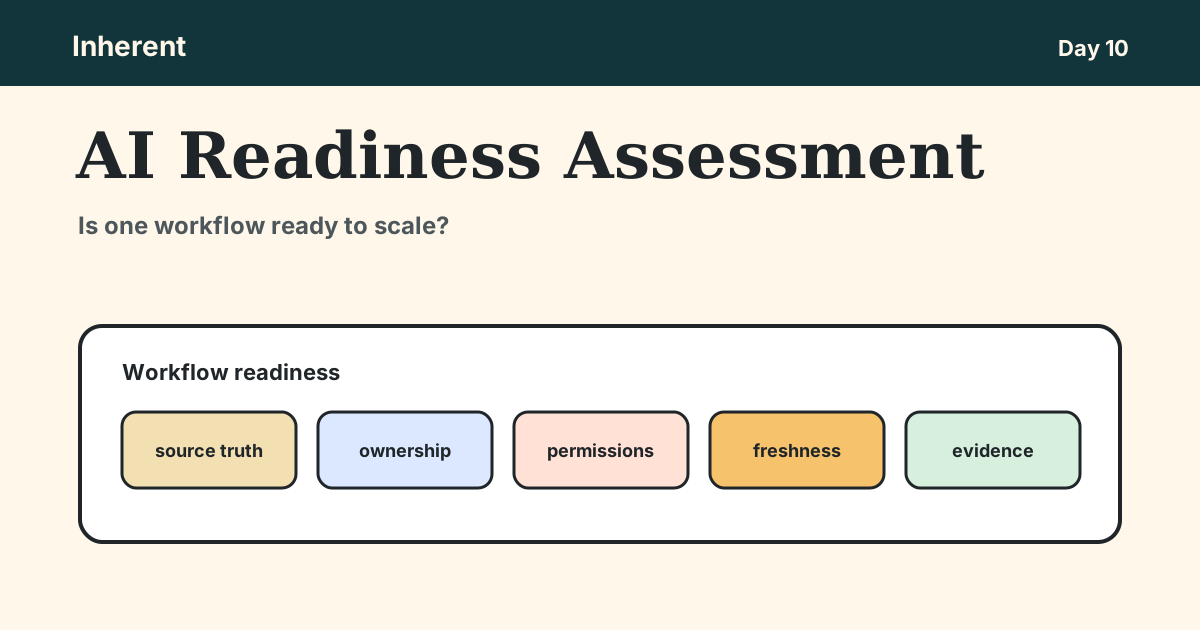
By the end, you should be able to decide whether one workflow is ready to scale, should remain a controlled pilot, or still needs foundation work.
- Why AI readiness is workflow-specific, not a company-wide label.
- Which three executive gates separate a useful pilot from a scalable workflow.
- Which five operating checks expose the most important readiness gaps.
- How the assessment works in a real customer-support workflow.
- How to reach a go, controlled-pilot, or fix-first decision in 20 minutes.
AI readiness is a workflow decision, not a technology inventory
AI readiness means a business can take one AI use case from demo to dependable operation. The test is not whether the company has model access, a chatbot, a data platform, or an AI strategy deck. The test is whether a specific workflow can produce a useful outcome repeatedly without creating unmanaged risk.
Google Cloud's guidance for defining an AI business use case starts with measurable business goals and recommends working backward from the outcome. Microsoft's AI readiness guidance similarly points leaders toward business priorities, data access, security, governance, and team expertise.
That is the right executive lens. A company can be broadly enthusiastic about artificial intelligence in business while remaining unready to scale a customer-facing support assistant, an internal policy search tool, or a finance-operations agent.
Technical explanation
An AI system operates on more than a model. It depends on source data, retrieval paths, permissions, business rules, human review, and logs. If those pieces are undefined, the system cannot reliably distinguish an approved policy from a draft, a live record from a stale copy, or an allowed action from one that requires escalation.
Business explanation
Imagine a support assistant handling refund requests. The demo looks capable because it drafts polite answers from a policy document. The live business is harder: the policy changes, account records differ, some refunds require approval, and the team needs to explain why a customer received a particular answer.
The readiness question is not, "Can the AI write the reply?" It is, "Can the workflow produce the right reply under real operating conditions, and can the business prove why?"
Three executive gates separate a pilot from a scalable workflow
The practical assessment has three gates: business value, reliable context, and operating control. The gates are sequential. A workflow should not absorb more investment if it cannot pass the earlier decision.
Gate 1: business value
The workflow needs one measurable outcome. A vague ambition such as "use AI in customer support" is not enough. A useful outcome is specific: reduce first-response time for billing questions while maintaining the current escalation policy.
This gate asks:
- Which workflow are we improving?
- Which business outcome should change?
- Who owns the result?
Gate 2: reliable context
The workflow needs an explicit context path. The AI must know which source to trust and how changes reach the system. Otherwise, a relevant answer can still be wrong because it came from a draft, a stale copy, or an incomplete record.
This gate asks:
- Which record, policy, or system is authoritative?
- How does an update reach the AI workflow?
Gate 3: operating control
The workflow needs boundaries and proof. The AI must operate within the current user's permissions, route exceptions correctly, and leave an evidence trail when it answers or acts.
This gate asks:
- Who may retrieve, review, approve, or act?
- Which cases require human review?
- What receipt shows the sources, rules, and actions behind the result?
These gates are intentionally narrower than a full enterprise AI strategy. They give a CEO, founder, or operating leader a fast investment filter for one workflow.
NIST's AI Risk Management Framework is broader and more rigorous. It is designed for voluntary use to help organizations incorporate trustworthiness considerations into the design, development, use, and evaluation of AI systems. Its core functions are govern, map, measure, and manage. NIST also explains that mapping the context of use helps inform an initial go/no-go decision.
The implication is simple: an AI readiness assessment is not a substitute for governance. It is the shortest useful starting point for discovering where governance work is needed.
Five operating checks make the assessment concrete
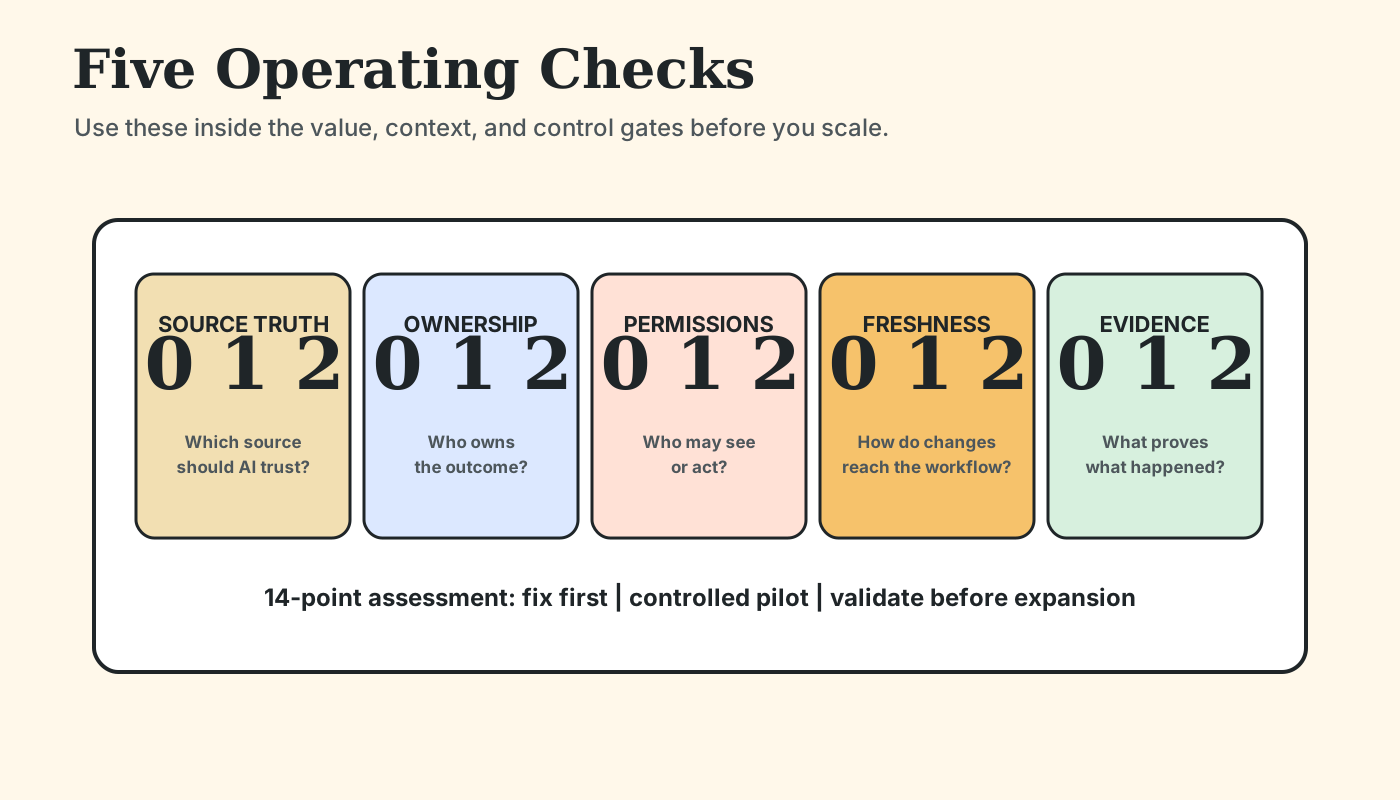
The three gates become actionable through five operating checks: source truth, ownership, permissions, freshness, and evidence. These checks force the team to replace assumptions with explicit answers.
| Operating check |
Executive question |
A weak answer sounds like |
| Source truth |
Which record, policy, or system should the AI trust? |
"It is probably in the wiki." |
| Ownership |
Who is accountable when the answer or action is wrong? |
"The AI team owns the tool." |
| Permissions |
Which user, agent, or role may see and act on this context? |
"Everyone with access to the assistant." |
| Freshness |
How does a source change reach the AI workflow? |
"We re-upload files when someone notices." |
| Evidence |
What receipt shows the sources, rules, and review path behind the result? |
"The model produced the answer." |
A refund workflow shows why the gates matter
Consider the support refund workflow again. A customer asks:
"I cancelled last week. Why was I charged today, and can you issue a refund?"
The AI assistant needs more than a helpful tone. It needs to retrieve an approved policy, inspect the current billing record, respect the support agent's role, detect exceptions, route larger refunds for review, and log the evidence behind the final response.
Run the assessment against that workflow:
| Gate |
Ready answer for the refund workflow |
| Business value |
The target is faster resolution of billing questions without bypassing the current refund policy. |
| Reliable context |
The assistant uses the approved refund policy and live billing record; policy and billing updates follow defined update paths. |
| Operating control |
The assistant retrieves only the current customer's records, escalates refunds above the approval threshold, and logs the policy version, permission check, rule, and final action. |
This is where an AI strategy becomes concrete. The assessment translates an ambition into a workflow-level investment decision.
Score one workflow before funding the next rollout
Use a three-point scale for each question:
0 means the answer is unknown or informal.1 means the answer exists but depends on manual work, tribal knowledge, or inconsistent enforcement.2 means the answer is explicit, owned, and testable in the workflow.
Workflow:
Business outcome:

Outcome:       0 / 1 / 2
Which measurable result should improve?

Ownership:     0 / 1 / 2
Who owns the workflow outcome and exceptions?

Source truth:  0 / 1 / 2
Which sources are authoritative?

Freshness:     0 / 1 / 2
How do source changes reach the workflow?

Permissions:   0 / 1 / 2
Who may retrieve, review, approve, or act?

Escalation:    0 / 1 / 2
Which cases require human review?

Evidence:      0 / 1 / 2
What receipt proves which context and rules shaped the result?

Total:         __ / 14
Interpret the result as a decision filter:
| Score |
Decision |
| 0-5 |
Fix first. Map the workflow, sources, owners, and controls before funding a broader pilot. |
| 6-10 |
Controlled pilot. Keep the scope narrow, require human review, and close the weakest gaps. |
| 11-14 |
Validate before expansion. Test real cases, monitor failures, and confirm escalation paths before scaling. |
The score is not a compliance certification. It is a forcing function. It stops a company from treating AI implementation as a tool purchase when the live workflow still depends on unstated assumptions.
What should you do today?
Pick one workflow your team wants to improve with AI: customer support, sales research, finance operations, onboarding, internal search, or product documentation.
Spend 20 minutes scoring outcome, ownership, source truth, freshness, permissions, escalation, and evidence. Do not score the company in the abstract. Score one workflow with one business outcome.
If the weakest dimension is unclear, map the company context behind that workflow: the sources, owners, access rules, update paths, and evidence trail. That map is the starting point for a company context audit.
DM Flow on X with the workflow and its lowest score. That is the readiness gap to solve before your next AI rollout.