Key takeaway: AI compliance is not a report you generate after the fact. It is a property of how documents enter your system. If you cannot prove which source, which version, and which permissions produced an answer, you do not have a compliance gap you can close with a dashboard — you have missing evidence that no dashboard can invent. The decision this post helps you make: whether your AI stack captures provenance at ingestion, or whether you are one auditor's question away from "we don't know."
If you are putting AI in front of a regulated workflow — a claim decision, a credit answer, a clinical summary, a policy lookup — the single most expensive assumption you can make is that compliance is something your team adds later. It is not. By the time an auditor, a regulator, or your own risk officer asks "why did the system say that, and can you prove it," the only answers available are the ones your pipeline recorded when the document was ingested. Everything downstream — the model, the prompt, the retrieval — is too late to capture what was never written down.
So the "so what" is concrete and it lands on your liability, not your latency: you cannot bolt compliance onto an AI system that did not record its own evidence. Most AI stacks retrieve context from a vector index that was rebuilt, re-embedded, and overwritten between the answer and the audit. The answer is gone, the source may have changed, and the trail does not exist. That gap is not a reporting problem. It is an architecture problem, and it is decided at ingestion.
Previous post: Why We Built Inherent: The Production Memory Problem.
What this post covers
By the end, you should be able to decide one thing for your own AI feature: whether it can survive an audit — and if it cannot, exactly which control to build first and where it belongs in the pipeline.
- What "AI compliance" actually means — the four evidence questions every regulated deployment must answer.
- Why bolt-on compliance fails — you cannot reconstruct provenance you never captured.
- Why compliance is a property of ingestion — the technical mechanism, and the same idea in a business workflow.
- A regulated example — what an audit looks like when the trail exists versus when it does not.
- The operating model — four controls to build at ingestion, as a checklist you can run this week.
- Where Inherent fits — the truth, memory, and audit layers, and one small next step.
What "AI compliance" actually means
Start with a definition, because "AI compliance" is used loosely enough to be useless. For a system that answers questions from your documents, compliance is not "the model is safe" or "we filter bad outputs." It is a narrower, harder property: for any answer the system gave, you can produce the evidence behind it.
That evidence resolves into four questions. An auditor will ask some version of each:
- Provenance — which document, and which version of it, produced this answer?
- Access — who was permitted to see that source, and was the boundary respected?
- Reproducibility — can you run the same request again and get the same context?
- Integrity — can you prove the source has not silently changed since?
Notice what these have in common. None of them are about the language model. They are all about the context layer — the ingestion, storage, and retrieval that decide what the model sees. AI compliance, in practice, is data-pipeline compliance wearing a new name. The model is the part everyone watches; the pipeline is the part that gets audited.
Why bolt-on compliance fails
Here is the answer first: bolt-on compliance fails because it tries to reconstruct evidence that was never recorded. Provenance, access, and integrity are not facts you can compute later from a vector index. They are facts you either captured at the moment of ingestion or lost forever.
Walk through why. A typical retrieval stack ingests documents, chunks them, embeds the chunks, and writes them to a vector store. Then, over the following weeks, it re-embeds when the model changes, rebuilds the index for performance, overwrites chunks when a document updates, and re-ranks results non-deterministically. Every one of those operations is normal, and every one of them destroys evidence. The index that answered a question in January is not the index you have in July. When the auditor points at the January answer, the January state is gone.
The exhibit below is the whole argument on one page: the four questions an auditor asks, and why only context captured at ingestion can answer them.
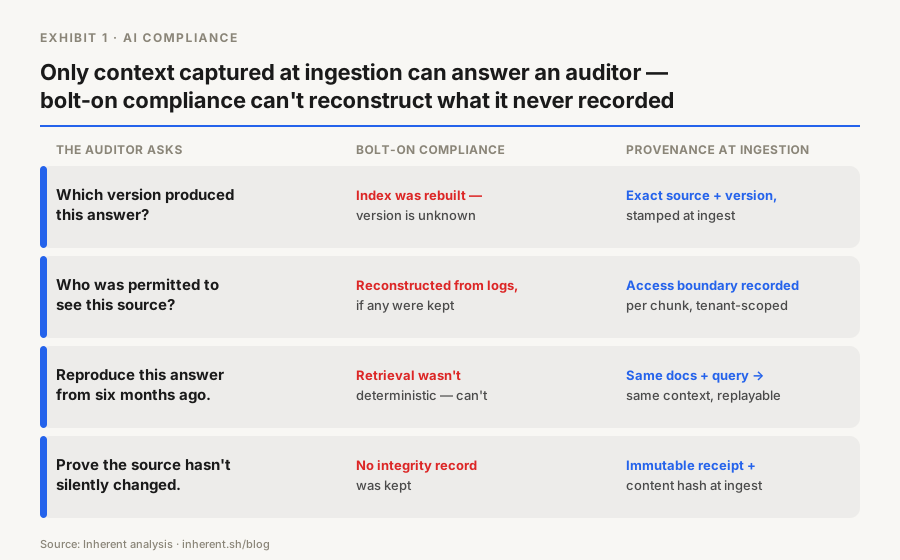
The pattern the exhibit exposes: the left column is not a weaker version of the right column. It is a different outcome entirely — "we don't know." In a regulated setting, "we don't know why the system decided that" is not an incomplete answer. It is a finding.
Compliance is a property of ingestion, not a report you run later
The reframe that fixes this is small and expensive to retrofit: treat every document that enters the system as an evidence event, not just a data load.
Technical view. At ingestion, the pipeline should record — immutably — the source identifier, the exact version and a content hash, the parse and chunk boundaries, the access scope the document belongs to, and a receipt tying all of it together. Retrieval then reads against that recorded state deterministically: the same documents plus the same query return the same context, every time, and every returned chunk carries its provenance forward into the answer. Compliance stops being a query you run against logs that may not exist, and becomes a guarantee the pipeline enforces by construction. You are not reconstructing the trail. You are reading a trail that was written the moment the data arrived.
Business view. Picture your finance team's AI assistant answering, "does this customer qualify for the promotional rate?" With ingestion-time provenance, when compliance later asks "on what basis," the answer is a receipt: this clause, from version 4 of the rate policy dated March 3, visible to this role, retrieved deterministically. Without it, your best honest answer is "the AI read something in the policy documents, but they've been updated twice since and the index was rebuilt, so we can't show you exactly what." One of those answers closes the audit. The other opens an investigation. The difference was decided months earlier, at ingestion — long before anyone thought about compliance.
A regulated example: the same audit, two pipelines
Make it concrete with one scenario run twice. A health insurer deploys an AI assistant that helps agents explain coverage decisions to members. Six months in, a member disputes a denial, and the regulator requests the basis for the AI-assisted explanation the member received in January.
Pipeline A (bolt-on). The team pulls application logs. They can see the member's question and the assistant's answer, but not which policy chunks were retrieved — the index has been re-embedded twice since. The coverage document itself was updated in March, so the current version differs from January's, and there is no stored hash of what January's looked like. The team's honest reconstruction is a best guess. In a regulated dispute, a best guess is a liability.
Pipeline B (ingestion-time provenance). The team queries the audit layer for that answer's receipt. It returns the exact source document, version, and hash as of January; the specific chunks retrieved; the access scope; and confirmation that the same query replayed today against January's state returns the same context. The regulator gets a traceable, reproducible basis for the explanation. The dispute is about the decision, not about whether the company can account for its own system.
The implication for you: the regulated example is not exotic. It is the ordinary shape of every AI deployment in finance, insurance, healthcare, and legal — the only difference is whether the trail exists before you need it.
The operating model: four controls to build at ingestion
You do not need a governance committee to start. You need four controls, and all four live at ingestion, not in a downstream report. Run this as a checklist against one workflow:
- Version + hash every source on the way in. If a document changes, the old version and its hash remain retrievable. You can always answer "what did this look like then."
- Record the access boundary per chunk. Every piece of retrievable context carries who is allowed to see it, so isolation is enforced at retrieval, not audited after a leak.
- Make retrieval deterministic. Same documents plus same query returns the same context. Without this, reproducibility — and therefore auditability — is impossible regardless of what else you log.
- Issue a receipt for every answer. Which sources, which versions, which chunks, which permissions. The receipt is the compliance artifact; everything else is plumbing to produce it.
If your current stack cannot do one of these, that is your first build — and notice that none of them can be added purely downstream. Each one requires capturing something at the moment of ingestion that a vector index alone throws away.
Where Inherent fits
Only now, with the problem clear, does the product framing earn its place. Inherent is the managed context layer that makes those four controls the default instead of a project. It sits above your vector storage and below your orchestration, and it maps to the three layers compliance actually needs.
The truth layer owns managed ingestion: it version-stamps, hashes, and re-processes each source as it changes, so the system never answers from a version that quietly disappeared. The memory layer makes retrieval deterministic and tenant-safe: the same documents and query return the same context, inside an access boundary that is on by default. The audit layer issues the receipt: for any answer, which sources, versions, chunks, and permissions shaped it. That is not a compliance dashboard bolted onto an AI app. It is provenance built at ingestion, which is the only place it can be built honestly.
To be clear about where we are: Inherent is early and has no regulated-industry case study to point to yet. This post is an argument about where compliance evidence has to come from, tested against your own audit experience — not a claim that we have already proven it at scale. If the "ingestion is where the trail is written" framing does not match how your audits actually go, it is wrong, and you should discard it.
The bottom line, and where to start
AI compliance is not a feature you add before an audit. It is a property you either designed into ingestion or did not — and by the time the question arrives, the evidence is either recorded or gone. The teams that survive regulatory scrutiny are not the ones with the best model. They are the ones who can produce a receipt.
Small action for today: take one AI workflow and run the four-question test in the exhibit — version, access, reproducibility, integrity. For each, ask whether your pipeline captures it at ingestion or hopes to reconstruct it later. If any answer is "reconstruct," that control is your first build. Then wire one workflow behind managed context and see the receipt for yourself: start with the Inherent Public API — get started in the docs. Building the audit layer yourself and hitting the walls this post describes? DM Flow on X with where it breaks — that failure mode is exactly what we are building against. Not ready to build yet? Book a company context audit to map one workflow's source truth, retrieval, and evidence first.
Next read: Inherent vs Pinecone: Vector Database or Managed Context Layer?.